How Web3 Payments Work: Wallets, Tokens and Settlement
A Web3 payment moves tokens between wallets and settles on a public ledger, with no bank or card network in the middle. Here is the full flow.
On this page
Short answer
A Web3 payment is a transfer of digital tokens between blockchain wallets, settled on a public ledger without a bank or card network in the middle. The sender signs a transaction, the network verifies it, and the receiver holds the tokens directly once it is confirmed.
How does a Web3 payment work?
A Web3 payment is a transfer of digital tokens between blockchain wallets, settled on a public ledger without a bank or card network in the middle. The sender signs a transaction with a private key, the network checks the signature and the balance, and the tokens move to the receiver's wallet address.
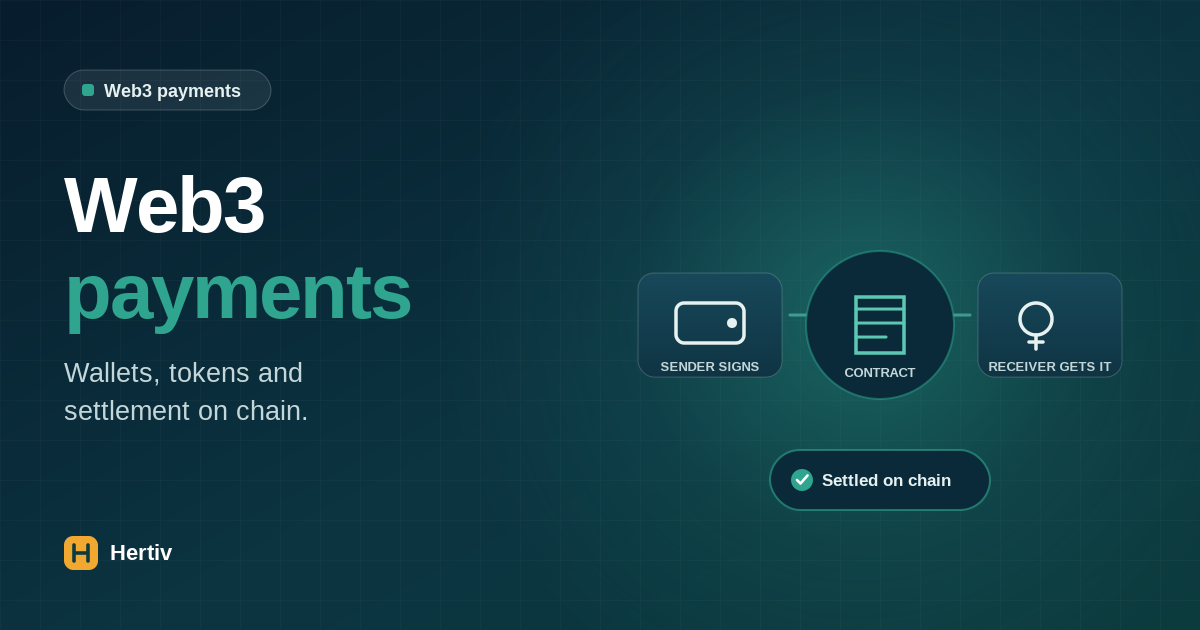
The flow has four steps. First, the receiver shares a wallet address or a payment link. Second, the sender's wallet builds a transaction stating the token, the amount and the destination. Third, the sender signs it, which proves they control the wallet without revealing the private key. Fourth, the network confirms the transaction and records it on the ledger, where anyone can verify it.
Settlement is the key difference from card payments. A card payment is a promise that settles days later through several intermediaries; a Web3 payment settles when the network confirms the transaction, and the receiver holds the tokens directly. That speed comes with new responsibilities, which the rest of this article covers.
Who and what is involved in a Web3 payment?
A Web3 payment involves wallets, tokens, a network and usually a smart contract, and each part has a clear job. Knowing who does what makes the flow easier to design and to debug when something goes wrong.
| Part | Role in the payment |
|---|---|
| Sender wallet | Holds the tokens and signs the transaction |
| Receiver wallet | Provides the address that receives the tokens |
| Token | The asset being moved, such as a stablecoin |
| Smart contract | Enforces rules, such as escrow or split payments |
| Blockchain network | Verifies signatures and records the transfer |
| On and off-ramp | Converts between tokens and local currency |
For a simple payment, only the wallets, the token and the network are needed. Smart contracts enter the picture when the payment has conditions, such as releasing funds when a delivery is confirmed or splitting a payment between several people. Crypto payment gateway services handle much of this plumbing for merchants.
Wallets, keys and signing
A wallet is software that holds private keys, and a private key is what proves ownership of the tokens at an address. The wallet never sends the private key anywhere; it uses it to sign a transaction, and the network checks the signature against the public address.
There are two broad kinds of wallet. A non-custodial wallet gives the user full control of the keys, which means nobody can freeze the funds, but also means a lost key usually means lost funds. A custodial wallet, such as one run by an exchange or a payment provider, holds the keys for the user, which is more convenient and recoverable, but means trusting the provider.
For businesses, the usual setup is a custodial or multi-signature wallet for day-to-day receiving, with a separate cold wallet for larger balances. A multi-signature wallet needs several people to approve a transfer, which protects against a single compromised key. Crypto wallet development covers the design choices in more depth.
Stablecoins, volatile tokens and fees
Most Web3 payments use stablecoins because their value is designed to stay close to a fiat currency, usually the dollar, which makes pricing simple. Paying with a volatile token means the price in dollars changes between the quote and the settlement, which is fine for speculation and awkward for a shop.
Fees, often called gas, pay the network for processing the transaction, and they vary by network and by how busy it is. Some networks charge a few cents per transfer, while others can cost several dollars at peak times. Choosing the network is therefore a cost decision as much as a technical one, and many merchants accept payments on a low-fee network and convert to local currency through a ramp.
Confirmations are the other variable. A transaction is usually visible within seconds, but most receivers wait for a few confirmations before treating it as final, which can take from under a minute to several minutes depending on the network. Stablecoin payments explains the stablecoin options and their trade-offs.
How to accept Web3 payments in six steps
You accept Web3 payments by choosing a token and network, setting up a wallet, adding a payment flow, testing it end to end, and planning refunds and accounting before you go live.
- Choose a token and network. A widely used stablecoin on a low-fee network is the usual starting point.
- Set up a receiving wallet. Use a custodial or multi-signature wallet, and decide who can move funds out of it.
- Add a payment flow. Use a payment gateway or a simple payment link that shows the amount, token and destination address.
- Set the price in fiat and convert at checkout. Quote in dollars or local currency and convert to tokens at the moment of payment, so the price stays stable.
- Test end to end with a small amount. Pay yourself, confirm the tokens arrive, test a refund, and check the accounting records.
- Plan refunds, taxes and record-keeping. Decide how refunds work, how you record token income, and what your accountant needs.
Refunds deserve attention before launch. A Web3 payment cannot be reversed by the network, so refunds are new transactions you send, which means you need a clear policy and a wallet with funds available for them. Blockchain development can help with the integration work.
Example: an online store takes its first crypto payment
Example (hypothetical): an online store sells a product for $120 and offers a Web3 payment option alongside cards. A customer chooses to pay in a dollar-pegged stablecoin on a low-fee network.
At checkout the store shows a payment request for $120 in the stablecoin. The network fee is $0.40, which the customer pays on top, so the customer sends $120 and the store receives $120 in stablecoins, minus nothing from the transfer itself. After the network confirms the transaction, the store marks the order as paid and ships it.
The store's accountant records $120 of income and notes the network fee the customer paid separately. A week later the customer returns the product, and the store sends a $120 stablecoin refund from its refund wallet, which the store keeps topped up for exactly this purpose. The refund is a new transaction, not a reversal, and the store's policy states that clearly at checkout.
What are the common mistakes?
The most common mistakes are pricing in volatile tokens, skipping the refund plan, and treating a wallet address as a customer identity. Each of these causes real problems after launch.
- Pricing in volatile tokens. A price set in a token that moves 10% in a day means the store and the customer disagree about what was paid.
- No refund plan. Web3 payments cannot be reversed, so a store without a refund wallet and policy cannot help a returning customer.
- Treating an address as an identity. A wallet address is not a name or an email, so order support needs an order number or contact details too.
- Ignoring fees and confirmations. A payment that looks complete before confirmation can still fail, and fees vary by network and time.
- One key, no backup. A single private key with no multi-signature protection is one lost phone away from lost funds.
- No accounting trail. Token income, fees and refunds need records your accountant can use, or tax time becomes painful.
Smart contracts add another layer of risk, since a bug in a payment contract can lock funds. A smart contract audit is worth doing before a contract handles real money.
Key takeaways
- A Web3 payment settles on the ledger when the network confirms it, not days later
- Stablecoins keep pricing simple because their value stays near a fiat currency
- Wallets sign transactions with a private key that never leaves the wallet
- Web3 payments cannot be reversed, so refunds are new transactions you send
- Multi-signature wallets and a refund plan belong in the setup from day one
Frequently asked questions
What is a Web3 payment?
A Web3 payment is a transfer of digital tokens, usually stablecoins, between blockchain wallets. The sender signs the transaction, the network verifies the signature and balance, and the tokens move to the receiver's address and settle on the public ledger.
Do I need a bank account to receive Web3 payments?
No, you need a wallet address, which anyone can create. To convert tokens into local currency you use an on and off-ramp, such as an exchange or a payment provider, which usually does need a bank account and identity checks.
How long does a Web3 payment take?
The transfer is usually visible within seconds, but most receivers wait for a few confirmations before treating it as final. That takes from under a minute to several minutes depending on the network, which is still faster than a card settlement.
What are Web3 payment fees?
Fees, often called gas, pay the network for processing the transaction and vary by network and congestion. Some networks charge a few cents per transfer, while others can cost several dollars at peak times, so choosing the network is a cost decision.
Can a Web3 payment be refunded?
Yes, but not by reversing the original transaction. A refund is a new transaction that sends tokens back to the customer, which is why merchants need a refund wallet with funds available and a clear refund policy shown at checkout.
Are Web3 payments safe?
The cryptography is strong, but the risks are different from card payments: lost keys, phishing, smart contract bugs and price volatility. Multi-signature wallets, audited contracts, stablecoins and clear refund policies are the main protections.


