4 White Label Blockchain Products for Enterprise Success
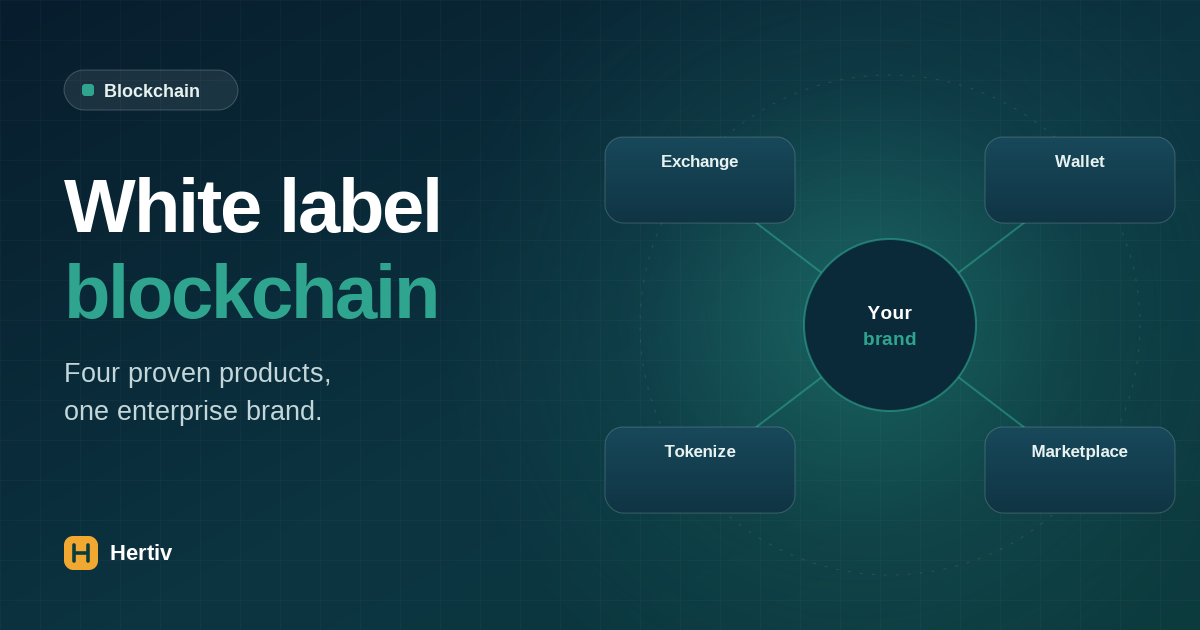
Four white label blockchain products enterprises buy: exchanges, wallets, tokenization platforms and NFT marketplaces, compared on what each does.
On this page
Short answer
White label blockchain products let an enterprise run a crypto exchange, wallet, tokenization platform or NFT marketplace under its own brand without building the core software. The right choice depends on the revenue model, the licences required and who holds the keys.
Which white label blockchain products should enterprises compare?
The white label blockchain products enterprises actually buy fall into four groups: exchanges, wallets, tokenization platforms and NFT marketplaces. Each one solves a different problem, and the wrong pick is expensive to undo.
Use this comparison to shortlist. "White label" means you license a ready-made product, put your brand on it, and run it as your own service instead of building from scratch.
| Product | What it does | Best for | Effort to launch |
|---|---|---|---|
| Crypto exchange | Buy, sell and swap digital assets | Trading and brokerage brands | High |
| Crypto wallet | Stores keys and signs transactions | Apps that hold user funds | Medium |
| Tokenization platform | Issues tokens backed by real assets | Funds, property and commodities | High |
| NFT marketplace | Lists and trades unique tokens | Brands, creators and clubs | Medium |
Start with the business you want to run, not the product that looks easiest. An exchange needs liquidity and licences; a wallet needs security audits; a tokenization platform needs legal structure around the underlying asset.
<h3>1. White label crypto exchange: best for trading brands</h3>
A white label crypto exchange gives you an order book, matching engine, user accounts and a trading interface under your brand. You operate the exchange; the vendor supplies the software and usually the liquidity connections.
It fits brokers, fintechs and regional brands that want to offer trading without building a matching engine. The work that remains is yours: licences, banking rails, customer support and market making. For a deeper look at the build side, see white label crypto exchange launch steps.
Pros:
- Trading revenue from day one of launch
- Proven matching engine instead of a new build
- Your brand on every screen the user sees
Cons:
- Licensing and compliance are your responsibility
- Liquidity depends on your market makers
- Vendor lock-in if the engine cannot be replaced
<h3>2. White label crypto wallet: best for apps that hold user funds</h3>
A white label crypto wallet stores private keys, signs transactions and shows balances inside your app. It is the product to pick when your users need to hold assets, not just trade them.
Security is the deciding factor. Ask how keys are generated and stored, whether the wallet supports multi-party computation or hardware signing, and what happens if a device is lost. A wallet that looks good in a demo but fails an audit is a liability. See white label crypto wallet apps for the feature checklist.
Pros:
- Users keep assets inside your product
- Works for payments, loyalty and custody
- Smaller compliance surface than an exchange
Cons:
- Key management mistakes can lose user funds
- Needs regular security audits
- Support load rises with lost-device requests
<h3>3. White label tokenization platform: best for real assets</h3>
A white label tokenization platform issues blockchain tokens that represent shares in a real asset, such as property, a fund or gold. Investors buy and trade the tokens instead of the asset itself.
This is the right product when the asset is the point. The platform handles issuance, investor onboarding and secondary trading, but the legal structure around the asset must be built with lawyers, not just software. See white label tokenization platforms for how the pieces fit.
Pros:
- Opens large assets to smaller investors
- Secondary trading adds liquidity
- Clear audit trail on chain
Cons:
- Legal setup is slow and jurisdiction-specific
- Investor demand is not guaranteed
- Regulatory rules change often
<h3>4. White label NFT marketplace: best for brands and creators</h3>
A white label NFT marketplace lets you list, buy and sell unique tokens under your brand. It fits sports clubs, artists, game studios and brands that want to sell memberships, collectibles or digital goods.
The product is only half the story. A marketplace with no buyers is an empty shop, so the launch plan matters as much as the software: what is being sold, who wants it, and why it is worth owning. See white label NFT marketplaces for the launch checklist.
Pros:
- Fast way to sell digital goods and memberships
- Royalties can pay creators on resale
- Strong fit for community and fan products
Cons:
- Demand depends on the brand, not the software
- Speculative buyers leave when hype fades
- Copyright and fraud checks fall on you
What makes a white label product enterprise-ready?
A white label product is enterprise-ready when it survives security review, legal review and real user load. A good demo proves none of these, so check them before signing.
- Security audits. Ask for recent audit reports on the smart contracts and the backend, and check what was fixed after each audit.
- Data and key control. Know who holds the keys, where user data lives, and how you exit if the vendor fails.
- Compliance tooling. KYC, sanctions screening and transaction monitoring should be built in or easy to connect.
- Uptime and support. Ask for real uptime figures from existing customers and a support agreement with response times.
- Customisation limits. Find out what you cannot change: fees, branding, supported chains and payout rails.
Run a pilot with a small user group before committing to a full launch. A pilot that processes real transactions will surface integration gaps that a sales demo never shows. For enterprise delivery, enterprise blockchain covers the architecture and governance around these products.
How to choose the right white label blockchain product
Choose by matching the product to the business you will run for the next three years, not to the feature list that looks longest today.
- Name the revenue model. Trading fees, custody fees, issuance fees or marketplace commissions each point to a different product.
- List the licences you need. Check the rules in every country where your users live before shortlisting vendors.
- Score vendors on security evidence. Audits, incident history and key management matter more than the interface.
- Run a paid pilot. Put real transactions through the product with a small group and measure support load.
- Price the whole operation. Vendor fees are one line; licences, liquidity, audits and support are the larger ones. See vendor sites for current pricing.
Write the exit plan into the contract: how you export user data and keys, and how long the vendor must keep the service running after termination.
Common mistakes with white label blockchain products
The most common mistakes are buying before the legal picture is clear, underestimating operations, and assuming the vendor owns the risk.
- Skipping legal review. A product that is legal in one country may be restricted in another. Get advice before launch, not after.
- Treating the vendor as the operator. Licences, customer funds and support are your responsibility even when the software is licensed.
- No liquidity plan. An exchange or marketplace with no buyers and sellers is unusable on day one.
- Ignoring key recovery. Users will lose devices and passwords. Plan the recovery flow before launch.
- Launching every feature at once. Start with one product and one user group, then expand.
Key takeaways
- Exchanges, wallets, tokenization platforms and NFT marketplaces are the four proven white label products
- The revenue model decides the product: trading fees, custody fees, issuance fees or marketplace commissions
- Security audits, key control and compliance tooling matter more than the feature list
- Licences, liquidity and support are your responsibility even when the software is licensed
- Pilot with real transactions before a full launch
Frequently asked questions
What is a white label blockchain product?
A white label blockchain product is ready-made software that a company licenses, brands as its own and operates. The vendor supplies the core system, such as a matching engine or wallet, while the buyer handles licences, customers and support.
How much does a white label blockchain product cost?
Costs vary widely by product and vendor, and most vendors quote per project. Expect vendor fees plus licences, audits, liquidity and support costs. Ask vendors for a full quote and check their pricing pages, since published prices change often.
Is a white label exchange legal to run?
It depends on the country and the assets traded. Many countries require a licence for exchanges and custodians. Get legal advice for each market where your users live before signing a vendor contract.
Who holds the private keys in a white label wallet?
It depends on the wallet design. In custodial wallets the operator holds the keys, while in non-custodial wallets the user does. Check the vendor documentation and confirm the key model in the contract.
Can I switch vendors later?
Switching is possible but rarely easy. User data, keys and transaction history must move, and the new vendor must support the same chains and assets. Write data export and exit terms into the original contract.
How long does a white label launch take?
A wallet or marketplace pilot can launch in weeks, while an exchange or tokenization platform usually takes months because of licences, audits and banking rails. The legal and operational work normally takes longer than the software setup.


