White Label Crypto Wallet App: What It Is and How to Choose
A white label crypto wallet app is a wallet your brand launches under its own name. Learn what comes inside, the custody choices, and the checks to run first.
On this page
Short answer
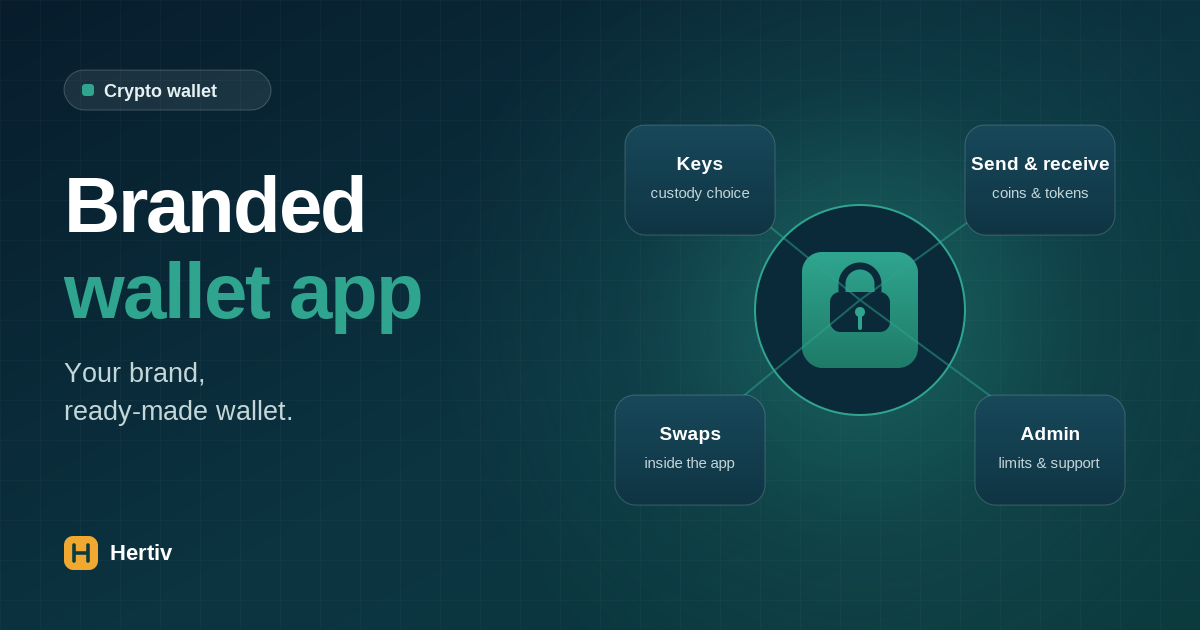
A white label crypto wallet app is a ready-made wallet product that a company rebrands and launches under its own name instead of building one from scratch. It usually includes key management, send and receive, token support, swaps and admin controls, with the vendor handling updates and security patches. The main decision is custody: who holds the keys, you or your users.
What is a white label crypto wallet app?
A white label crypto wallet app is a wallet that a vendor builds once and many companies launch under their own brand. Your logo, colours and name go on the front, while the vendor supplies the code, the infrastructure and the updates behind it.
It is the wallet version of a white label product in any other industry: you buy a finished product and brand it, instead of building from zero. The vendor keeps improving the core product, and every brand using it gets those improvements.
White label wallets suit fintechs, exchanges, games and loyalty programmes that want to offer crypto without hiring a wallet team. They do not suit teams that need full control over every line of code or a design that no other brand shares. For the build-or-buy question, see crypto wallet development cost for what a custom build usually involves.
What comes inside the app
A white label wallet app is more than a balance screen. The parts below are the core of most products, and the gaps between vendors show up in exactly these rows.
| Part | What it does | Why it matters |
|---|---|---|
| Key management | Creates and stores keys or key shares | Losing keys means losing funds |
| Send and receive | Moves coins and tokens to addresses | The core job of any wallet |
| Token support | Shows balances for many tokens | Users expect their tokens to appear |
| Swaps | Exchanges one asset for another | Keeps users inside your app |
| Admin controls | Limits, fees, user support tools | Lets your team run the product |
| Compliance tools | Checks, screening and reporting | Required in most regulated markets |
Ask each vendor which rows are included in the base price and which cost extra. Token support and compliance tools are the two rows most often sold as add-ons, and both are hard to add later.
Custody models: who holds the keys
Custody is the biggest decision in a white label wallet, because it decides who can move funds and who is blamed when something goes wrong. There are three common models.
| Model | Who holds the keys | Best for |
|---|---|---|
| Custodial | Your company or the vendor | Beginners and regulated products |
| Non-custodial | The user, with a recovery phrase | Users who want full control |
| Multi-party (MPC) | Key shares split across parties | Teams that want control without one key |
Custodial wallets are simpler for users but put the risk on you: you must protect the keys and meet the rules that apply. Non-custodial wallets shift the risk to the user, which is honest but loses users who forget their recovery phrase. MPC splits the key so no single party can move funds alone. Multisig wallets work on a similar idea, with several keys needed to approve a transaction.
Features to check before you sign
Feature lists look alike across vendors, so check the details that decide whether the product works for your users. The list below is the short version of a full vendor review. Walk through each item with the vendor's demo, not their brochure, and note which answers are vague or need a follow-up.
- Which chains and tokens are supported on day one, and how new ones are added.
- How keys are created, stored and recovered, and what happens if a user loses a phone.
- Whether swaps, staking and fiat on-ramps are included or sold separately.
- What the admin panel lets your team do: freeze accounts, set limits, help users.
- Which compliance checks are built in, and which markets they cover.
- How updates and security patches reach your users, and how fast.
Ask for a demo with your own test users, not a sales walkthrough. A demo on real phones with real tasks shows the gaps that a slide deck hides. Fees and plans change often, so check the vendor site for current pricing.
How to choose a provider in 5 steps
Choose a provider by testing the product with your users, not by comparing marketing pages. The steps below keep the decision grounded in what your users will actually do.
- Write down your users, your chains and your custody model before talking to vendors.
- Shortlist three vendors that support your chains and your custody model on day one.
- Run a demo with your own test users doing send, receive, swap and recovery.
- Check security: ask for audit reports, patch history and incident handling.
- Compare total cost, including add-ons, support and updates, then pick one.
Talk to the vendor's support team before you sign. The quality of support during a demo is usually the quality you get during an incident, and incidents in wallets are expensive. A crypto wallet development partner can help you review the vendor's security claims before you commit.
A worked example: a fintech launch
Example (hypothetical): a fintech launches a white label wallet for 5,000 users. In the first month, 10% of users are active each week, which is 500 active users a week.
Each active user sends 2 transactions a week, so the wallet handles 500 × 2 = 1,000 transactions a week. If the network fee passed through to users is $0.50 per transaction, that is 1,000 × $0.50 = $500 a week in network fees, or about $2,000 a month.
The fintech uses that figure to set its own fee and support budget. If only 100 users were active instead of 500, the same maths gives 100 × 2 × $0.50 = $100 a week, so the budget scales with real use, not with the total user count. Plan for active users, not registered ones.
Common mistakes
Most white label wallet problems come from skipping the demo and the security review. Both are cheap compared with a launch that loses user funds or fails a compliance check.
- Picking a vendor on price alone and finding key features are add-ons.
- Choosing a custody model without asking a lawyer what it means.
- Skipping the demo with real users on real phones.
- Assuming token support is included when it is sold separately.
- Ignoring how updates and security patches reach users.
- Launching with no plan for lost phones and forgotten recovery phrases.
Key takeaways
- A white label wallet is a finished product you brand.
- Custody is the biggest decision: who holds the keys.
- Check token support and compliance before you sign.
- Demo with real users on real phones.
Frequently asked questions
What is the difference between a white label wallet and a custom wallet?
A white label wallet is a finished product built by a vendor and rebranded by many companies, while a custom wallet is built from scratch for one company. White label is faster and cheaper to launch, but you share the design and the roadmap with other brands. Custom gives full control at a much higher cost and longer timeline.
Who holds the keys in a white label wallet?
It depends on the custody model you choose. In a custodial wallet, your company or the vendor holds the keys. In a non-custodial wallet, the user holds them with a recovery phrase. In an MPC wallet, key shares are split across parties so no single party can move funds alone.
How long does it take to launch a white label wallet?
A basic launch usually takes weeks rather than months, because the core product already exists. Branding, token setup, compliance checks and testing take most of the time. The exact timeline depends on your chains, your custody model and the rules in your market.
Can a white label wallet support many blockchains?
Most vendors support several major chains on day one, and add new ones over time. Ask which chains are included in the base price and how new chains are added, because token support is often sold as an add-on. Your users will expect their tokens to appear, so check this early.
What happens if a user loses their phone?
It depends on the custody model. In a custodial wallet, your support team can restore access after identity checks. In a non-custodial wallet, the user needs their recovery phrase, and without it the funds are usually lost. Ask the vendor how recovery works before you sign.
Do I need a licence to launch a wallet?
It depends on your country and what the wallet does. Holding user funds, offering swaps or handling fiat usually needs a licence or a licensed partner. Rules vary widely by market, so ask a lawyer in your market before you launch, not after.


