What Is a Multisig Wallet, and How Does It Work?
A multisig wallet needs more than one key to approve a transaction, so no single person or device can move the funds alone. Here is how the signing rules work.
On this page
Short answer
A multisig wallet is a cryptocurrency wallet that requires a set number of private keys to approve a transaction before it is sent. Instead of one key controlling the funds, a multisig wallet spreads control across several keys, so a single lost key or a single compromised device cannot move the money on its own.
What is a multisig wallet?
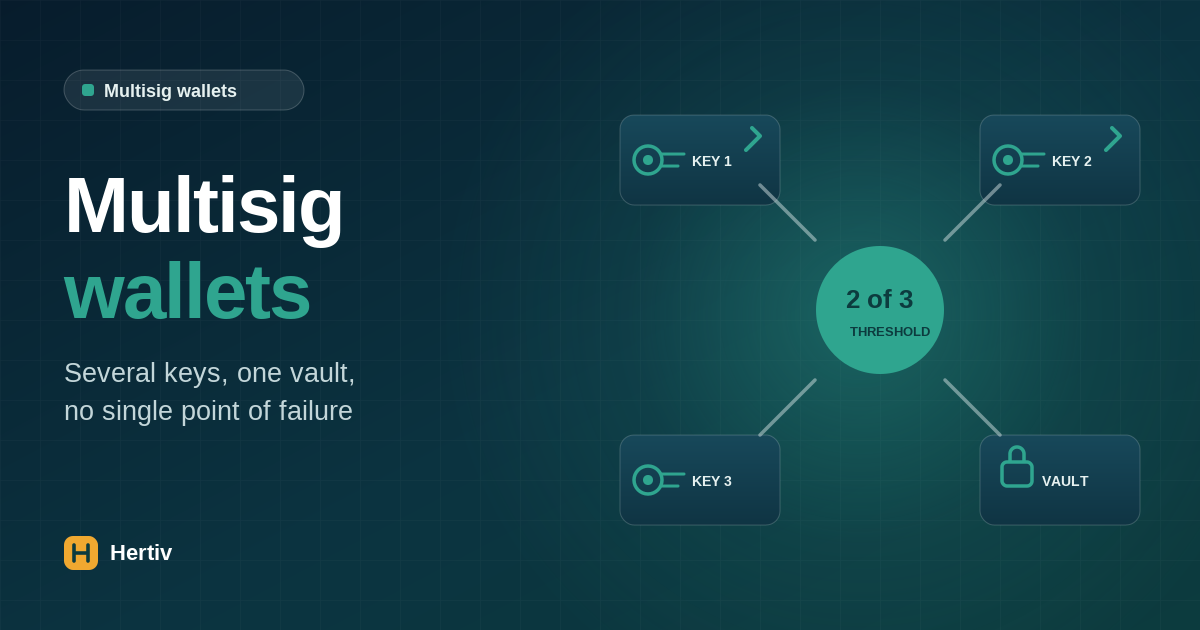
A multisig wallet is a cryptocurrency wallet that needs more than one private key to authorise a transaction. The wallet is set up with a signing rule, such as 2-of-3, which means any two of three keys must sign before funds move.
The point is to remove the single point of failure. With a normal wallet, one key is enough: lose it and the funds are gone, or have it stolen and the funds are gone. With a multisig wallet, an attacker needs several keys, and a lost key can be replaced while the others still control the wallet.
Multisig is a wallet design, not a currency. The same idea works on Bitcoin, Ethereum and other networks, although the way the wallet is built differs by chain. Some networks support multisig natively, while others use a smart contract that holds the funds and enforces the signing rule.
How does a multisig wallet work?
A multisig wallet works by splitting control across a set of keys and a threshold rule. When a transaction is proposed, the wallet collects signatures from the key holders until the threshold is met, and only then does it broadcast the transaction.
A typical flow looks like this:
- The wallet is created with a list of public keys and a threshold, for example 2-of-3.
- One key holder proposes a transaction, such as sending funds to a supplier.
- Other key holders review the transaction details and sign with their own keys.
- Once the second signature is collected, the threshold is met and the transaction is sent.
- The transaction appears on the blockchain like any other, with the multisig address as the sender.
The keys should live in different places: one on a hardware wallet at the office, one with a co-founder at home, one in a bank safe. If all the keys sit on one laptop, the wallet is no safer than a single-key wallet. Top multisig wallets lists the tools teams commonly use to run this setup.
Multisig vs single-key wallets
Multisig wallets trade a little convenience for much stronger control. A single-key wallet is fast and simple, which suits small personal amounts; a multisig wallet suits shared funds where a mistake or a theft would be costly.
| Feature | Single-key wallet | Multisig wallet |
|---|---|---|
| Keys needed to send | One | Two or more, per the threshold |
| Lost key | Funds usually lost | Replaceable if other keys remain |
| Stolen key | Funds can be taken | Attacker needs several keys |
| Shared control | One person decides | Several people must agree |
| Speed | Instant | Slower, needs coordination |
| Setup effort | Minutes | An hour or more, plus testing |
The other comparison worth knowing is multisig versus MPC wallets, which split a single key into shares instead of using several keys. MPC versus multisig wallets explains the difference and when each fits.
What are the common multisig setups?
The common multisig setups are 2-of-3 for small teams, 3-of-5 for larger treasuries, and 2-of-2 for a personal backup arrangement. The right setup depends on how many people should be able to act and how much can go wrong at once.
A 2-of-3 setup suits a three-founder startup: any two founders can pay a supplier, and if one founder loses a key or leaves, the other two can still operate and replace the key. A 3-of-5 setup suits a larger treasury, where five people hold keys and any three can approve, so two people can be unavailable without blocking payments.
A 2-of-2 setup is sometimes used by one person with two devices, for example a hardware wallet plus a phone, so both must agree. This protects against a single stolen device but is risky if one device is lost, since there is no spare key. For most teams, a setup with a spare key is the safer choice.
Where are multisig wallets used?
Multisig wallets are used wherever several people share control of funds: startup treasuries, DAO treasuries, escrow arrangements and family inheritance plans. They are also used by exchanges and custodians to protect hot wallets.
For a startup, the wallet holds the company's crypto and the founders each hold a key, so no founder can move funds alone. For a DAO, token holders elect signers who approve spending from the treasury. For escrow, a buyer, a seller and an arbitrator each hold a key, and any two can release the funds, which lets the arbitrator settle a dispute.
Multisig also helps with inheritance. A family can set up a 2-of-3 wallet where the owner, a spouse and a lawyer hold keys, so the funds are recoverable if the owner dies, without any one person having full control during the owner's life.
Example (hypothetical): a three-founder startup sets up 2-of-3
Example (hypothetical): three founders run a startup with a crypto treasury worth 90,000 in stablecoins. Each founder holds one key on a hardware wallet, and the wallet rule is 2-of-3.
Each month the startup pays 12,000 to a developer agency. One founder proposes the payment, a second founder checks the invoice and signs, and the wallet sends the 12,000. The third founder is travelling and does not need to be involved.
One founder then loses a hardware wallet on a trip. The other two founders use their keys to move the remaining 78,000 to a new 2-of-3 wallet with a replacement key, so the treasury is safe and the startup misses no payments. With a single-key wallet, the same loss would have frozen the funds or handed them to whoever found the device.
What are the common mistakes?
The most common multisig mistakes are storing all keys in one place, never testing recovery, and choosing a threshold that blocks the team.
- All keys on one device. If the keys live on the same laptop, the wallet has no more protection than a single-key wallet.
- Never testing recovery. A setup that has never been tested with a small transaction may fail when it matters most.
- Threshold too high. A 4-of-5 rule with busy signers means payments stall for days.
- Threshold too low. A 1-of-3 rule is effectively a single-key wallet with extra steps.
- No plan for a lost key. Without a written recovery process, replacing a key takes weeks of argument.
- Signing without reading. Approving a transaction without checking the address and amount defeats the purpose of the second signer.
Test the wallet with a small amount before moving real funds, and write down who holds each key and how a lost key is replaced. If you are building wallet features into a product, crypto wallet development covers the design choices that matter.
Key takeaways
- A multisig wallet needs a set number of keys to approve a transaction, such as 2-of-3
- It removes the single point of failure: one lost or stolen key cannot move the funds alone
- 2-of-3 suits small teams; 3-of-5 suits larger treasuries that need spare signers
- Keys must live in different places, or the wallet is no safer than a single-key wallet
- Test recovery with a small transaction and write down the lost-key process before funding the wallet
Frequently asked questions
What happens if I lose one key in a multisig wallet?
Nothing is lost if the remaining keys still meet the threshold. With a 2-of-3 wallet, the other two key holders can move the funds to a new wallet with a replacement key. Losing two of three keys would lock the funds.
Is a multisig wallet safer than a hardware wallet?
They solve different problems. A hardware wallet protects one key from malware, while a multisig wallet spreads control across several keys. The safest setup for shared funds is several hardware wallets used as the keys of one multisig wallet.
Can a multisig wallet be hacked?
An attacker would need to compromise enough keys to meet the threshold, which is much harder than stealing one key. The main risks are keys stored together, signers approving transactions without checking them, and a bug in the wallet software.
How many keys should a multisig wallet have?
Three keys with a 2-of-3 threshold suits a small team, and five keys with a 3-of-5 threshold suits a larger treasury. The threshold should allow one key holder to be unavailable without blocking payments, and no single person should meet it alone.
Do multisig wallets cost more to use?
They usually cost a little more in network fees, because the transaction carries several signatures and therefore more data. On most networks the difference is small compared with the value of the funds being protected.
What is the difference between multisig and MPC wallets?
Multisig uses several separate keys and a threshold rule, while MPC splits one key into shares that are never combined. Multisig is simpler to audit and works on more networks; MPC can be more flexible for signing policies and key rotation.


