White Label Tokenization Platforms Explained
A white label tokenization platform lets a business issue tokens under its own brand without building the blockchain parts. Here is how it works and what to check.
On this page
Short answer
A white label tokenization platform is ready-made software that turns real or digital assets into blockchain tokens and lets a business run it under its own brand. The provider builds the token contracts, the investor dashboard and the compliance checks, while the business keeps its name, its colours and its customer relationship.
What is a white label tokenization platform?
A white label tokenization platform is software that a business licenses and brands as its own, used to create, sell and manage tokens that represent an asset such as property, a fund share or a bond. "White label" means the provider's name does not appear; the business's own logo and domain do.
Tokenization itself means recording ownership of an asset as tokens on a blockchain, so shares can be split, transferred and tracked more easily. The platform supplies the parts a business would otherwise have to build: token contracts, a sale page, investor onboarding, payment handling and a record of who owns what.
The table below shows the main parts of a typical platform and what each one does. Later sections explain how they fit together and what to check before choosing one.
| Part | What it does | Who uses it |
|---|---|---|
| Token contracts | Issue and move tokens on a chain | The platform provider |
| Investor dashboard | Shows holdings, documents and payouts | Investors and the business |
| Onboarding checks | Identity and eligibility checks | Compliance team |
| Payment handling | Takes fiat or crypto for token sales | Investors |
| Ownership record | Tracks who holds which tokens | The business and its auditors |
How does a white label platform work?
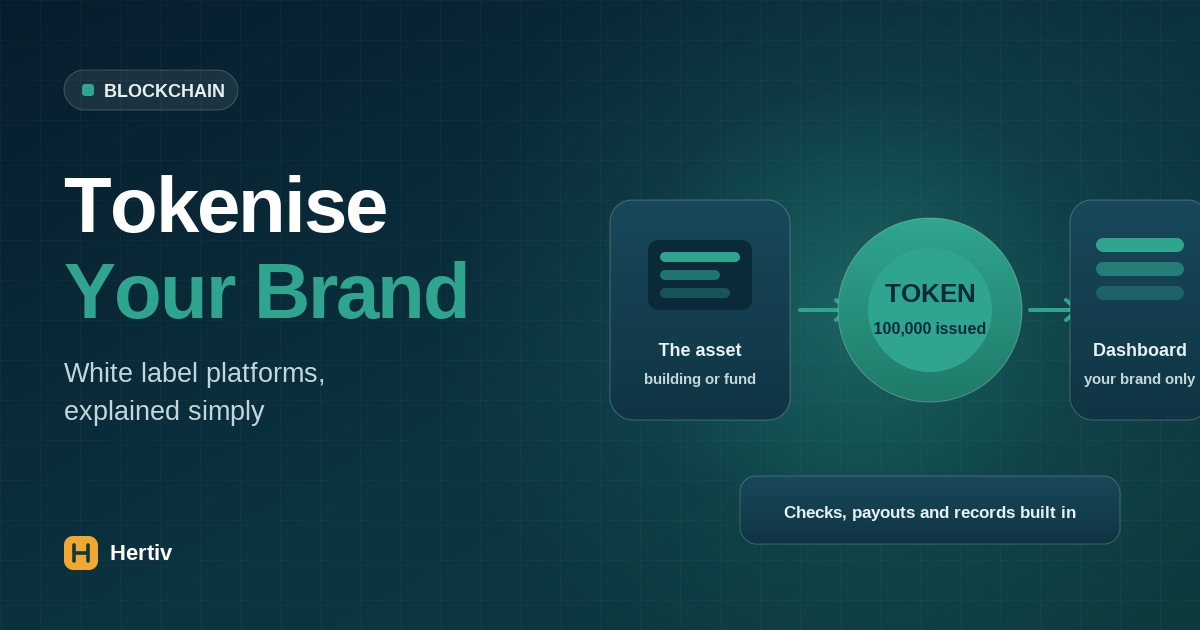
A white label platform works by connecting four pieces: the asset, the token contract, the investor flow and the ownership record. The business defines the asset and the terms, and the platform turns that into tokens investors can buy.
A typical flow looks like this:
- Define the asset and the terms. The business sets what the token represents, how many tokens exist, the price per token and who may buy.
- Issue the tokens. The platform deploys a token contract and mints the supply, usually with rules such as lock-up periods built in.
- Onboard investors. Each buyer completes identity checks and signs the offering documents before paying.
- Take payment and allocate tokens. Payment in fiat or crypto is recorded, and the matching tokens move to the buyer's wallet.
- Manage the asset. The dashboard tracks ownership, sends payouts and keeps the records an auditor will ask for.
The business controls the brand and the commercial terms, while the provider runs the chain and the software. For context on the asset side, see how RWA tokenization turns real-world assets into tokens.
What features should you expect?
You should expect a white label tokenization platform to cover token issuance, investor onboarding, payments, secondary transfers and reporting, with the rules for each set by the business rather than hard-coded by the provider.
The features that matter most are the ones that protect the business legally and operationally. Identity checks, transfer limits and audit trails are not extras; they are the reason a regulated offering can run on the platform at all.
- Token issuance and rules. Minting, burning, lock-ups and transfer limits, all set per offering.
- Investor onboarding. Identity checks, document signing and eligibility rules by country.
- Payments. Fiat and crypto payment options, with a clear record of each payment against each allocation.
- Secondary transfers. Controlled transfer of tokens between investors, with the same eligibility rules applied.
- Reporting. Ownership lists, payout records and exportable reports for auditors and regulators.
- Branding. The business's logo, colours and domain, with no provider branding visible to investors.
Ask the provider which of these are included in the base licence and which cost extra. A platform that charges separately for transfer rules or audit exports can become expensive fast.
Who uses white label tokenization platforms?
White label tokenization platforms are used by property firms, fund managers, startups and banks that want to offer tokenised assets without building blockchain software from scratch.
Property firms use them to split a building into smaller shares so more investors can take part. Fund managers use them to issue tokenised fund shares and handle subscriptions online. Startups use them to run a token sale with investor onboarding built in, and banks use them to test tokenised bonds or deposits under their own brand.
The common thread is a business that already has the asset and the customers, and wants the token rails without the build. If the business has neither an asset nor a customer base, a platform will not create them; it only makes the offering easier to run.
Smaller teams often start with one offering on one chain, then add more assets once the first sale works. That keeps the licence cost and the compliance work in line with real demand.
What does a white label tokenization platform cost?
A white label tokenization platform usually costs a setup fee plus a monthly licence fee, and sometimes a share of the value raised. Exact prices are set by each provider, so check the vendor site for the current pricing before budgeting.
The cost drivers are the number of offerings, the chains supported, the volume of investors and the level of compliance support. A platform that includes identity checks, audit support and secondary transfer rules will cost more than a basic issuance tool, and will also save more staff time.
Budget for more than the licence: legal advice on the offering, audit of the token contract, and staff time for onboarding and support. A realistic first-year budget includes the platform fee, a legal review and a reserve for fixes after the first sale.
Ask for a written quote that lists what is included: the chains, the number of offerings, the investor limit and the support hours. Compare two or three providers on the same list, because headline prices often cover different things.
Example (hypothetical): a property fund tokenises one building
Example (hypothetical): a property fund wants to offer shares in one office building worth $10,000,000 to smaller investors. It licenses a white label platform and sets the token price at $100, so the building is split into 100,000 tokens: 100,000 times $100 equals $10,000,000.
The fund sets a minimum investment of $1,000, which is 10 tokens per investor. If 200 investors buy the minimum, they take 2,000 tokens, worth $200,000, which is 2 percent of the building. The platform records each purchase, runs the identity checks and shows each investor their holding in the dashboard.
Each quarter the building pays $150,000 in rent after costs. The platform splits that payout by token: $150,000 divided by 100,000 tokens is $1.50 per token per quarter. An investor holding 10 tokens receives $15 that quarter, and the dashboard shows the payment against their holding.
The fund's team spends its time on the property and the investors, not on the token contract. The platform handles issuance, onboarding and the ownership record, and the fund's brand is the only one the investors see.
What are the common mistakes?
The most common mistakes with white label tokenization platforms are picking on price alone, skipping the legal review, and launching with no plan for secondary transfers.
- Choosing on price alone. A cheap licence that lacks transfer rules or audit exports creates costs later, when the offering needs them.
- Skipping the legal review. The platform is software, not legal advice; the offering still needs a lawyer in each market where it is sold.
- No secondary transfer plan. Investors will ask how to sell, and a platform that cannot handle controlled transfers will stall.
- Over-customising the first launch. Heavy custom work delays the sale and makes upgrades harder; start close to the standard flow.
- Weak onboarding. Slow or confusing identity checks lose investors before they pay, however good the asset is.
Key takeaways
- A white label platform lets a business sell tokens under its own brand
- The provider builds the contracts, dashboard and checks; the business keeps the customer
- Transfer rules, audit trails and onboarding checks are core features, not extras
- Budget for legal review and contract audit on top of the licence fee
- Start with one offering and one chain, then expand once the first sale works
Frequently asked questions
What is the difference between white label and building your own platform?
Building your own platform means writing the token contracts, dashboard and compliance flows yourself, which takes months and a specialist team. A white label platform gives you the same parts ready-made under your brand, so you can launch in weeks and focus on the asset and the investors.
Do investors know a platform is white label?
No, if it is done well. The investor sees the business's brand, domain and documents, and never sees the provider's name. The token contract itself may name the provider's code, but the investor-facing experience belongs to the business.
Which assets can be tokenised on a white label platform?
Property, fund shares, bonds, invoices and revenue shares are the common cases, because each has a clear value and a clear owner. The platform does not make an asset suitable; the legal structure and the market for it do.
How long does it take to launch on a white label platform?
A standard launch usually takes a few weeks once the legal documents and the asset terms are ready. Custom branding, extra chains and unusual transfer rules add time, so teams that start close to the standard flow launch fastest.
Can tokens be traded after the first sale?
Only if the platform supports controlled secondary transfers with the same eligibility rules as the first sale. Check this before signing, because adding it later can mean new contracts and a new onboarding flow for existing holders.
What happens if I stop using the platform?
That depends on the contract. You should be able to export the ownership record and keep the token contract running, but the dashboard and onboarding tools usually stop with the licence. Agree the exit terms in writing before the first sale.


