Top Crypto Wallets for Business: 6 to Compare
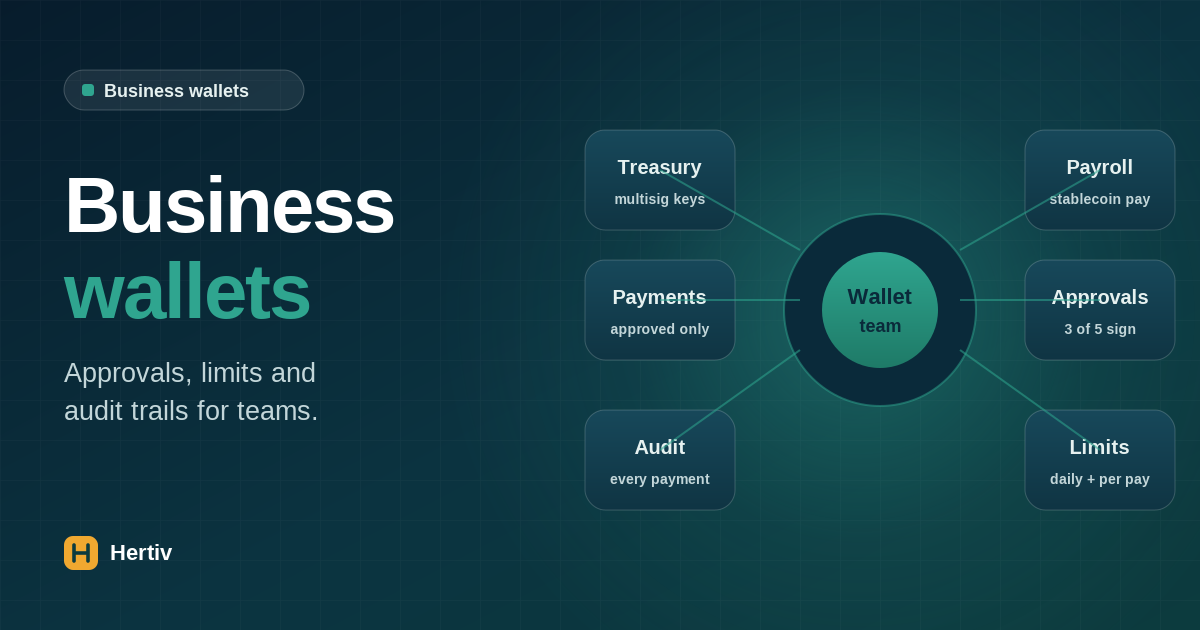
A business crypto wallet must handle approvals, limits and audit trails, not just hold coins. Here are six wallets built for teams, and how to pick the right one.
On this page
Short answer
The best crypto wallet for a business depends on who must approve a payment, how much can move without a second signature, and what records the finance team needs, so a team wallet needs multi-signature approvals, spending limits, roles and audit trails that a personal wallet does not have. This guide compares six options, from self-custody multisig wallets to managed custody, and explains how to choose one for your team.
Which crypto wallet should a business use?
A business crypto wallet is a wallet built for a team, where payments need approvals, limits and records, rather than a single person tapping to send. The right choice depends on who approves payments, how much can move, and what the finance team must be able to prove later.
Personal wallets are built for one owner and one device. A business wallet adds roles, so a junior staff member can prepare a payment while a manager approves it, and it keeps a record of who did what and when. Multi-signature approvals, where several owners must sign before a payment moves, are the most common control, as explained in what a multisig wallet is.
| Wallet | Best for | Custody | Key strength |
|---|---|---|---|
| Safe | Multisig team treasury | Self-custody | On-chain approvals |
| Fireblocks | Managed custody, trading desks | Managed | Policy engine, many chains |
| BitGo | Regulated custody | Managed | Insurance-backed custody |
| Coinbase Wallet | Small teams starting out | Self-custody | Simple start, many chains |
| Ledger Live | Hardware-backed team storage | Self-custody | Keys kept offline |
| MetaMask Institutional | Teams using DeFi apps | Self-custody | DeFi access with controls |
The table above is a shortlist, not a ranking. The sections below explain what each wallet does well, where it is awkward, and which kind of team it fits. Fees and plans change often, so check the vendor site for current pricing before you decide.
<h3>1. Safe: best for a multisig team treasury</h3>
Safe is a smart-contract wallet where a payment only moves when enough named owners approve it. A team might set three approvals out of five owners, so no single person can move treasury funds on their own.
Safe works on Ethereum and several other chains, and it is the most widely used multisig wallet for teams that hold funds together. Its rules live on the chain, so anyone can check how many approvals a payment needs. Other multisig options exist too, and the top multisig wallets list compares them side by side.
Pros:
- Approvals are enforced on the chain, not by a promise
- Works with hardware wallets for extra safety
- Widely supported by other tools and apps
Cons:
- Needs some setup and learning before the team is comfortable
- Each approval costs a network fee
- No built-in customer support team to call
<h3>2. Fireblocks: best for managed custody and trading desks</h3>
Fireblocks is a managed custody platform for businesses that move crypto often. It combines wallets, a policy engine and trading tools, so a team can set rules for who can send, to which addresses, and up to what amount.
It fits teams that need speed and support, such as trading desks and payment companies, and it covers many chains and tokens from one dashboard. Because it is a managed service, the team does not run its own key infrastructure.
Pros:
- Detailed policies for users, amounts and destinations
- Fast transfers between internal wallets
- Support team and reporting for finance
Cons:
- Priced for larger teams, not for a first wallet
- The business relies on a vendor for custody
- Setup takes time and a sales conversation
<h3>3. BitGo: best for regulated custody</h3>
BitGo is a custody provider that holds crypto for businesses under regulated arrangements in several regions. It suits companies that need a licensed custodian, such as funds, exchanges and payment firms, rather than a wallet they run themselves.
BitGo wallets use multi-signature keys, with keys held in different places, so a single stolen key cannot move funds. The service also offers insurance on assets held in custody, subject to its terms.
Pros:
- Regulated custody in several regions
- Multi-signature keys held apart
- Insurance on custodied assets, per its terms
Cons:
- Built for larger clients, with onboarding to match
- Less control than running your own wallet
- Fees depend on assets and services, so check the vendor site
<h3>4. Coinbase Wallet: best for small teams starting out</h3>
Coinbase Wallet is a self-custody wallet from Coinbase that works on a phone or as a browser extension. A small team can start with it quickly, hold many chains and tokens, and connect to apps without setting up new infrastructure.
It is the simplest option on this list, which is also its limit. It does not add team approvals or spending limits on its own, so a team that needs those controls should pair it with a multisig wallet or a custody service.
Pros:
- Quick to set up and easy to use
- Supports many chains and tokens
- Connects to a large number of apps
Cons:
- No built-in team approvals or limits
- One set of keys per wallet, so roles need care
- Less suited to large treasuries
<h3>5. Ledger Live: best for hardware-backed team storage</h3>
Ledger Live is the companion app for Ledger hardware wallets, where private keys stay on a physical device and never touch the internet. A team can keep its main holdings on hardware and use the app to check balances and prepare transactions.
Hardware storage is the strongest defence against remote theft, which is why many teams keep long-term funds on a Ledger. The trade-off is speed: a payment needs someone with the device, so it is better for storage than for daily spending.
Pros:
- Keys stay offline on a hardware device
- Supports many chains and tokens
- Clear record of accounts and balances
Cons:
- Payments need physical access to the device
- No built-in multi-person approvals
- Losing the device and the recovery phrase together is serious
<h3>6. MetaMask Institutional: best for teams using DeFi apps</h3>
MetaMask Institutional is the business version of MetaMask, built for teams that use decentralised finance apps. It adds organisation accounts, roles and reporting on top of the familiar wallet, and it connects to custodians so keys can sit with a provider the team trusts.
It fits teams that lend, stake or trade through DeFi apps and need finance to see what happened. The wallet itself does not hold the funds; it routes signing through the custodian or key setup the team chose.
Pros:
- Works with the DeFi apps teams already use
- Roles, reporting and custodian connections
- Familiar interface for crypto-native staff
Cons:
- Needs a custodian setup to get the full benefit
- DeFi apps carry their own smart-contract risks
- More moving parts than a simple wallet
How to choose a crypto wallet for your business
Choose a crypto wallet for your business by starting with who approves payments and how much can move, then matching the wallet to those rules.
- Map the approval flow. Decide who prepares, who approves and how many signatures a payment needs at each amount.
- Set spending limits. Agree daily and per-payment limits for each role, and write them down before you pick a wallet.
- Decide on custody. Choose self-custody if the team can manage keys safely, or a managed custodian if it cannot.
- Check the chains you need. Make sure the wallet supports every chain and token the business actually uses.
- Test the finance workflow. Run a small real payment and a month-end export before moving larger sums, so the records match what finance needs.
A wallet that looks cheap can become expensive if finance spends hours rebuilding records each month. Test the reporting and export early, not after the first quarter ends.
If the team already uses a wallet for fiat payments, check whether it also covers the business rules above before adding a second wallet to the stack.
What are the common mistakes?
The most common business wallet mistakes are using a personal wallet for company funds, letting one person hold all the keys, and skipping the recovery plan.
- One person holds everything. If that person is away or loses access, the funds are stuck.
- No approval rules. A wallet with no limits lets a single mistake or bad actor move the whole balance.
- No recovery plan. Recovery phrases and hardware backups must exist, be tested and be stored apart.
- Ignoring records. Finance needs exports and audit trails, so a wallet with poor reporting creates extra work.
- Skipping a small test. Move a small amount first and check the full flow before trusting the wallet with real sums.
Key takeaways
- A business wallet needs approvals, limits, roles and audit trails that a personal wallet does not have
- Multisig wallets such as Safe enforce approvals on the chain, while managed custodians add support and reporting
- Hardware storage is strongest for long-term funds but slower for daily payments
- Decide the approval flow and spending limits before choosing a wallet
- Test a small real payment and a month-end export before moving larger sums
Frequently asked questions
What is the difference between a business and a personal crypto wallet?
A personal wallet is built for one owner, while a business wallet adds roles, approvals, spending limits and audit trails for a team. The coins are the same, but the controls around who can move them are very different.
Do I need a multisig wallet for my business?
Yes, for any balance the business cannot afford to lose to a single mistake or a single stolen key. A multisig wallet needs two or more approvals before a payment moves, which is the simplest strong control a team can add.
Is a managed custodian safer than self-custody?
It depends on the team. A managed custodian brings regulated storage, support and insurance, while self-custody keeps full control but needs the team to guard keys and recovery phrases itself. Many businesses use both for different sums.
Can a business wallet hold stablecoins?
Yes. Most business wallets hold stablecoins alongside other tokens, and stablecoins are often used for payments and payroll because their value stays near the dollar. Check that the wallet supports the stablecoin and the chain you plan to use.
How do I back up a business wallet?
Store recovery phrases and hardware backups in separate secure places, test the recovery process with a small wallet first, and write down who holds each backup. A backup that has never been tested is not a backup you can rely on.
What records does finance need from a crypto wallet?
Finance needs a list of every payment with the date, amount, token, sender, receiver and approver, plus a month-end balance for each wallet. Test the wallet's export before the first month ends, so the records are ready when they are needed.


