Best Crypto Wallets for Fiat Payments: 6 to Compare
Some crypto wallets let you buy with a card, sell back to your bank and pay in crypto. These six handle fiat payments well, with the checks to make first.
On this page
Short answer
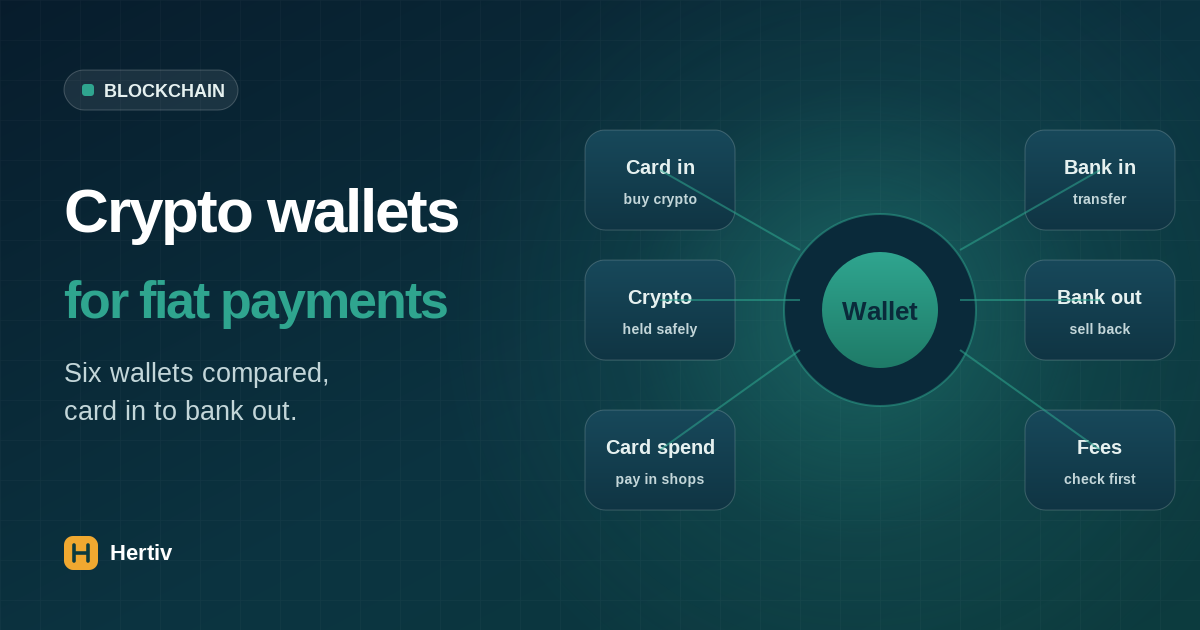
A crypto wallet that supports fiat payments lets you move between ordinary money and crypto without leaving the wallet: buy with a card or bank transfer, sell back to your bank, and in some cases spend from a card. The six wallets below all handle fiat on-ramps and off-ramps, but they differ in which currencies, cards and countries they support. Check the vendor site for current availability in your country.
Which crypto wallets support fiat payments?
The wallets worth comparing are the ones where fiat is part of the product, not an afterthought. A good fiat wallet lets you buy crypto with a card or bank transfer, sell it back to your bank, and see the fees before you confirm. The table below compares six well-known wallets on those points.
| Wallet | Fiat in | Fiat out | Card spending |
|---|---|---|---|
| Coinbase Wallet | Card, bank transfer | Bank transfer | Through linked card |
| Crypto.com Onchain | Card, bank transfer | Bank transfer | Through Crypto.com card |
| Trust Wallet | Card, bank transfer | Bank transfer | No direct card |
| Exodus | Card, bank transfer | Bank transfer | No direct card |
| Ledger Live | Card, bank transfer | Bank transfer | Through linked card |
| MetaMask | Card, bank transfer | Bank transfer | Through linked card |
Availability differs by country, and the exact payment methods depend on where you live. A wallet that supports card payments in one country may only support bank transfers in another, so check the vendor site for your country before choosing. What is a stablecoin explains the tokens most people use for everyday crypto payments.
Wallets with the smoothest fiat flow
1. Coinbase Wallet: best for buying with a card
Coinbase Wallet is the self-custody wallet from Coinbase, and its fiat flow is the most direct of the six: you can buy crypto with a card or a bank transfer and sell it back to your bank without leaving the wallet. The connection to the Coinbase exchange is the reason it feels smooth, since the buying and selling runs through the same account.
The trade-off is that the smooth flow depends on Coinbase supporting your country and your bank. If either is missing, the wallet is still usable, but the fiat features are limited. It is a good fit for people who already use Coinbase and want a self-custody wallet with the same payment rails.
Pros: card and bank buying, easy selling, wide token support. Cons: fiat features vary by country, and the wallet is tied to one exchange.
2. Crypto.com Onchain: best for card spending
Crypto.com Onchain is the self-custody wallet from Crypto.com, and it pairs with the Crypto.com card for spending. You can buy crypto with a card or bank transfer, sell back to your bank, and spend from the card where cards are accepted. For people who want crypto in daily spending, that combination is the main draw.
The card itself has its own terms and availability, and the benefits depend on the card tier, so check the vendor site before deciding. The wallet is a good fit for people who already use Crypto.com and want their wallet and card to work together.
Pros: card spending, bank transfers both ways, wide token support. Cons: card terms vary by tier and country, and the wallet is tied to one provider.
3. Trust Wallet: best for a simple first wallet
Trust Wallet is a widely used mobile wallet that supports buying crypto with a card or bank transfer through third-party providers. It does not offer its own card, but it covers the two jobs most people need: getting money in and getting it back out to a bank.
The fiat features are provided by partners, which means the exact methods and fees depend on the partner serving your country. That is worth checking before you rely on it. It is a good fit for people who want a simple wallet with broad token support and no tie to one exchange.
Pros: simple to use, broad token support, no exchange tie-in. Cons: fiat features come from partners, and there is no card for spending.
Wallets for control and everyday use
4. Exodus: best for a clean, simple interface
Exodus is a wallet known for a clear interface across desktop and mobile, and it supports buying crypto with a card or bank transfer through third-party providers, plus selling back to a bank. It does not offer its own card, so spending means selling first and then spending from your bank.
The simplicity is the point: Exodus hides the complexity of chains and tokens behind a design that non-technical users can follow. The fiat providers and fees vary by country, so check the vendor site for your location. It is a good fit for people who want a wallet that is easy to use and easy to explain.
Pros: clear design, desktop and mobile, broad token support. Cons: fiat features come from partners, and there is no card for spending.
5. Ledger Live: best for hardware-backed security
Ledger Live is the companion app for Ledger hardware wallets, and it supports buying crypto with a card or bank transfer and selling back to a bank, with the keys held on the hardware device. The fiat flow runs through partners, and spending through a linked card is available in some countries.
The hardware is the reason to choose it: the keys never leave the device, which is a stronger security model than a phone-only wallet. The trade-off is cost and setup, since you need the device itself. It is a good fit for people holding larger amounts who want fiat access without giving up hardware security.
Pros: hardware security, card and bank buying, selling to a bank. Cons: needs a hardware device, and fiat features vary by country.
6. MetaMask: best for using crypto apps
MetaMask is the most widely used wallet for crypto apps, and it supports buying crypto with a card or bank transfer and selling back to a bank through third-party providers. It is the wallet most decentralised apps expect, so it is often the first choice for people who use those apps regularly.
The fiat features are provided by partners, and the interface assumes you know your way around crypto, which can be confusing for a first wallet. It is a good fit for people who use crypto apps and want fiat access in the same wallet. Top multisig wallets covers wallets built for shared control, which is a different need.
Pros: works with most crypto apps, card and bank buying, selling to a bank. Cons: fiat features come from partners, and the interface suits experienced users.
How to choose a wallet for fiat payments
Choosing well matters more than choosing fast. Follow these five steps before moving money into a wallet.
- Check your country first. Fiat features vary by country, so confirm that card buying, bank selling and card spending work where you live. The vendor site has the current list.
- Decide how you will spend. If you want to spend crypto directly, you need a wallet with a card. If you are happy to sell to your bank first, any of the six will do.
- Compare the full cost. Look at the buy fee, the sell fee and the exchange rate, not just one of them. A wallet with no visible fee can still cost more through a worse rate.
- Check who holds the keys. Self-custody wallets give you control of the keys, which also means you are responsible for the recovery phrase. Hardware wallets add a further layer of protection.
- Test with a small amount. Buy a small amount, sell a small amount, and check that the money arrives in your bank. A wallet that works in a test is one you can trust with more.
The wallet that wins is rarely the one with the most features. It is the one where fiat works in your country, at a cost you can see, with a security model you understand. What is a hot wallet explains the difference between wallets connected to the internet and those kept offline.
Common mistakes
The most common mistake is assuming fiat features work everywhere. A wallet that supports card payments in one country may not support them in yours, and finding that out after moving money in is a painful lesson. Check availability first.
Another mistake is ignoring fees. Buying, selling and exchanging each have a cost, and the total can be much higher than the headline fee. Compare the full cost, including the exchange rate, before choosing.
People also lose money by mishandling the recovery phrase. Write it down on paper, keep it somewhere safe, and never share it with anyone or store it in a screenshot. And never treat a wallet as a bank account: crypto prices move, and the value in a wallet can fall as well as rise.
Key takeaways
- Check fiat availability in your country first: it varies widely between wallets.
- Coinbase Wallet and Crypto.com Onchain offer the smoothest fiat flow, including cards.
- Compare the full cost: buy fee, sell fee and exchange rate together.
- Self-custody means you hold the keys, so protect the recovery phrase.
- Test with a small amount before moving larger sums into a wallet.
Frequently asked questions
Which crypto wallet is best for fiat payments?
It depends on your country and how you want to spend. Coinbase Wallet suits card buying, Crypto.com Onchain suits card spending, and Trust Wallet and Exodus suit simple buying and selling. Check the vendor site for availability in your country.
Can I buy crypto with a card in a wallet?
Yes, most of the wallets in this guide support card buying through the wallet itself or a partner. The exact methods and fees depend on your country, so check the vendor site before you rely on it.
Can I sell crypto back to my bank from a wallet?
Yes, the wallets in this guide all support selling crypto and withdrawing to a bank account, usually through a partner. Test with a small amount first and check that the money arrives before selling more.
Do crypto wallets have debit cards?
Some do. Crypto.com offers a card linked to its wallet, and Ledger and MetaMask support linked cards in some countries. Trust Wallet and Exodus do not offer their own cards, so spending means selling to a bank first.
Are fiat payments in crypto wallets safe?
The wallet itself is only part of the answer. Use a wallet from a known provider, protect the recovery phrase, and check that the fiat provider is regulated in your country. Never share the recovery phrase with anyone.
What fees do crypto wallets charge for fiat payments?
Fees vary by wallet, provider and country, and the exchange rate matters as much as the fee. Compare the buy fee, the sell fee and the rate together, and check the vendor site for current numbers.


