What Is a Stablecoin, and How Does It Hold Its Value?
A stablecoin is a token designed to keep a steady value, usually one dollar, by holding reserves or using rules. Here is how the peg works and what can break it.
On this page
Short answer
A stablecoin is a cryptocurrency designed to hold a steady value, usually one unit of a fiat currency such as the US dollar, instead of swinging in price like other crypto assets. It keeps its peg by holding reserves of cash and safe assets, or by using rules that expand and shrink supply, so that one token can be redeemed for close to one dollar.
What is a stablecoin?
A stablecoin is a digital token that aims to keep a stable price, most often one US dollar per token. Unlike other cryptocurrencies, whose price moves with the market, a stablecoin is built to be boring: its job is to stay at one dollar so people can hold, send and settle payments without price risk.
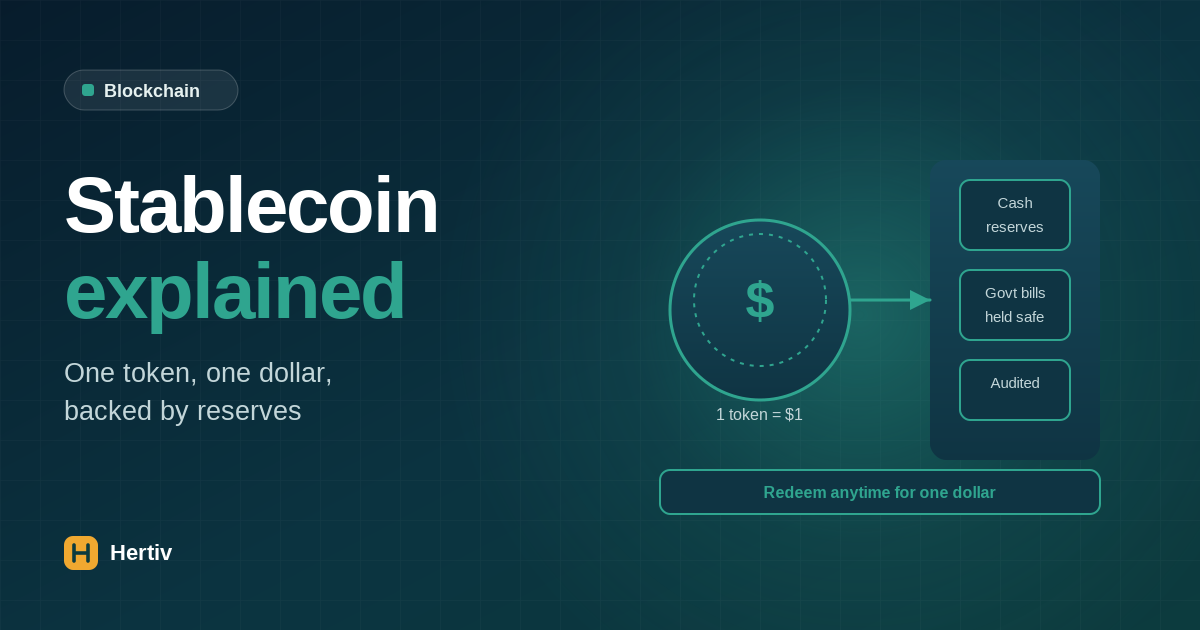
It works because each token is backed by something, or governed by rules that keep supply in line with demand. The most common design holds reserves, such as cash and short-term government bills, so that token holders can redeem their tokens for dollars.
Stablecoins run on public blockchains, which means they can be sent anywhere in the world, at any hour, without a bank in the middle. That combination, a steady value plus blockchain transfer, is why they are used for payments, trading and settling between crypto platforms.
The idea is simple, but the details matter: what backs the token, who holds the reserves, and how often that is checked. Those details decide whether a stablecoin is trustworthy. For the business side, stablecoin development covers how issuers build and launch them.
What are the main types of stablecoin?
The main types of stablecoin are fiat-backed, crypto-backed, commodity-backed and algorithmic. Each keeps its peg in a different way, and each carries different risks.
| Type | How the peg is kept | Example backing | Main risk |
|---|---|---|---|
| Fiat-backed | Reserves of cash and bills | Dollars in a bank | Reserve quality and audits |
| Crypto-backed | Over-collateralised crypto | Ether held in a vault | Collateral price falls |
| Commodity-backed | Reserves of a commodity | Gold in storage | Storage and audit trust |
| Algorithmic | Rules expand or shrink supply | No reserves, code rules | Rules fail in a panic |
Fiat-backed stablecoins are the most widely used for payments, because the peg is the easiest to understand: one token, one dollar in reserve. Algorithmic designs have the weakest record, because the rules that hold the peg in calm markets can break when many holders redeem at once.
How does a stablecoin keep its price at one dollar?
A fiat-backed stablecoin keeps its price at one dollar through redemption and arbitrage. Anyone can exchange one token for one dollar with the issuer, and traders buy the token when it trades below a dollar and sell it when it trades above, which pulls the price back.
The mechanism only works if redemption actually happens. If the issuer delays or limits redemptions, traders lose confidence and the price slips. That is why the reserve reports and the redemption process matter more than the marketing around the token.
Crypto-backed stablecoins work differently: they hold more collateral than the tokens issued, so a fall in the collateral price still leaves enough to cover redemptions. If the collateral falls too far, the system sells some of it automatically to protect the peg.
In practice, most stablecoins trade within a fraction of a cent of a dollar on large exchanges. The peg is a market outcome, not a guarantee, and it depends on trust in the reserves behind it.
What backs a stablecoin, and who checks it?
A fiat-backed stablecoin is backed by reserves held by the issuer, usually cash, bank deposits and short-term government bills. The issuer publishes reports about those reserves, and independent auditors check them on a schedule.
What to look for in a reserve report:
- What the reserves are. Cash and short-term government bills are the safest; riskier assets are a warning sign.
- Who holds them. Reserves should sit with regulated banks or custodians, not with the issuer itself.
- How often they are checked. Regular independent audits beat a one-off report.
- Whether redemption works. The test is whether a holder can actually redeem tokens for dollars quickly.
Rules differ by country, and new stablecoin laws are appearing in several major markets. A token that follows the rules in its home market is easier to use in a business than one that does not. The MiCA regulation post covers the European rules for stablecoin issuers.
Where are stablecoins actually used?
Stablecoins are used where a steady digital dollar is useful: trading on crypto exchanges, sending money across borders, paying suppliers, and settling between platforms. They are also used inside decentralised finance, where they act as the stable unit in lending and trading.
Common uses:
- Trading. Traders move in and out of volatile assets without leaving crypto rails.
- Cross-border payments. A payment that takes days through banks can settle in minutes on a blockchain.
- Business payments. Suppliers and freelancers can be paid in a stable token instead of a volatile one.
- Savings in unstable currencies. People in countries with high inflation hold stablecoins as a digital dollar.
The payment uses are growing fastest, because they solve a real problem: moving dollars across borders cheaply and quickly. For the retail angle, stablecoin use cases in retail covers where shops and brands use them.
What are the risks of stablecoins?
The risks of stablecoins are de-pegging, reserve problems, issuer failure and regulation. A token can lose its peg if reserves are weak, if redemption stops working, or if a market panic causes many holders to redeem at once.
- De-pegging. The token trades below a dollar, sometimes sharply, when confidence falls.
- Reserve risk. Reserves may include assets that lose value or cannot be sold quickly.
- Issuer risk. The company behind the token can fail, freeze redemptions or face legal action.
- Smart contract risk. Bugs in the token contract can be exploited, as with any blockchain code.
- Regulatory risk. New rules can restrict how a token is issued or used in a country.
These risks are why businesses usually hold stablecoins briefly for settlement rather than as a long-term store of value. Holding them is a decision about the issuer, not just about the technology.
Example (hypothetical): a small exporter gets paid in stablecoins
Example (hypothetical): a small exporter sells goods to a buyer overseas and agrees to be paid 10,000 dollars in a fiat-backed stablecoin. The buyer sends 10,000 tokens, which arrive in minutes instead of the three days a bank transfer would take.
The exporter checks the token before accepting it: the issuer publishes monthly reserve reports, holds cash and short-term government bills with regulated custodians, and offers redemption within one business day. The exporter then converts 8,000 tokens to dollars for payroll and keeps 2,000 tokens to pay a supplier who also accepts them.
The arithmetic is simple: 10,000 tokens in, 8,000 converted, 2,000 kept, and no exchange loss from price swings, because the token held its dollar peg. The saving is time: three days of waiting becomes minutes, and the exporter can pay the supplier the same day.
The numbers are invented to show the shape of the saving, not a real result. The point is that the value comes from speed and a steady price, not from the token itself.
What are the common mistakes?
The most common stablecoin mistakes are treating the peg as a guarantee, ignoring reserve quality, and holding large amounts in a single token.
- Trusting the peg blindly. A peg is a market outcome backed by reserves, not a promise that cannot break.
- Skipping the reserve report. If you cannot see what backs the token, do not hold it.
- One token for everything. Spreading holdings across two well-audited tokens lowers issuer risk.
- Ignoring redemption terms. Some issuers limit who can redeem or how fast, which matters in a panic.
- Forgetting taxes and rules. Stablecoin payments are still payments, and the tax and reporting rules in your country apply.
Before using a stablecoin in a business, check the issuer, the reserves, the redemption process and the rules in your market. The how to create a cryptocurrency post covers the technical side of launching a token.
Key takeaways
- A stablecoin is a token designed to hold a steady value, usually one dollar.
- Fiat-backed designs hold cash and bills; algorithmic designs rely on rules alone.
- The peg holds through redemption and trading, not through a guarantee.
- Reserve quality, audits and redemption speed decide whether a token is trustworthy.
- Use stablecoins for settlement and payments, not as a long-term store of value.
Frequently asked questions
How is a stablecoin different from Bitcoin?
Bitcoin has no peg and its price moves with the market, while a stablecoin is designed to hold a steady value, usually one dollar. Bitcoin is used as an asset and a store of value; a stablecoin is used as a medium of exchange and for settlement.
Are stablecoins safe to hold?
They are safer than volatile crypto for short-term holding, but they carry issuer, reserve and regulatory risk. Check the reserve reports, the auditor and the redemption process before holding a large amount, and do not treat the peg as a guarantee.
What happens if a stablecoin loses its peg?
The token trades below a dollar, sometimes sharply, when holders lose confidence in the reserves or redemption. Holders who redeem early usually get out at full value; those who wait may get less. This is why redemption speed matters.
Do I need a bank account to use a stablecoin?
No. You need a crypto wallet and access to an exchange or a peer who accepts the token. You do need a bank account to convert the token back to dollars through the issuer or an exchange.
Are stablecoins regulated?
Yes, increasingly. Several major markets now have rules for who can issue a stablecoin, what reserves they must hold and how they must report. The rules differ by country, so check the position in your market before using one in a business.
Which stablecoin should a business use?
Pick a widely used, fiat-backed token with regular independent audits, reserves in cash and short-term government bills, and a redemption process that works in practice. Test redemption with a small amount before moving real payments through it.


