What Is the MiCA Regulation, and Who Has to Follow It?
MiCA is the EU's single set of rules for crypto-assets, covering stablecoin issuers and crypto service providers. Here is who it covers and what each group must do.
On this page
Short answer
The MiCA regulation is the European Union's Markets in Crypto-Assets Regulation, a single set of rules for crypto-assets across all EU member states. It covers crypto-assets not already covered by existing EU financial rules, and it sets out who can issue them, who can offer services around them, and what they must disclose.
What is the MiCA regulation?
The MiCA regulation is the European Union's Markets in Crypto-Assets Regulation, a single set of rules for crypto-assets across all EU member states. It covers crypto-assets that are not already covered by existing EU financial rules, and it sets out who can issue them, who can offer services around them, and what they must disclose.
MiCA was adopted in 2023 and phased in during 2024, with the rules for stablecoins applying first and the rules for crypto-asset service providers following. Before MiCA, each EU country set its own rules, so a company that wanted to operate across the EU had to deal with many different regimes. MiCA replaces that patchwork with one framework and one licence that works across the Union.
The regulation matters beyond Europe too. A company outside the EU that wants to serve EU customers must meet MiCA's rules, and other regions watch it as a model for their own crypto rules. For any team building a crypto product with European users, MiCA is now the starting point, not an afterthought.
Who does MiCA cover?
MiCA covers three groups: issuers of crypto-assets, issuers of stablecoins, and crypto-asset service providers, known as CASPs. The table below shows what each group is and what MiCA asks of it.
| Group | Who it is | What MiCA asks |
|---|---|---|
| Asset-referenced tokens | Stablecoins backed by a basket of assets | Authorisation, reserves, disclosure, redemption rights |
| E-money tokens | Stablecoins backed by one official currency | Authorisation, one-to-one reserves, redemption at par |
| Other crypto-assets | Tokens offered to the public in the EU | A white paper with defined contents, filed with the regulator |
| CASPs | Exchanges, brokers, custodians, advisers | A licence, capital, governance, custody and conduct rules |
| Trading platforms | Venues where crypto-assets trade | Market rules, order handling, conflict checks |
Bitcoin and ether themselves are largely outside MiCA's issuer rules, because no single issuer offers them to the public. But the platforms that trade them, hold them for customers or advise on them are inside MiCA, so most of the crypto business that touches EU users is covered.
The stablecoin side is covered in more detail on the stablecoin development page, which explains how issuers build the reserves and redemption systems MiCA asks for.
What must stablecoin issuers do under MiCA?
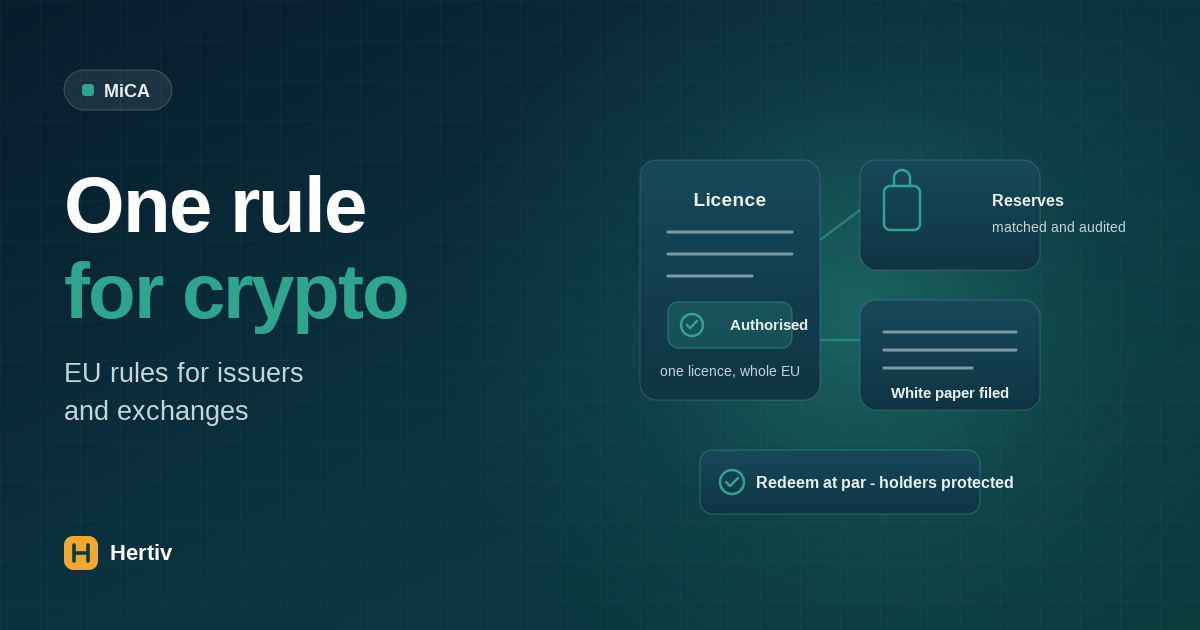
Stablecoin issuers under MiCA must be authorised, hold reserves that match what they have issued, publish clear information, and let holders redeem. The rules are strictest where the stablecoin is widely used.
For an e-money token, the issuer must hold reserves equal to the tokens in circulation, in low-risk assets, and must redeem at par value when a holder asks. For an asset-referenced token, the issuer must hold a reserve of the assets the token refers to, keep it separate from its own funds, and have it audited.
Issuers must also publish a white paper that describes the token, the reserve, the risks and the rights of holders, and they must keep it up to date. If the token is used widely enough to be classed as significant, extra rules apply, including supervision by the European Banking Authority.
The practical effect is that issuing a stablecoin in the EU is now a regulated activity with real capital, audit and reporting duties. A team that plans to issue one should treat the licence and the reserve setup as the first work, not the last. The token itself is covered in how to create a cryptocurrency.
What must crypto service providers do under MiCA?
Crypto-asset service providers, or CASPs, must hold a MiCA licence, meet capital and governance requirements, keep client assets separate, and follow conduct rules. The licence is granted in one member state and then works across the whole EU.
The capital requirement depends on the services offered: custody, trading, brokerage and advice each carry their own minimum. The provider must also have fit and proper management, a clear organisational structure, and systems for handling complaints, conflicts of interest and market abuse.
Client assets must be kept separate from the provider's own funds, and custodians must be liable for losses caused by their own failures. Providers must also warn clients about the risks of crypto-assets in plain language, and they must not offer products a client does not understand.
The licence is the hard part, and it takes time. A team that starts building before it starts the licence process usually finds the licence, not the code, sets the launch date.
Example (hypothetical): an exchange preparing for MiCA
Example (hypothetical): a crypto exchange with 500,000 users wants to serve EU customers. It handles 120,000 EU users, which is 120,000 divided by 500,000, or 24% of its user base. It decides to apply for a MiCA licence in one member state.
The exchange lists 40 tokens. It checks each one against MiCA's classes and finds that 30 are ordinary crypto-assets, 8 are e-money tokens issued by others, and 2 are asset-referenced tokens. It must publish or check a white paper for the 30, and it must confirm the reserves behind the 10 stablecoins before it can list them.
The licence process takes 9 months and costs the team about 2,000 hours of work across legal, compliance and engineering. That is 2,000 divided by 9, or about 222 hours a month. The numbers are invented to show the arithmetic, not a real application.
The point is that the licence work is large, planned and front-loaded. A team that treats it as paperwork at the end will launch late, while a team that starts it first can build the product around the rules it must meet.
What are the common mistakes?
The most common mistakes with MiCA are starting the licence too late, treating the white paper as marketing, and assuming the rules stop at the EU border.
- Starting the licence too late. A MiCA licence takes months of work across legal, compliance and engineering. If the team builds first and applies later, the licence sets the launch date.
- Treating the white paper as marketing. The white paper is a legal document with defined contents. A glossy version that omits the risks will be sent back.
- Ignoring the reserve rules. A stablecoin issuer that does not hold matching reserves, kept separate and audited, cannot operate under MiCA at all.
- Assuming the rules stop at the border. A company outside the EU that serves EU customers must meet MiCA's rules. The border does not protect a website that takes EU users.
- Forgetting the Travel Rule. MiCA sits beside the EU's transfer-of-funds rules, which ask for sender and receiver details on crypto transfers. The two must be built together, as the Travel Rule guide explains.
Each mistake has the same root: the team treated MiCA as a legal problem for later, instead of a design input for the product.
What does MiCA mean for teams outside the EU?
MiCA means that any team serving EU customers must meet its rules, wherever the team is based. A company in the US, the UK or Asia that takes EU users is inside MiCA's scope, and it must hold a licence or work through a licensed partner.
For teams that do not serve the EU, MiCA still matters as a model. Other regions are writing their own crypto rules, and they borrow heavily from MiCA's structure: issuer authorisation, reserve rules, white papers and CASP licences. A product built to MiCA's shape is easier to adapt to the next regime than one built with no rules in mind.
The practical step is to decide early whether EU users are in scope. If they are, start the licence work first and build the product around it. If they are not, write that decision down, block EU users clearly, and keep the record, because the question will be asked.
For teams weighing an EU launch, a partner for crypto exchange development can help plan the licence, the reserves and the compliance systems together, instead of treating them as three separate projects.
Key takeaways
- MiCA is one EU-wide framework, replacing a patchwork of national crypto rules
- It covers stablecoin issuers and crypto-asset service providers, or CASPs
- Stablecoin issuers must hold matching reserves, kept separate and audited
- CASPs need a licence that works across the whole EU
- Teams outside the EU must still meet MiCA if they serve EU customers
Frequently asked questions
What does MiCA stand for?
MiCA stands for Markets in Crypto-Assets. It is the European Union's regulation for crypto-assets, adopted in 2023 and phased in during 2024. It sets one set of rules across all EU member states for issuers of crypto-assets and for crypto-asset service providers.
Who has to follow MiCA?
Issuers of crypto-assets, issuers of stablecoins, and crypto-asset service providers such as exchanges, brokers and custodians must follow MiCA. Any company that serves EU customers is in scope, wherever it is based.
Does MiCA cover Bitcoin?
Bitcoin itself is largely outside MiCA's issuer rules, because no single issuer offers it to the public. But the platforms that trade Bitcoin, hold it for customers or advise on it are inside MiCA, so most of the crypto business that touches EU users is covered.
What is the difference between an asset-referenced token and an e-money token?
An asset-referenced token is a stablecoin backed by a basket of assets, while an e-money token is a stablecoin backed by one official currency. E-money tokens must be redeemable at par value, and both types must hold matching reserves, kept separate and audited.
How long does a MiCA licence take?
It takes months of work across legal, compliance and engineering, and the exact time depends on the services offered and the readiness of the applicant. A team that starts building before it starts the licence process usually finds the licence, not the code, sets the launch date.
Is MiCA the same as the Travel Rule?
No. MiCA sets the rules for issuers and service providers, while the Travel Rule asks for sender and receiver details on crypto transfers. The two sit side by side in the EU, and a compliant product must build both together.


