What Is the Travel Rule, and Who Has to Follow It?
The Travel Rule requires crypto businesses to share sender and receiver details when they move digital assets. Here is who must follow it and what data travels.
On this page
Short answer
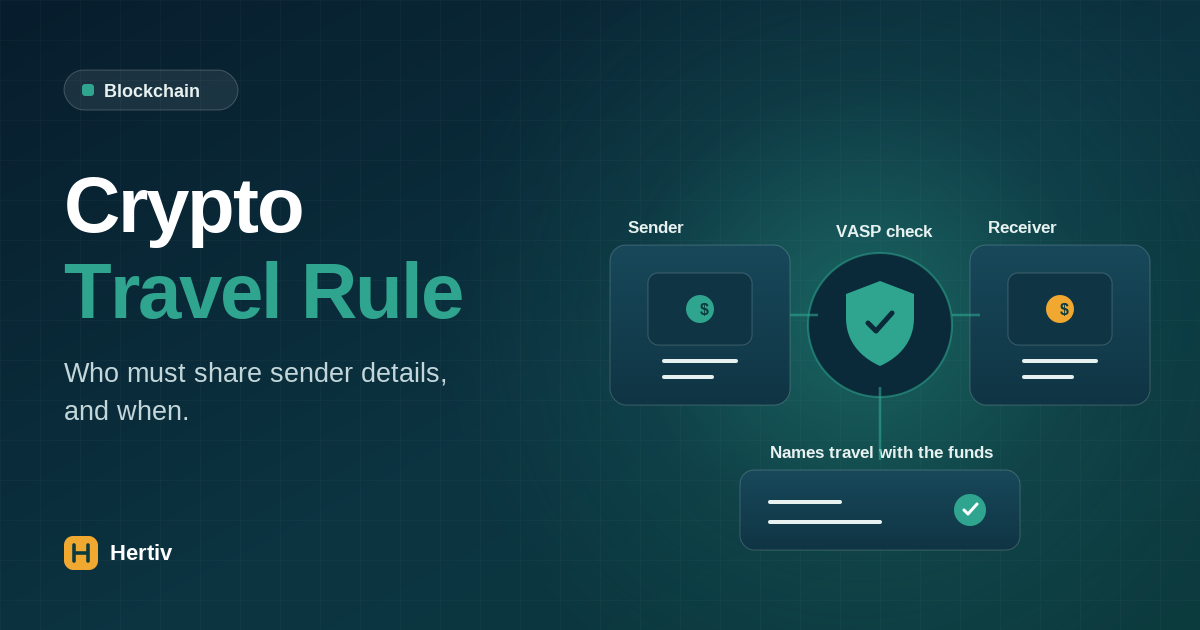
The Travel Rule is a regulation that requires crypto businesses, known as VASPs, to share sender and receiver details when they move digital assets for a customer. It treats a crypto transfer much like a bank wire, so a transfer does not arrive anonymously.
What is the Travel Rule?
The Travel Rule is a regulation that requires crypto businesses to share sender and receiver details when they move digital assets for a customer. It applies to exchanges, custodians and other virtual asset service providers, known as VASPs, and it treats a crypto transfer much like a bank wire.
The rule comes from the Financial Action Task Force, or FATF, which sets global standards against money laundering and terrorist financing. The FATF recommended the rule for crypto in 2019, and countries have since written it into their own laws, each with its own threshold and timetable.
The idea is simple: a transfer should not arrive anonymously. When a customer sends crypto from an exchange to another exchange or to a private wallet, the sending business must pass on who sent it and who is meant to receive it, so the receiving business can check the names against sanctions lists and its own risk rules.
Who has to follow the Travel Rule?
Any business that moves crypto for customers has to follow the Travel Rule in the countries where it operates. That includes centralised exchanges, custodians, brokers, and payment firms that handle digital assets on behalf of customers.
The rule follows the business, not the blockchain. A decentralised protocol with no company behind it has nobody to send the data, which is why regulators focus on the businesses that sit between customers and the chain. A person moving their own crypto between their own wallets is not a VASP and does not have to send Travel Rule data, though the exchange they withdraw from may still ask where the funds are going.
The tricky part is that the rule is not the same everywhere. Countries set their own thresholds, their own deadlines and their own list of which businesses are covered. A company operating in several countries must meet the strictest rule it faces for each transfer, not the loosest.
For teams building in this space, the wider picture is covered in blockchain consulting.
The practical side is covered in crypto payment gateways.
What information must travel with a transfer?
The information that must travel with a transfer is the sender's name and account details, the receiver's name and account details, and enough data to identify both. The exact fields depend on the country, but the shape is the same everywhere.
The table below shows the fields most countries require.
| Field | Sender side | Receiver side |
|---|---|---|
| Name | Full legal name of the sender | Full legal name of the receiver |
| Account | Wallet address or account number | Wallet address or account number |
| Identifier | Date of birth, ID number or address | Date of birth, ID number or address |
| Business | Name of the sending VASP | Name of the receiving VASP |
| Amount | Amount and asset sent | Amount and asset expected |
The threshold decides when the rule applies. In many countries the threshold is 1,000 in local currency, so a transfer above that amount needs the full data set. Below the threshold, countries differ: some still require the data, some require only the names, and some require nothing. The United States uses a higher threshold of 3,000 dollars for its own funds travel rule, which shows why a company cannot assume one number fits everywhere.
Timing matters too. The data should travel with the transfer or be available to the receiving business before the funds are released. A transfer that arrives with no data, or with data that arrives days later, is the problem the rule was written to stop.
How do VASPs comply in practice?
VASPs comply with the Travel Rule by checking the transfer, collecting the data, sending it to the receiving business, and screening both names before releasing the funds. Most of this happens automatically, because a manual check on every transfer would stop the business.
- Check the amount. The system compares the transfer against the threshold in each country involved and decides what data the transfer needs.
- Collect the sender data. The sender's name and account details come from the verified account, not from what the sender types in a free-text box.
- Identify the receiver. The system checks whether the destination is another VASP, a private wallet, or an address on a sanctions list.
- Send the data securely. The data goes to the receiving VASP through an encrypted channel or a shared protocol, not in a plain message.
- Screen and decide. Both names are screened against sanctions and risk lists. A match stops the transfer for review; a clean result releases it.
- Keep the record. The data and the screening result are stored so the business can answer a regulator's question months later.
Several shared protocols exist for sending this data between VASPs, and most exchanges use one of them. The choice of protocol matters less than the discipline: every transfer above the threshold gets its data, every time.
The building side is covered in how to create a cryptocurrency, which explains the token and chain choices a team faces before compliance even starts.
Example (hypothetical): an exchange handles 500 transfers a day
Example (hypothetical): an exchange handles 500 customer transfers a day. About 120 of them are above the local threshold of 1,000, so 120 divided by 500 is 24% of transfers need full Travel Rule data.
A compliance check on each of those takes 2 minutes of staff time when done by hand, so 120 times 2 is 240 minutes, or 4 hours of staff time a day. That is half a working day spent on checks alone, before any review of flagged transfers.
With an automated check, the same 120 transfers take about 5 seconds each, which is 10 minutes a day in total, and the staff only handle the few that get flagged. The numbers are invented to show the arithmetic, not a real exchange.
The point is that the Travel Rule is a volume problem. A small exchange can check transfers by hand, but a growing one must automate the threshold check, the data collection and the screening, or the compliance queue becomes the bottleneck.
What are the common mistakes?
The most common mistakes with the Travel Rule are treating it as one global rule, collecting data that arrives too late, and screening names after the funds are released.
- Assuming one threshold. The threshold differs by country, and the United States uses 3,000 dollars while many others use 1,000. A single global threshold will be wrong somewhere.
- Data that arrives late. If the receiver's data arrives after the funds, the receiving VASP cannot screen before releasing them, which defeats the purpose.
- Screening after release. A sanctions check that runs after the transfer has settled is a record of a mistake, not a control.
- Private wallets ignored. Transfers to private wallets still need the sender's data and a risk check on the destination, even when there is no receiving VASP to send data to.
- No record keeping. If the business cannot show what data it sent and what it screened, it cannot answer a regulator's question later.
Each mistake has the same root: the rule was treated as a form to fill in rather than a control that must run before funds move.
What happens if a transfer arrives without the data?
When a transfer arrives without Travel Rule data, the receiving VASP has to decide whether to accept it, hold it, or send it back. The right answer depends on the amount, the risk of the sender, and the rules in the country where the VASP operates.
Most VASPs hold the funds and ask the sending business for the missing data. If the data arrives and the names are clean, the transfer is released. If the sender cannot or will not provide it, the transfer is usually returned. A VASP that routinely accepts transfers with no data is taking on the sender's risk as its own.
Repeated failures have consequences. A regulator can fine the business, restrict its licence, or require it to stop dealing with the counterparty that keeps sending incomplete transfers. That is why larger VASPs track which counterparties send clean data and which do not, and why they sometimes refuse to deal with the worst offenders.
For a customer, the practical effect is delay. A transfer that should take minutes can take days while the two businesses exchange data, which is why customers should expect questions about large transfers and answer them with the correct details the first time.
Key takeaways
- The Travel Rule comes from the FATF and is written into each country's own law
- It applies to exchanges, custodians and other businesses that move crypto for customers
- Sender and receiver names, accounts and identifiers must travel with the transfer
- Thresholds differ by country, so a company must meet the strictest rule it faces
- Data must arrive in time to screen before funds are released, not after
Frequently asked questions
What is the Travel Rule in crypto?
The Travel Rule is a regulation that requires crypto businesses to share the sender's and receiver's names and account details when they move digital assets for a customer. It comes from the Financial Action Task Force and is written into each country's own law, with its own threshold and timetable.
Who must follow the Travel Rule?
Any business that moves crypto for customers, such as an exchange, a custodian or a broker, must follow it in the countries where it operates. A person moving their own crypto between their own wallets is not covered, though the exchange they use may still ask where the funds are going.
What is the Travel Rule threshold?
The threshold differs by country. In many countries it is 1,000 in local currency, so transfers above that amount need the full data set. The United States uses 3,000 dollars for its own funds travel rule, which is why a company cannot assume one number fits everywhere.
Does the Travel Rule apply to private wallets?
Partly. A transfer to a private wallet still needs the sender's data and a risk check on the destination, even though there is no receiving business to send the data to. The sending exchange must still record the details and screen the destination address.
What happens if Travel Rule data is missing?
The receiving business usually holds the funds and asks the sender for the missing data. If the data arrives and the names are clean, the transfer is released. If it does not arrive, the transfer is usually returned, and repeated failures can bring fines or licence restrictions.
Is the Travel Rule the same as KYC?
No. KYC is about verifying a customer's identity when they open an account. The Travel Rule is about sharing that identity information with the other business involved in a specific transfer, so both sides can screen the names before the funds move.


