Why Tokenized Fractional Ownership Is Growing
Tokenized fractional ownership splits one asset into many small digital shares, so more people can buy in. Here is why it is growing and where it can go wrong.
On this page
Short answer
Tokenized fractional ownership is growing because it lowers the entry cost of expensive assets, lets owners trade small shares, and records every share on a blockchain. A property, fund or artwork is split into tokens, each token stands for a small share, and holders receive their part of the income in proportion to what they own.
What is tokenized fractional ownership?
Tokenized fractional ownership is a way of splitting one asset into many small digital shares, called tokens, so that several people can own a part of it. Each token stands for a fixed share of the asset, and the blockchain records who holds which tokens.
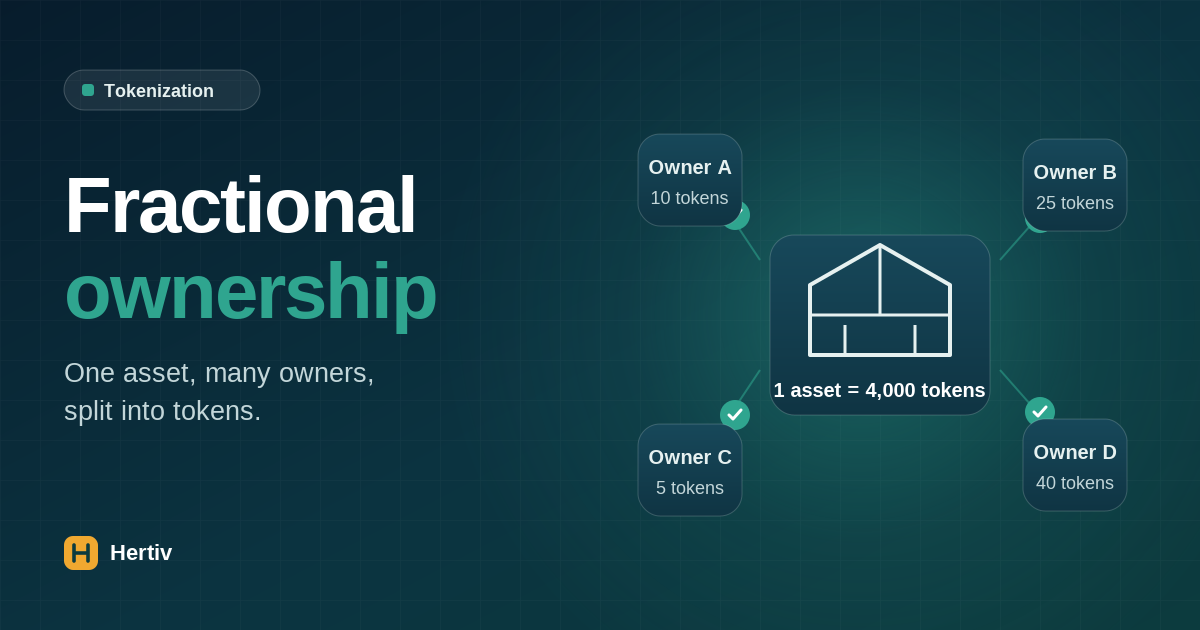
The idea is old. People have shared ownership of property and boats for decades. What is new is the token: a digital record that can be split into tiny pieces, sent in seconds and tracked without a paper register. A $400,000 property can become 4,000 tokens at $100 each, and a buyer with $1,000 can own 10 of them.
| What changes | Before tokenization | With tokenization |
|---|---|---|
| Minimum buy-in | Whole asset or a large share | One token, often a small sum |
| Ownership record | Paper register or a lawyer's file | Tokens on a blockchain |
| Trading a share | Slow, with high legal costs | Token transfer, where allowed |
| Income split | Manual, per owner | Paid in proportion to tokens held |
| Who can buy in | Wealthy buyers and funds | More small buyers, where rules allow |
Tokenized fractional ownership is not the same as owning the asset outright. Token holders usually own a share of the income and value, while a manager or a company holds the asset itself and runs it. Read the token terms before you buy, because they decide what a token actually gives you.
Why is it growing?
It is growing because it lowers the entry cost of assets that were once out of reach. A flat, a fund or a painting that costs hundreds of thousands can be split into shares that a small buyer can afford. That opens the market to people who could never buy the whole asset.
It also makes shares easier to move. Selling a tenth of a property used to mean lawyers, months of paperwork and a buyer for that exact share. A token can move between wallets in minutes, where the law and the platform allow it. That speed is the main reason teams reach for tokens instead of paper shares.
Transparency is the third driver. Every token transfer is recorded on the chain, so the register of owners is always current and easy to check. A buyer can see how many tokens exist and how many are in circulation before deciding.
Finally, it fits how funds already work. A fund holds many assets and sells units to investors; tokenizing those units is a small step from a paper unit to a digital one. RWA tokenization use cases show the same pattern across property, funds and commodities.
How does it work, step by step?
Tokenized fractional ownership follows the same five steps in most projects. The steps are simple to describe, but each one needs legal and technical work behind it.
- Pick and value the asset. The team chooses an asset with a clear value, such as a property, and gets an independent valuation.
- Put it in a legal wrapper. A company or trust holds the asset, so the tokens can stand for shares in that wrapper rather than a direct claim on the bricks.
- Split it into tokens. The team mints a fixed number of tokens, each worth the same share of the wrapper. The total supply is fixed at the start.
- Sell the tokens. Buyers pass identity checks where the law requires them, then buy tokens and hold them in a wallet.
- Pay income and report. Rent or other income is collected, costs are taken out, and the rest is paid to holders in proportion to their tokens.
Every step after the first depends on the legal wrapper. If the wrapper is wrong, the tokens may not give holders the rights they expect, no matter how good the code is. That is why a lawyer reviews the structure before any tokens are sold.
Secondary trading is the step most teams get wrong. A token that can move freely may count as a security in some places, and a token that cannot move at all is hard to sell. Check the rules in each country where buyers live before you promise a market. How tokenization works covers the token side of the process in more detail.
Which assets suit fractional ownership?
Property is the most common fit. A flat or a small commercial building produces rent, has a clear value and can be valued by a surveyor. Splitting it into tokens lets many buyers share the rent without buying the whole building.
Funds are the next fit. A fund already splits its value into units, so turning those units into tokens is a small change. Investors get the same fund, with a digital record instead of a paper statement. How tokenized fund ecosystems work explains that structure in full.
Art, collectibles and music rights also appear, but they are harder. Their value is a matter of taste, they earn no regular income, and a buyer may wait years for a sale. Fractional shares work best where the asset earns steady income and can be valued by a professional.
Commodities such as gold suit the model too, because gold is fungible and easy to price. The token stands for a fixed weight of gold held in a vault, and the holder can redeem it or trade the token. The same idea fails for assets that are hard to store, value or sell.
What are the risks?
The biggest risk is legal. Tokens that act like shares may be treated as securities, and the rules differ by country. A project that sells tokens in a country where it has no licence can be shut down, and holders may be left with tokens they cannot trade.
Liquidity is the second risk. A token is only easy to sell if buyers exist. Many fractional projects have no active market, so a holder who needs cash may wait months for a buyer or accept a low price. Do not assume a token is liquid because it is digital.
Platform risk comes third. If the company that manages the asset fails, token holders depend on the legal wrapper to protect them. A good wrapper keeps the asset separate from the company's own money; a weak one does not. Ask who holds the asset and what happens if the manager disappears.
Valuation risk is easy to miss. A property or artwork is worth what a buyer will pay, not what the last valuation said. If the market falls, token prices fall with it, and small holders have no way to force a sale of the underlying asset.
Example (hypothetical): splitting a $400,000 property
A team buys a flat valued at $400,000 and splits it into 4,000 tokens at $100 each. A buyer with $1,000 buys 10 tokens, which is 10 out of 4,000, or 0.25% of the property. The buyer owns a quarter of one percent, not a room in the flat.
The flat earns $2,000 a month in rent. The buyer's share is 0.25% of $2,000, which is $5 a month. The manager takes a 10% fee on the income, which is $0.50 from the buyer's $5, so the buyer receives $4.50 a month before tax.
Over a year, that is $4.50 times 12, which is $54 on a $1,000 buy-in. That is the income side only; the tokens may also rise or fall in value if the property is revalued or if buyers pay more or less for a token on a market.
The example is made up to show the arithmetic. Real costs include insurance, repairs, empty months and tax, and each of those cuts the payout. A project that quotes only the gross rent is hiding the costs that matter.
Common mistakes
The most common mistake is treating a token like the asset itself. A token is a claim defined by its terms, and those terms may give you income but no vote, no right to use the asset and no right to force a sale. Read the terms, not the marketing page.
- Assuming instant liquidity. A token with no buyers is hard to sell, however digital it is.
- Ignoring the legal wrapper. If the company holding the asset fails, the wrapper decides what holders get.
- Forgetting the fees. Management, custody and platform fees all come out before holders are paid.
- Buying on hype. A famous asset is not a good investment if the token price already includes years of growth.
- Skipping the exit plan. Ask how you sell, who buys, and what happens if nobody does.
Fractional ownership works best as a slow, income-led holding, not a quick trade. Check the asset, the wrapper, the fees and the exit before you buy, and start with an amount you can afford to hold for years. How to tokenize real estate shows the same checks from the project side.
Key takeaways
- Tokenized fractional ownership splits one asset into many small tokens.
- Each token stands for a fixed share of the income and value.
- Lower entry cost, faster transfers and a clear owner register drive growth.
- A legal wrapper holds the asset; the token terms decide holder rights.
- Liquidity, law, platform risk and valuation are the main risks.
- Read the terms and the fees before buying any fractional token.
Frequently asked questions
What is tokenized fractional ownership?
It is a way of splitting one asset, such as a property or fund, into many digital tokens. Each token stands for a small share of the asset, and holders receive income in proportion to the tokens they own.
What can be fractionally owned?
Property and funds are the most common, because they earn income and can be valued. Art, collectibles, music rights and commodities also appear, but they are harder to value and often earn no regular income.
Do token holders own the asset?
Usually not directly. A company or trust holds the asset, and the tokens stand for shares in that wrapper. The token terms decide what holders get, so read them before buying.
Can I sell my tokens?
Only if a market exists and the law allows it. Many fractional projects have no active secondary market, so selling can take time or mean accepting a low price. Check the exit options first.
Is fractional ownership regulated?
It often is. Tokens that act like shares may count as securities, and the rules differ by country. A project needs the right licences where it sells, and buyers may need identity checks.
How is income paid to holders?
Income from the asset is collected, costs and fees are taken out, and the rest is paid to holders in proportion to their tokens. The payout schedule and the fees should be written in the token terms.


