How to Tokenize Real Estate: A Practical Step-by-Step Guide
Tokenizing real estate means issuing blockchain tokens that represent fractional ownership or economic rights in a property. Learn the legal, structural and technical steps.
On this page
Short answer
Real estate tokenization issues blockchain tokens that represent fractional ownership or economic rights in a property or property company. You start with the legal structure and a compliant issuance route, then build the token, the investor onboarding and the transfer rules around it.
What does it mean to tokenize a real estate asset?
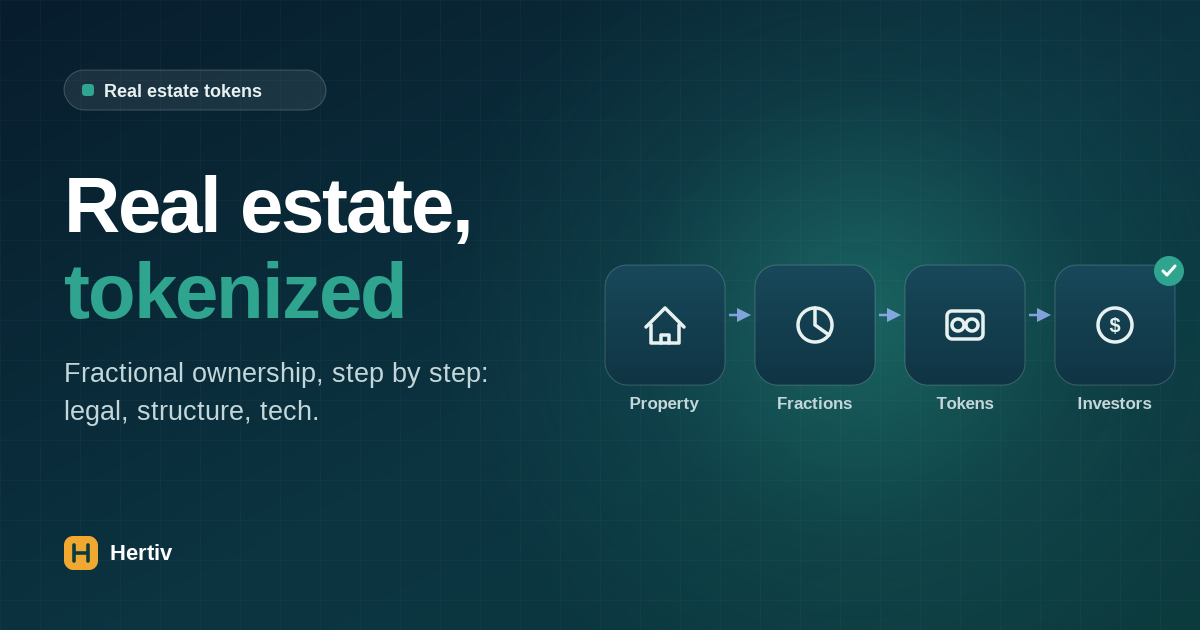
Real estate tokenization is the process of issuing blockchain tokens that give holders defined legal or economic rights over a property, a property-holding company or a property-backed instrument. The token is a record of a right, not the building itself.
The token can represent several different things, and the choice is the most consequential decision in the project:
- Direct fractional title. Each token maps to a share of the property. Legal ownership models for this vary widely by jurisdiction and are not available everywhere.
- Equity in a holding company. The property sits inside a special-purpose vehicle and tokens represent shares in that vehicle. This is the most common structure because company law is well understood.
- Debt or revenue share. Tokens represent a claim on interest or a share of rental income rather than ownership.
- Fund units. Tokens represent units in a closed or open fund that holds several properties.
Each structure changes who can invest, what rights holders have, how transfers work and which regulator is involved. Write this down before any code is produced. For a broader view of how tokenization fits property businesses, see AI and tokenization for real estate.
What legal and regulatory work comes first?
Legal and regulatory design comes before development, because it determines what the smart contract must enforce. In most markets a token with an expected financial return is likely to be treated as a security or a regulated investment, which brings licensing, disclosure and investor-eligibility rules.
The typical sequence is:
- Choose the jurisdiction and the issuing entity. The entity that issues tokens, the entity that holds the property and the entity that operates the platform may be three separate legal persons.
- Classify the token. Get a written opinion on whether it is a security, a fund unit, a utility token or something else in the target markets.
- Set investor eligibility. Define who may hold the token: retail, professional, accredited or qualified investors only. This becomes a whitelist rule in code.
- Define transfer restrictions. Lock-ups, approval by the issuer, maximum holder counts and geographic limits are all enforceable on-chain.
- Agree the disclosure pack. Offering documents, risk statements and reporting obligations must match what the platform promises.
How do you structure the token and the smart contracts?
The token standard and the contract design should follow from the legal structure, not the other way round. A permissioned token with an on-chain allowlist is the normal starting point for property assets.
Key design decisions:
- Standard. Security-token standards on Ethereum-compatible chains and equivalent standards on other networks support transfer restrictions, forced transfers and document references. A plain fungible token with no restrictions is rarely suitable for regulated property offerings.
- Chain choice. Public chains give liquidity and transparency; permissioned enterprise chains give privacy and known participants. Some projects use a public chain with private data stored off-chain and referenced by hash.
- Identity and allowlist. Investor wallets are linked to verified identities through an onboarding service. The contract checks the allowlist on every transfer.
- Corporate actions. Dividends or rental distributions, splits and buybacks need an on-chain mechanism and an off-chain cash process that matches it.
- Upgrade and recovery. Decide how bugs are fixed and how lost keys are handled. This is a governance question as much as a technical one.
Hertiv's real estate tokenization platform development page covers this build in more detail, and blockchain consulting with a straight answer is a useful starting point if the structure is still open.
How does investor onboarding and compliance work in practice?
Onboarding is where most tokenization projects either succeed or stall. The platform must verify identity, check eligibility and connect a verified person to a wallet before that wallet can hold tokens.
The usual flow:
- The investor registers and submits identity documents and proof of eligibility.
- An onboarding provider or compliance team runs know-your-customer and anti-money-laundering checks.
- A wallet address is linked to the verified identity record.
- The allowlist on the token contract is updated, often through an API call from the platform to a signing service.
- Secondary transfers are re-checked: the receiving wallet must also be verified and eligible.
Compliance does not stop at issuance. Ongoing obligations typically include suspicious-activity monitoring, periodic re-verification and reporting to holders. Build the audit trail from day one: every allowlist change, transfer restriction and distribution should be logged with a timestamp and a reason.
What does a worked example look like?
Example (hypothetical, figures for illustration only): a property company wants to raise capital against a single commercial building valued at 4,000,000 in local currency.
- The property is placed in a special-purpose vehicle. The platform issues 40,000 tokens at 100 each, representing the full equity of that vehicle.
- The offering is limited to professional investors in one jurisdiction, with a minimum subscription of 10,000, which means 100 tokens.
- An investor subscribes for 500 tokens and pays 50,000. The cash goes to the issuer's bank account, and the platform confirms settlement before releasing tokens to the investor's verified wallet.
- Rental income after costs is 160,000 for the year. If the issuer distributes all of it, each token receives 4.00, and the investor holding 500 tokens receives 2,000. That is 4% of the 50,000 invested before tax and fees.
- A secondary transfer requires the buyer's wallet to be verified. If the buyer is not on the allowlist, the contract rejects the transfer.
The arithmetic is simple; the hard parts are settlement, record-keeping and the legal paperwork behind each step. None of it requires a public listing, and many first projects never list on an exchange at all.
Which technology components do you actually need?
A tokenization platform is more than a smart contract. Plan for six components and expect the contract to be the smallest part of the build.
- Investor platform. Registration, document upload, eligibility checks, portfolio view and reporting.
- Compliance engine. Identity verification, sanctions screening and ongoing monitoring, integrated through APIs.
- Token contracts. Restricted token, allowlist, distribution and corporate-action logic, with an independent audit before launch.
- Custody. Either a regulated custodian or a key-management setup with defined recovery and approval policies. Institutional investors will ask about this early.
- Cash and settlement. Fiat payment rails, bank reconciliation and a clear record of which cash movement corresponds to which token movement.
- Asset servicing and data. Property valuations, rent collection, expense reporting and the link between off-chain records and on-chain events.
A builder experienced in regulated token issuances will usually recommend buying identity verification and custody rather than building them. Custom development belongs in the parts that are specific to your property business. Enterprise blockchain development is the right starting point for the platform build itself.
How do you choose the right approach and partners?
Choose by matching the structure to your investor base and your regulatory reality, not by chasing the most advanced technical option.
- Start with one asset. A single property or a single closed fund is easier to explain to regulators, auditors and investors than a portfolio.
- Pick the structure that fits existing law. Equity in a holding company is usually the least contested route; direct fractional title depends heavily on jurisdiction.
- Decide whether you need a secondary market. If not, skip exchange integrations and keep transfers issuer-approved. This dramatically reduces scope.
- Separate the platform from the asset. The technology can serve many properties; the legal vehicle should stay asset-specific.
- Get the contract audited. Have the legal documents and the contract reviewed together, so the code enforces exactly what the documents promise.
What are the most common mistakes?
Most failures come from starting with the token and working backwards. These are the patterns worth avoiding.
- Treating tokenization as a legal shortcut. It does not remove securities law, tax or anti-money-laundering duties; it adds a technical layer that must match them.
- Skipping the cash leg. A distribution that exists on-chain but has no matching bank payment creates reconciliation problems and investor complaints.
- Over-engineering the contract. Every added feature increases audit cost and the chance that legal terms and code drift apart.
- Ignoring custody and key recovery. Lost keys and unclear ownership of wallets are common causes of stalled pilots.
- Promising liquidity. Fractional ownership does not guarantee a buyer. Say plainly that transfer may be restricted and markets may not exist.
- Building identity verification in-house. It is regulated, specialised and rarely a differentiator.
For finance-sector context on how these compliance patterns work elsewhere, see AI and blockchain for finance and banking. If you want a second opinion before committing budget, the blockchain development services page lists the engagements Hertiv runs for this kind of work.
Key takeaways
- Decide first whether the token represents direct title, a share in a holding company or a debt claim; the choice drives every later step
- Most first projects tokenize a single property or a closed fund rather than a broad portfolio
- Transfer restrictions and investor whitelisting are usually enforced on-chain, not only in a contract
- Tokenization does not remove securities, tax or anti-money-laundering obligations; it moves them into code
- A working pilot needs custody, a cash leg for distributions and asset servicing, not just a smart contract
- Budget for legal and compliance work before development; that is where most cost sits
Frequently asked questions
Do you need a license to tokenize real estate?
It depends on the jurisdiction and on what the token represents. If the token is a security or fund unit, issuing or marketing it usually requires a licence or an exemption. Get a written legal opinion for each market where you plan to offer tokens before building anything.
Can anyone invest in tokenized property?
No. The issuer sets eligibility rules that reflect local law, often limiting participation to professional or accredited investors. The platform enforces those rules through identity verification and an on-chain allowlist, so ineligible wallets cannot receive tokens.
Is tokenized real estate the same as a REIT?
They are related in economics but different in structure. A REIT is a regulated listed company that owns property; a tokenized property is typically equity in a special-purpose vehicle or a claim on a single asset, with transfers restricted by the issuer.
How are rental incomes paid to token holders?
The issuer collects rent through normal property management, deducts costs, and distributes the remainder according to the token terms. The platform records the distribution on-chain and the cash is paid through the banking system, so the two records must be reconciled.
How long does a tokenization project take?
A single-asset pilot with legal structuring, identity verification, contracts and a distribution typically takes several months, and legal work usually sets the pace. Portfolio-scale platforms with secondary markets take considerably longer.
What does it cost to tokenize a property?
Typical ranges vary widely by jurisdiction, legal structure and platform scope, and legal and compliance work usually accounts for a large share. Treat any quoted figure as an early estimate until the structure and the regulator's position are clear.


