How Tokenized Fund Ecosystems Work: A Guide for Asset Managers
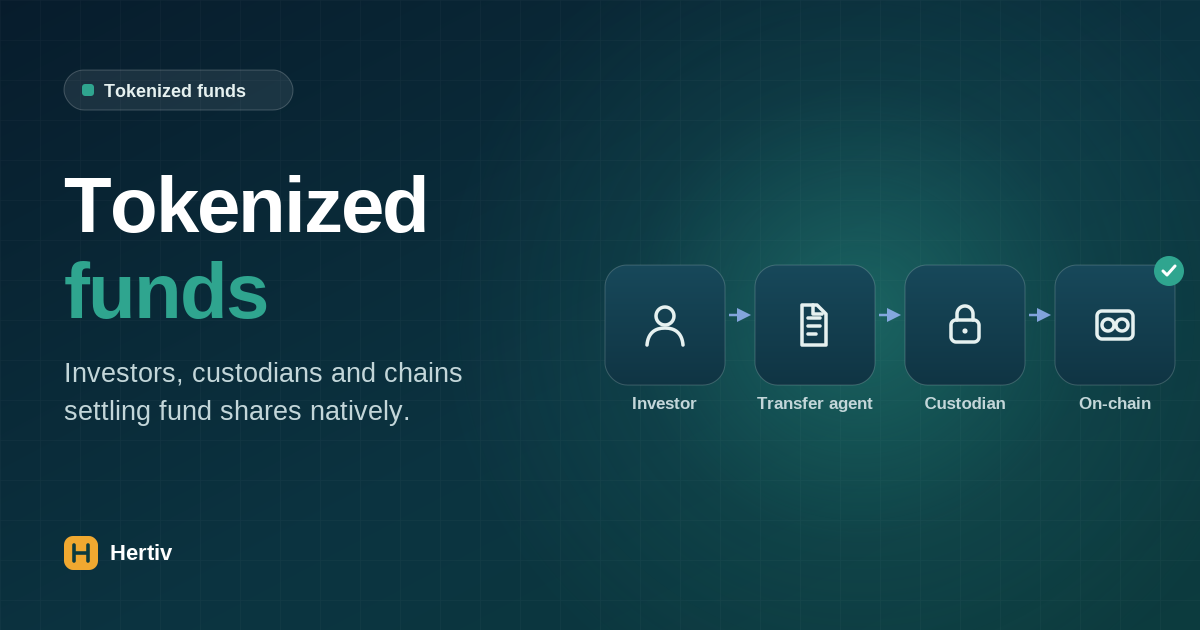
Tokenized fund ecosystems connect investors, transfer agents, custodians and blockchains so fund shares can be issued and settled natively. Here is how they work.
On this page
Short answer
A tokenized fund ecosystem is the network of investors, asset managers, transfer agents, custodians and blockchain infrastructure that issue, trade and settle fund shares as tokens. Each participant plays a defined role, and the ledger replaces manual reconciliation with a shared record of ownership.
What is a tokenized fund ecosystem?
A tokenized fund ecosystem is the full set of participants, systems and rules that let fund shares exist as tokens and move between parties without each institution keeping a separate version of the truth. The token is only one part; the ecosystem is what makes it usable.
At minimum, an ecosystem includes:
- The fund and its asset manager, who define share classes, eligibility and investment policy.
- The transfer agent, who maintains the register of holders and processes subscriptions and redemptions.
- The custodian, who safes the underlying assets and, in many structures, the token itself.
- Distributors and platforms, who bring investors and apply their own onboarding rules.
- The blockchain layer, which records ownership and transfers, either on a public chain or a permissioned network.
- Compliance, audit and reporting functions, which need read access to the same events.
A token on its own does not make an ecosystem. The value appears when a subscription placed on a distributor's platform updates the register, notifies the custodian and produces a reportable event without a chain of emails. That end-to-end flow is the product. Hertiv's fund tokenization work covers this full picture rather than the token alone.
How the main participants connect
Participants connect through two layers: a legal layer of fund documents and service agreements, and a technical layer of APIs, wallets, identity checks and on-chain permissions. A working ecosystem keeps both layers aligned.
A typical flow for a subscription:
- The investor completes onboarding with the distributor, including identity and eligibility checks.
- The distributor submits a subscription instruction to the transfer agent through an API.
- The transfer agent validates the order against the fund's rules and confirms the cash leg with the bank or payment provider.
- Once cash is confirmed, the token contract mints shares to the investor's wallet or to a custodian-held wallet.
- The register, the custodian's records and the compliance dashboard all receive the same event.
Redemptions run the same path in reverse, with the added question of which party burns the token and when. The hard part is rarely the smart contract; it is agreeing who is authoritative for each step and what happens when one system is unavailable. That is why most programmes begin with a written role map before any code.
Public chain or permissioned network: which fits
Neither option is universally right. The choice depends on who your investors are, which regulators you answer to and how much control you need over who can hold the token.
Permissioned networks give you a known set of validators, built-in identity rules and easier alignment with existing custody arrangements. They suit private funds, institutional share classes and jurisdictions where the regulator expects a controlled participant list.
Public chains offer broader distribution, transparent settlement records and a large pool of wallet and custody tooling. They suit tokenized money market products and funds aimed at a wider set of eligible investors, but they require transfer-restriction logic in the token contract and a clear policy on privacy.
A common middle path is a permissioned token with periodic proofs anchored on a public chain, giving auditors and distributors a verifiable record without exposing holder data. Many teams also run a pilot on a test network before committing to either model. Hertiv's enterprise blockchain practice builds both patterns.
The standards that decide whether the ecosystem scales
A tokenized fund scales only if other platforms can read and act on it without custom work for each counterparty. Three standards matter most.
- Token standard and transfer rules. The contract must enforce eligibility, lock-ups and jurisdiction restrictions at transfer time, not only at issuance.
- Identity and permissioning. A shared way to represent verified investors lets a distributor admit an investor once and reuse that check across funds and platforms.
- Data and event reporting. Positions, transactions and corporate actions need a consistent schema so that custodians, administrators and reporting tools can consume them.
Without these, each new distributor becomes a bespoke integration, and the ecosystem stays a set of one-to-one links rather than a network. A useful test is to ask whether a new distributor could connect using published documentation alone. If the answer is no, the standards work is incomplete.
Where tokenization changes the operating model
Tokenization changes settlement timing, reconciliation and the cost of servicing small or frequent orders. It does not remove the fund's legal obligations.
The clearest gains appear in three places:
- Settlement and reconciliation. A shared ledger reduces the number of independent records that must be matched after each trade.
- Access and distribution. A tokenized share class can be offered through platforms that would not build a bespoke feed for a single fund.
- Servicing granularity. Smaller subscriptions and more frequent dealing become practical when processing is programmatic rather than manual.
The cash leg remains the constraint. If subscriptions settle in fiat through a slow banking rail, the token leg can only be as fast as the money. Tokenized cash and stablecoin rails address this in some markets, but they bring their own regulatory questions. Treat speed as an outcome of the whole flow, not a property of the token.
A worked example
Example (hypothetical): a mid-market asset manager tokenizes one share class of a money market fund for a set of eligible institutional investors.
The ecosystem has four participants: the manager, a transfer agent, a custodian and two distributor platforms. In the first phase, subscriptions and redemptions are processed daily. The transfer agent receives orders through an API, validates eligibility against the fund's rules and instructs the token contract to mint or burn.
The custodian confirms the cash leg before any token movement. Positions are reported to the distributors each morning from the same event log.
After two quarters of stable operation, the manager adds a second share class and a third distributor. Because identity checks and reporting follow a shared schema, the new distributor connects in weeks rather than months. The measurable outcome is fewer reconciliation breaks and a shorter dealing cycle; the token itself is not the benefit.
The sequencing, not the technology, is what made the second phase cheaper than the first.
Common mistakes
Most failed tokenized fund programmes fail on operating model, not on technology. The patterns repeat.
- Treating the token as the project. The token is a small part of the work; the integration and governance are the bulk.
- Skipping the cash leg. A fast token settlement wrapped around a slow cash rail creates new exceptions rather than removing old ones.
- Building custom links for every distributor. Without shared standards, each connection becomes a permanent maintenance cost.
- Ignoring transfer restrictions until launch. Eligibility rules enforced only at onboarding fail when a token is transferred later.
- Leaving the transfer agent out of the design. The register is the legal record; if it is updated as an afterthought, reconciliation breaks increase.
- No plan for a chain migration. Contracts and data may need to move; design for export from day one.
How to plan your first ecosystem
Start narrow, prove the full flow end to end, then widen the network.
- Pick one share class and one investor segment. Limit variables so the operating model can be tested.
- Map roles and authority. Write down who is authoritative for orders, cash confirmation, the register and token movement.
- Choose the chain model against your regulatory context. Document why permissioned or public fits, and what would change the answer.
- Define standards before integrations. Data schema, identity representation and transfer rules should be agreed with at least one counterparty.
- Run a pilot with real but limited volume. Measure reconciliation breaks and dealing time, not transaction counts.
- Expand only when operations are stable. Add distributors and share classes once the first flow runs without manual intervention.
If you are weighing this against your current operating model, Hertiv's blockchain consulting starts with a straight answer on whether tokenization fits your fund and timeline.
Key takeaways
- A tokenized fund ecosystem is a network of roles, not just a smart contract: issuer, transfer agent, custodian, distributor, blockchain and auditors must all interoperate.
- The token is a representation of a share class; legal ownership, subscription rules and redemption rights still come from the fund documents and local regulation.
- Permissioned and public chains can both work; most production setups use permissioned access for the token while anchoring proofs on a public chain.
- Cash legs matter as much as token legs: settlement fails when subscriptions and redemptions cannot move money on the same rail.
- Standards for identity, transfer restrictions and data reporting decide whether a tokenized fund can be distributed beyond one platform.
- Start with one share class and a defined investor segment, then expand the ecosystem only when reconciliation and compliance flows are stable.
Frequently asked questions
Do tokenized funds need a transfer agent?
In most regulated structures, yes. The transfer agent maintains the legal register of holders and processes subscriptions and redemptions. Tokenization changes how orders and records move, but the register remains the authoritative record that auditors and regulators rely on.
Can a tokenized fund run on a public blockchain?
Yes, provided the token contract enforces eligibility and transfer restrictions, and privacy is handled through permissioned access or off-chain data. Public chains suit wider distribution; permissioned networks suit institutional share classes. Many programmes combine both.
What is the difference between a tokenized fund and a tokenized share class?
A tokenized fund usually refers to the whole structure, including its legal wrapper, service providers and token infrastructure. A tokenized share class is a specific class of shares represented as tokens. Most programmes begin with one tokenized share class.
How long does it take to launch a tokenized fund ecosystem?
Timelines vary widely by jurisdiction, fund structure and the number of counterparties. A narrow pilot with one share class and one distributor is typically faster than a multi-platform launch, because legal review, integration and operating model design each take time.
Does tokenization remove the need for a custodian?
No. The custodian still safes the underlying assets and, in many structures, holds the tokens. Tokenization changes how ownership is recorded and transferred, not who is responsible for safekeeping the fund's assets.
How do investors redeem tokenized fund shares?
Redemption follows the fund's dealing rules. The investor submits an instruction through a distributor or platform, the transfer agent validates it, the token contract burns the shares and the cash leg settles through the banking or payment rail. The order of these steps should be documented in advance.


