Stablecoin Rails for Crypto Exchanges: How They Work
Stablecoin rails let crypto exchanges move dollars in and out as tokens, so deposits, withdrawals and settlements clear in minutes instead of days.
On this page
Short answer
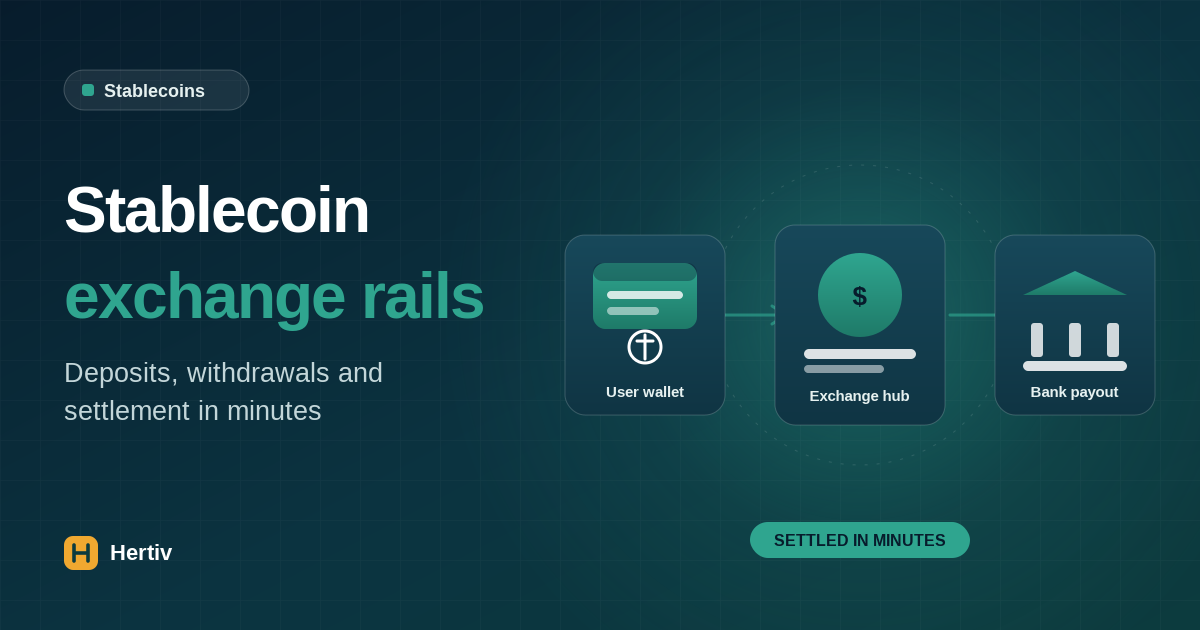
Stablecoin rails for crypto exchanges are the systems that move stablecoins between users, exchanges and banks, so a deposit, a withdrawal or a settlement clears in minutes. They combine on-chain transfers, internal exchange ledgers, liquidity providers and fiat payment rails, and they are how an exchange turns a token balance into spendable money and back again.
What are stablecoin rails for crypto exchanges?
Stablecoin rails for crypto exchanges are the routes that carry stablecoins into, out of and between exchanges. A stablecoin is a token designed to hold a steady value, usually one US dollar, and the rails are the software and partnerships that move it from a user's wallet to an exchange, from one exchange to another, or from an exchange to a bank account.
Think of them as the payment plumbing behind the trading screen. When a user deposits USDT to buy bitcoin, the rails receive the tokens, credit the account and confirm the deposit. When the same user sells and withdraws USDC, the rails send the tokens to the user's wallet or convert them to bank money. The trading engine matches orders; the rails move the money.
An exchange needs more than one rail. Deposits arrive on several chains, withdrawals leave on several chains, and large customers settle in bulk. A single rail that fails or slows down can block withdrawals, so exchanges run several in parallel and switch between them when one is congested or costly.
If you are new to the tokens themselves, start with what a stablecoin is before choosing how to move one.
How do exchanges use stablecoin rails?
Exchanges use stablecoin rails for deposits, withdrawals, inter-exchange settlement and payouts to partners. The table below shows the four main flows and what each one needs.
| Flow | What happens | What it needs |
|---|---|---|
| Deposit | User sends stablecoins to the exchange | Wallet addresses, chain confirmations, credit to account |
| Withdrawal | Exchange sends stablecoins to the user's wallet | Hot wallet balance, network fee, address checks |
| Inter-exchange settlement | Exchange moves stablecoins to another venue | Liquidity, bridge or direct transfer, reconciliation |
| Fiat payout | Stablecoins convert to bank money | Bank partner, off-ramp, compliance checks |
Deposits are the simplest flow, but they still need care. The exchange must watch the right chains, wait for enough confirmations, and credit the account only after the deposit is final. A deposit credited too early can be reversed by a chain reorganisation, which is rare on large chains but costly when it happens.
Withdrawals are where the rails earn their keep. Users expect them fast, so the exchange keeps enough stablecoins in a hot wallet to cover normal demand, and it batches small withdrawals into fewer on-chain transactions to keep fees down. Large withdrawals go through extra checks and may be sent from cold storage, which takes longer.
What rails move stablecoins between exchanges?
Stablecoins move between exchanges on-chain, through internal ledgers, through bridges, or through a bank. The rail chosen depends on speed, cost and how much is moving.
- On-chain transfer. The exchange sends tokens directly on the chain where they live. This is the default for most transfers, and the cost is the network fee plus the time to confirm.
- Internal ledger. Two accounts on the same exchange settle by updating balances, with no chain transaction at all. This is instant and free, but it only works inside one exchange.
- Cross-chain bridge. Tokens move from one chain to another by locking them on the first chain and releasing them on the second. Bridges add risk, because they hold funds on two chains, so large amounts are usually split into smaller steps.
- Liquidity provider. A market maker holds stablecoins on several exchanges and settles the net amounts later. This is how exchanges move large sums without moving tokens on chain for every trade.
- Fiat rail. Stablecoins are sold to a bank partner and the money moves by bank transfer. This is the slowest rail, but it is the one that connects crypto to the banking system.
Most exchanges use several of these at once. A user withdrawal goes on-chain, a trade between two accounts on the same exchange settles on the internal ledger, and a large settlement with a partner goes through a liquidity provider. For the swap side of moving between stablecoins, see stablecoin swap rails.
What does it cost to run stablecoin rails?
Running stablecoin rails costs network fees, liquidity costs, banking fees and compliance work. The table below shows where the money goes.
| Cost | What it is | How exchanges control it |
|---|---|---|
| Network fees | Fee per on-chain transaction | Batch withdrawals, use low-fee chains |
| Liquidity costs | Spread paid to market makers | Hold balances on several venues |
| Banking fees | Charges for fiat on- and off-ramps | Negotiate volume rates, use several banks |
| Compliance | Screening, reporting, audits | Automate checks, keep records |
| Operations | Staff, monitoring, incident response | Alerts, runbooks, on-call cover |
Network fees are the most visible cost and the easiest to cut. An exchange that sends 20,000 withdrawals a month as separate transactions pays 20,000 fees. The same withdrawals batched ten to a transaction pay 2,000 fees, which is why batching is standard practice. The trade-off is time: a batched withdrawal waits for the batch to fill, so urgent withdrawals are sent alone.
Compliance is the cost that grows fastest. Every deposit and withdrawal must be screened, large movements reported, and records kept for years. An exchange that treats compliance as an afterthought will pay for it later, in fines or in lost banking partners. For the wider picture of business payments with these tokens, see stablecoins in B2B payments.
What are the risks, and how do exchanges control them?
The risks of stablecoin rails are a depeg, a bridge failure, a hot-wallet theft and a lost banking partner. Each one needs a control, because a rail failure can stop withdrawals, which is the fastest way for an exchange to lose trust.
- Depeg. A stablecoin can lose its peg to the dollar. Exchanges limit exposure by holding several stablecoins and by pausing deposits of one that is slipping.
- Bridge failure. A bridge that is attacked or halted can strand funds. Exchanges use bridges with audits and track records, and they move large amounts in smaller steps.
- Hot-wallet theft. The hot wallet holds the funds for fast withdrawals, so it is a target. Exchanges cap its balance, use multi-signature approval and keep the bulk of funds in cold storage.
- Lost banking partner. A bank can end the relationship, which cuts the fiat rail. Exchanges keep more than one banking partner and more than one fiat route.
- Wrong chain or address. A user can send tokens on the wrong chain or to the wrong address. Exchanges show the chain clearly, warn before sending, and run address checks on withdrawals.
The pattern is the same for each risk: limit the exposure, keep a second route, and make the failure visible fast. An exchange that learns about a rail problem from its users has already lost the trust it was trying to protect.
Example (hypothetical): an exchange cuts withdrawal costs
Example (hypothetical): an exchange processes 20,000 USDT withdrawals a month, and each withdrawal is sent as its own on-chain transaction. The network fee is $1 per transaction, so the exchange pays 20,000 times $1, which is $20,000 a month in network fees.
The exchange starts batching withdrawals, sending ten withdrawals in each transaction. The number of transactions falls from 20,000 to 2,000, and the fee falls to 2,000 times $1, which is $2,000 a month. The saving is $20,000 minus $2,000, which is $18,000 a month, or $216,000 a year.
Batching has a cost of its own: a withdrawal now waits for its batch to fill, which adds up to an hour of delay. The exchange handles this by sending urgent withdrawals alone and batching the rest. Users who pay for priority get speed, and the exchange still saves most of the fee.
The exchange also keeps a second rail ready. If the chain it uses becomes congested and fees spike, it can switch withdrawals to another chain where the same stablecoin is available, rather than passing a sudden fee rise to its users.
What are the common mistakes?
The most common mistakes with stablecoin rails are running a single rail, ignoring the fiat route, and treating compliance as a later problem.
- Running a single rail. One chain, one bank and one liquidity provider is a single point of failure. Keep a second route for every flow that matters.
- Ignoring the fiat route. Tokens are only useful if they can become bank money. An exchange without a working off-ramp will strand its users' funds.
- Treating compliance as later. Screening and record-keeping are part of the rails, not an add-on. Building them in late costs more than building them in at the start.
- Crediting deposits too early. A deposit credited before it is final can be reversed. Wait for enough confirmations, even if users ask for speed.
- Holding too much in the hot wallet. A large hot wallet is a large target. Cap it at normal demand and move the rest to cold storage.
Key takeaways
- Stablecoin rails move tokens between users, exchanges and banks so deposits and withdrawals clear in minutes
- Exchanges use on-chain transfers, internal ledgers, bridges, liquidity providers and fiat rails together
- Batching withdrawals is the easiest way to cut network fees, and urgent withdrawals can still go alone
- The main risks are a depeg, a bridge failure, a hot-wallet theft and a lost banking partner
- Compliance and record-keeping are part of the rails, not an add-on to build later
Frequently asked questions
What are stablecoin rails for crypto exchanges?
They are the systems that move stablecoins between users, exchanges and banks, so a deposit, a withdrawal or a settlement clears in minutes. They combine on-chain transfers, internal exchange ledgers, liquidity providers and fiat payment rails.
How do exchanges move stablecoins between venues?
They use on-chain transfers, cross-chain bridges, liquidity providers that settle net amounts later, or a fiat rail through a bank partner. The choice depends on speed, cost and how much is moving, and most exchanges use several rails at once.
Why do exchanges batch withdrawals?
Because each on-chain transaction carries a network fee. Sending ten withdrawals in one transaction pays one fee instead of ten, which can cut monthly network costs by most of the total. Urgent withdrawals are sent alone so they are not delayed.
What happens if a stablecoin loses its peg?
Its value falls below one dollar, so exchanges limit exposure by holding several stablecoins and pausing deposits of the one that is slipping. A depeg is a reason to keep more than one stablecoin in the treasury, not a reason to stop using them.
How do stablecoin rails connect to banks?
Through a fiat off-ramp: the exchange sells stablecoins to a bank partner and the money moves by bank transfer. Without a working off-ramp, users cannot turn token balances into bank money, which is why exchanges keep more than one banking partner.
What is the difference between stablecoin rails and swap rails?
Swap rails convert one stablecoin into another, such as USDT into USDC. Stablecoin rails for exchanges cover the wider job: deposits, withdrawals, settlement between venues and conversion into bank money, of which swapping is only one step.


