What Are Stablecoin Swap Rails and How Do They Work?
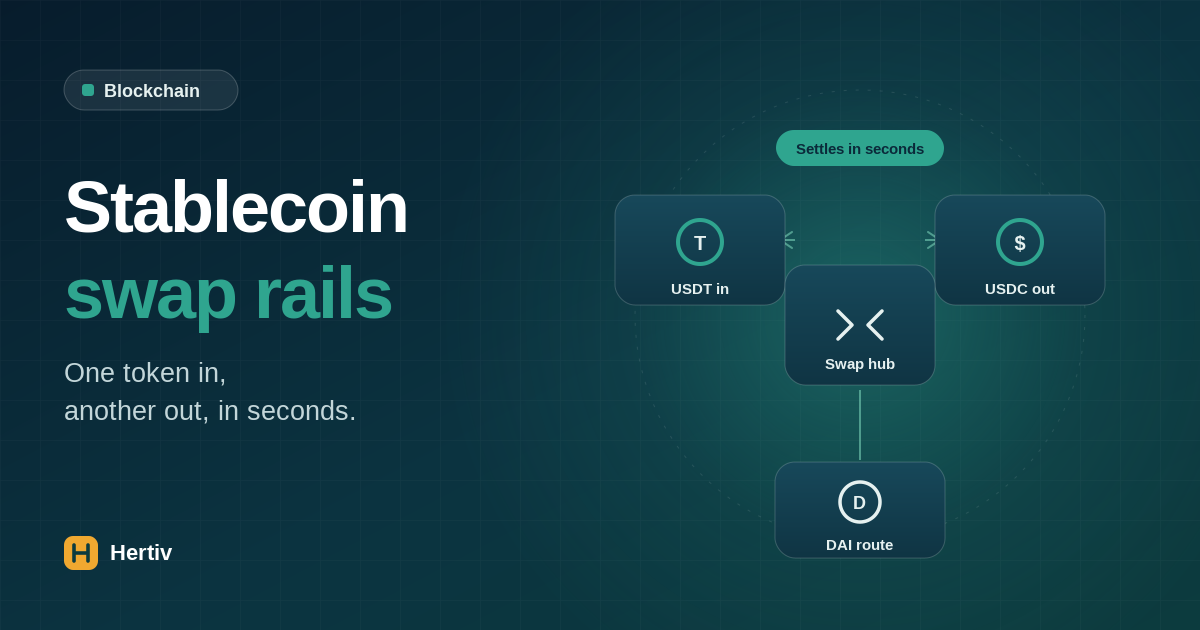
Stablecoin swap rails are the on-chain routes that convert one stablecoin into another. They run on exchanges, aggregators and bridges, and they settle in seconds.
On this page
Short answer
Stablecoin swap rails are the on-chain systems that convert one stablecoin into another, for example USDT into USDC or USDC into DAI. They include decentralised exchanges, swap aggregators, order-book exchanges, over-the-counter desks and cross-chain bridges. A swap usually settles in seconds, and the cost is the trading fee plus any price slippage and the network fee.
What are stablecoin swap rails?
Stablecoin swap rails are the routes that move value from one stablecoin to another without going through a bank. A stablecoin is a token designed to hold a steady value, usually one US dollar, and swap rails are the markets and services that exchange one such token for another.
Think of them as the pipes between stablecoins. A business that is paid in USDT but pays its suppliers in USDC needs a rail that converts the first into the second. A trader who wants to move funds from Ethereum to Solana needs a rail that swaps and bridges at the same time. The rails are the software that finds the price, executes the trade and settles it on chain.
Swap rails matter because stablecoins are not one currency. USDT, USDC and DAI are all meant to be worth a dollar, but they live on different chains, are issued by different companies and are accepted by different partners. A business that holds the wrong one for its next payment needs a way to change it quickly and cheaply.
If you are new to the tokens themselves, start with what a stablecoin is before choosing a rail.
How does a stablecoin swap work?
A stablecoin swap works by matching your trade against liquidity: a pool of tokens held by a market, or an order book of buyers and sellers. The steps are the same on most rails, even though the software differs.
- Quote. You ask for a price to convert a set amount, for example 10,000 USDT into USDC. The rail shows the rate, the fee and the expected amount you will receive.
- Route. The rail finds the best path. It may swap directly in one pool, or split the trade across two pools, or move it through an intermediate token when no direct pool exists.
- Approve and sign. You approve the rail to move your tokens and sign the transaction with your wallet. On some rails the approval and the swap are one step.
- Execute. The smart contract or the exchange takes your tokens, takes the other tokens from the pool or the order book, and sends them to your wallet.
- Settle. The trade is final once the transaction is confirmed on chain. On most chains that takes seconds; on a cross-chain swap it can take minutes while the bridge confirms both sides.
For small swaps between two large stablecoins on the same chain, the price you get is usually within a fraction of a percent of one dollar per token. The difference grows when the amount is large, the pool is small, or the swap crosses chains.
What kinds of swap rails are there?
There are five main kinds of stablecoin swap rails, and each one fits a different size and speed of trade. The table below compares them.
| Rail | How it works | Best for |
|---|---|---|
| Automated market maker | Trade against a token pool priced by a formula | Small to mid-size swaps on one chain |
| Swap aggregator | Splits a trade across several pools for the best price | Getting the best rate without checking each pool |
| Order-book exchange | Match against buy and sell orders from other traders | Large swaps with tight pricing |
| Over-the-counter desk | A dealer quotes a fixed price for a large trade | Very large swaps that would move a pool price |
| Cross-chain bridge | Lock tokens on one chain and mint or release them on another | Moving stablecoins between chains |
Most businesses use an aggregator for day-to-day swaps and an over-the-counter desk for large ones. An aggregator saves time by checking the pools for you, while a desk protects a large trade from moving the price against you. Bridges are the riskiest rail, because they depend on code that holds funds on two chains at once, so they deserve a separate security review.
What does a stablecoin swap cost?
A stablecoin swap costs three things: a trading fee, price slippage, and a network fee. The trading fee is the most visible part, and it is usually a small share of the trade, often between 0.05% and 0.3% on a decentralised exchange. Centralised exchanges and desks set their own fees, so check the rate before you trade.
Slippage is the gap between the quoted price and the price you actually get. It grows when the trade is large relative to the pool, because taking tokens out of a pool moves its price. A swap of $1,000 in a deep pool may slip by a few cents; a swap of $1,000,000 in a shallow pool can slip by thousands of dollars.
Aggregators reduce slippage by splitting the trade, and most rails let you set a maximum slippage so the trade fails rather than executing at a bad price.
The network fee is the cost of writing the transaction to the chain. It is small on low-fee chains and can be large on busy ones, so the cheapest rail on paper is not always the cheapest once the network fee is added. For a full view of how businesses pay with these tokens, see stablecoins in B2B payments.
How do businesses use stablecoin swap rails?
Businesses use stablecoin swap rails to pay suppliers, convert incoming payments and manage cash across chains. The pattern is the same in each case: the business receives one stablecoin and needs another, or it holds tokens on one chain and needs them on another.
A common use is supplier payments. A company is paid in USDT by its customers but its supplier only accepts USDC, so it swaps the incoming USDT before paying the invoice. The swap replaces a bank transfer and a currency conversion, and it settles the same day instead of taking two or three working days.
Another use is treasury management. A company that holds stablecoins on several chains swaps them onto one chain before moving them to a custodian or an exchange, so its reporting and its tax records stay simple.
A third use is payroll and contractor payments, where the company swaps into the stablecoin each recipient prefers. In each case the rail is a tool for moving value between the tokens a business holds and the tokens its partners accept. For the wider picture of token swaps in DeFi, see DeFi token swap trends.
Example (hypothetical): a supplier payment in two stablecoins
Example (hypothetical): a 40-person exporter is paid $50,000 in USDT on Ethereum and must pay a supplier $50,000 in USDC on the same chain. The exporter swaps the USDT for USDC through an aggregator instead of sending a bank wire.
The swap costs three things. The aggregator charges a 0.1% trading fee, which is $50 on $50,000. Slippage on the deep USDT to USDC pool is 0.05%, which is $25. The network fee to confirm the transaction is $2. The total cost is $50 plus $25 plus $2, which is $77, and the exporter receives $49,923 in USDC.
The supplier is paid the same day, and the exporter's books show a $77 conversion cost. A bank wire would have cost a $45 fee and taken two working days, and it would still have needed a currency conversion if the supplier's bank settled in a different currency. The swap is not free, but its cost is visible before the trade and its settlement is fast.
What are the common mistakes?
The most common mistakes with stablecoin swap rails are ignoring slippage, trusting a bridge without checking it, and swapping into a token your partner does not accept.
- Ignoring slippage. A quoted price is not the price you get on a large trade. Set a maximum slippage and check the expected amount before signing.
- Trusting any bridge. Bridges hold funds on two chains and have been a target for attacks. Use a bridge with an audit and a track record, and move large amounts in smaller steps.
- Swapping into the wrong token. Not every partner accepts every stablecoin. Confirm which token and which chain your supplier wants before you swap.
- Forgetting the network fee. A cheap trading fee can be wiped out by a high network fee. Add all three costs together before comparing rails.
- No record of the trade. Swaps are taxable events in many places. Keep the rate, the fee and the time of every swap, or the bookkeeping will be painful later.
Key takeaways
- Stablecoin swap rails convert one stablecoin into another without a bank
- The cost is a trading fee plus slippage and a network fee, and slippage grows with trade size
- Aggregators suit day-to-day swaps; over-the-counter desks suit very large ones
- Always confirm which token and chain your partner accepts before you swap
- Keep the rate, fee and time of every swap for your books
Frequently asked questions
What are stablecoin swap rails?
They are the on-chain systems that convert one stablecoin into another, such as USDT into USDC. They include decentralised exchanges, swap aggregators, order-book exchanges, over-the-counter desks and cross-chain bridges, and a swap usually settles in seconds.
How much does a stablecoin swap cost?
A swap costs a trading fee, price slippage and a network fee. On a deep pool the trading fee is often 0.05% to 0.3%, slippage is small for small trades and grows with trade size, and the network fee depends on the chain you use.
What is slippage in a stablecoin swap?
Slippage is the gap between the quoted price and the price you actually get. It grows when the trade is large relative to the pool, because taking tokens out moves the price. Most rails let you set a maximum slippage so the trade fails instead of executing at a bad price.
Are stablecoin swaps faster than bank transfers?
Usually, yes. A swap on one chain settles in seconds and a cross-chain swap in minutes, while an international bank wire often takes two or three working days. The trade-off is that you take on price and smart contract risk instead of bank risk.
Do I need a bridge to swap stablecoins?
Only when the swap crosses chains. A swap between two tokens on the same chain uses a pool or an exchange and needs no bridge. A bridge is needed when the tokens live on different chains, and it deserves a separate security check.
Can a business use stablecoin swaps for payroll?
Yes. Some businesses swap into the stablecoin each contractor prefers before paying them. The key is to confirm the token and chain each person accepts, and to keep a record of every swap for tax and accounting.


