How to Use Stablecoins for B2B Payments
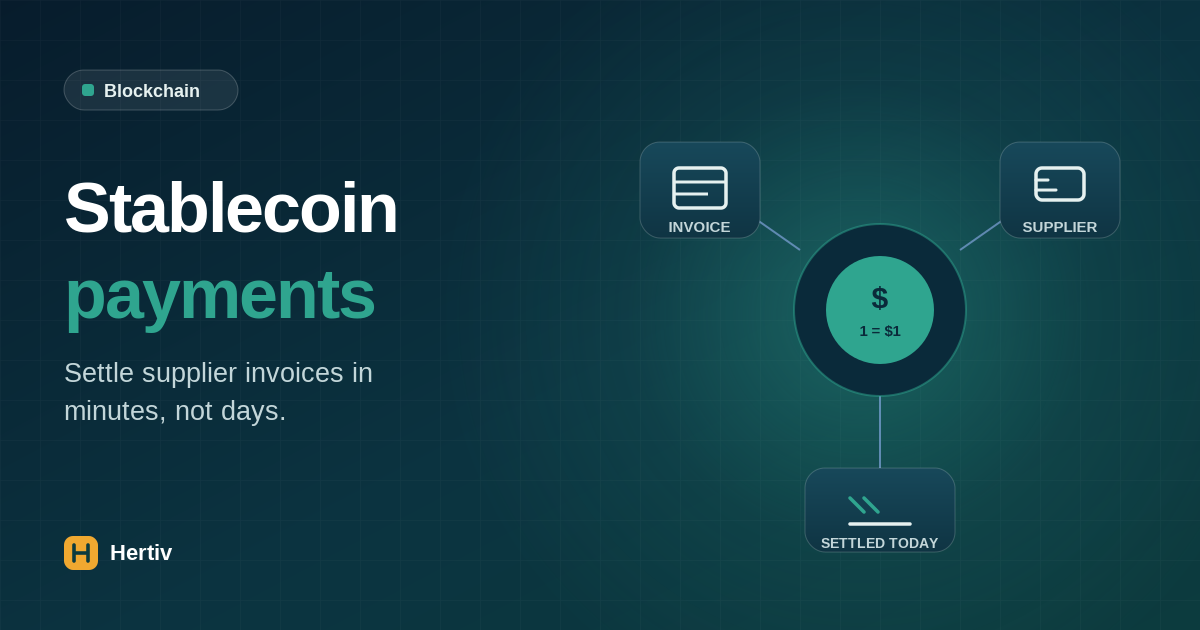
Stablecoins can settle supplier invoices in minutes instead of days. Here is how the payment flows, which rails to choose, and how to keep the books straight.
On this page
Short answer
To use stablecoins for B2B payments, agree the invoice and the stablecoin with the supplier, screen the counterparty and confirm the wallet address through a second channel, fund a company wallet, send the payment with two approvals for large amounts, and reconcile it against the invoice with the conversion rate recorded. Start with one widely used dollar stablecoin and a small supplier before scaling.
What does it mean to pay a business with stablecoins?
Paying a business with stablecoins means settling an invoice, a supplier bill or a salary in a digital token that is designed to hold a steady value, usually one token to one dollar. The payment moves on a blockchain from the payer's wallet to the payee's wallet, without a bank or card network in the middle.
The stablecoin itself is the key difference from paying in a volatile cryptocurrency. A dollar-pegged stablecoin keeps its value while the payment is in flight, so both sides know what the invoice is worth when it settles. The most common choices are tokens backed by cash and short-term government debt, held by the issuer.
For a business, the appeal is speed and reach. A cross-border payment that takes days through banks can settle in minutes on chain, and it can reach a supplier in a country where the payer has no banking relationship. The trade-off is that the business takes on new work: custody, compliance checks and accounting for a new kind of payment.
Stablecoin payments are not a replacement for every business payment. They fit cross-border supplier payments, freelancer payouts and treasury moves between a company's own accounts. They fit less well where the payee insists on local currency or where the amounts are small and local rails are already instant. Stablecoin payments for business covers the costs and compliance side in more depth.
Why do businesses use stablecoins for B2B payments?
Businesses use stablecoins for B2B payments because they settle fast, cost less than correspondent banking on many routes, and run outside banking hours. A supplier invoice paid on a Friday evening can settle before Monday, which matters when the goods are already on a ship.
Speed is the most common reason. Traditional cross-border payments pass through several banks, each adding time and a fee, and each able to hold the payment for checks. A stablecoin payment moves directly between wallets, so the delay is the time the chain needs to confirm the transfer.
Cost is the second reason. Bank wires, currency conversion and intermediary fees add up on large invoices, and the final cost is often unclear until the money arrives. A stablecoin payment has a visible network fee and a visible conversion rate, so the finance team can price the payment before sending it.
Reach is the third. A business can pay a supplier in a country where it has no bank account, as long as the supplier has a wallet and the payment complies with the rules in both countries. That does not remove the compliance work, but it removes the need for a banking relationship in every market.
How does a stablecoin B2B payment flow work?
A stablecoin B2B payment follows the same steps as a bank payment, but the money moves on chain and the checks happen before the transfer, not after it.
- Agree the invoice. The supplier issues an invoice in a fiat currency, and both sides agree to settle it in a named stablecoin at an agreed rate and date.
- Check the counterparty. The payer screens the supplier against sanctions and fraud lists, and confirms the wallet address belongs to the supplier, usually through a verified channel rather than an email alone.
- Fund the wallet. The payer buys or holds enough stablecoins in a company wallet, keeping a small buffer for network fees.
- Send the payment. The payer signs the transfer, ideally with two approvals for large amounts, and the chain confirms it within minutes.
- Confirm and reconcile. The supplier confirms receipt, and both sides match the payment to the invoice in their accounting systems.
- Convert if needed. If the supplier wants local currency, it converts the stablecoins through an exchange or an off-ramp, and records the conversion rate for its books.
The step teams most often skip is the address check. A payment sent to the wrong address on chain cannot be reversed, so confirming the address through a second channel is worth the extra minute.
Which stablecoin and payment rails should you choose?
The choice of stablecoin and rails decides how much trust you place in the issuer, how fast the payment settles, and what it costs. There is no single best choice; the right one depends on the route, the amount and the payee.
| Option | Strength | Watch out for |
|---|---|---|
| Large dollar stablecoin | Widely accepted, deep liquidity | Issuer and reserve risk |
| Regulated stablecoin | Clearer legal status, audited reserves | May be unavailable in some regions |
| Euro stablecoin | No dollar conversion for euro invoices | Thinner liquidity than dollar tokens |
| Payment processor | Handles wallets, checks and conversion | Processor fees and limits |
| Direct wallet transfer | Lowest fees, full control | Your team owns custody and checks |
| Bank-linked off-ramp | Payee receives local currency | Conversion spread and settlement delay |
Most teams start with one large dollar stablecoin on one chain, and a payment processor that handles the compliance checks and the off-ramp. That keeps the first payments simple while the finance team learns the workflow. A stablecoin payment provider can handle the rails while your team keeps control of approvals.
Example (hypothetical): a company pays three suppliers in stablecoins
Example (hypothetical): a company in Singapore owes three suppliers $40,000, $25,000 and $15,000, a total of $80,000, for components that have already shipped. The usual bank route takes three working days and costs about $45 per wire plus a conversion spread.
The finance team agrees with each supplier to settle in a dollar stablecoin at one token to one dollar. It buys 80,000 tokens, keeps a $200 buffer for network fees, and sends three payments on a Friday afternoon. Each transfer confirms within minutes, and all three suppliers confirm receipt the same day.
The network fees come to $12 in total, against $135 for three bank wires, a saving of $123. The bigger gain is time: the suppliers release the next shipment on Monday instead of waiting until the following Wednesday, which keeps the production line running.
One supplier converts the tokens to local currency through an off-ramp at a 0.4% spread, which costs $100 on a $25,000 payment. The finance team records the conversion rate and the fee against the invoice, so the books match the bank route it replaced.
How do accounting, tax and compliance work?
Accounting, tax and compliance are where stablecoin B2B payments differ most from bank payments, and they are the reason many teams start small. The payment is fast, but the paperwork still has to be right.
For accounting, record the invoice in fiat, the stablecoin amount, the conversion rate at the time of payment, and any fees. If the rate moves between the invoice date and the payment date, the difference is a gain or loss that belongs on the books. Keep the transaction hash with the invoice so an auditor can trace the payment on chain.
For tax, the rules depend on the country. In many places a stablecoin payment is treated like a payment in foreign currency, which means gains and losses on conversion are taxable events. Ask your accountant before the first payment, not after the year ends.
For compliance, screen the counterparty, keep records of the checks, and set approval limits so no single person can send a large payment alone. Sanctions rules apply to stablecoin payments just as they do to bank wires, and the fact that the payment is on chain does not remove the obligation. What a stablecoin is explains how the token holds its value and what backs it.
What are the common mistakes?
The most common mistakes with stablecoin B2B payments are skipping the address check, ignoring the off-ramp cost, and treating the payment as settled before the accounting is done.
- Sending to an unverified address. A payment to the wrong address cannot be reversed. Confirm the address through a second channel and send a small test payment first for a new supplier.
- Forgetting the off-ramp. If the supplier converts to local currency, the spread and the delay are part of the real cost. Price the whole route, not just the on-chain leg.
- One person approving large payments. Two approvals for amounts above a threshold is a simple control that stops both mistakes and fraud.
- No record of the rate. Without the conversion rate at payment time, the accounts will not reconcile and the tax return will be guesswork.
- Using a thin stablecoin. A token with low liquidity can be hard to buy or sell at the quoted price. Stick to widely used tokens for supplier payments.
Key takeaways
- A dollar-pegged stablecoin keeps its value while the payment is in flight, so both sides know what the invoice is worth
- The main gains are settlement in minutes, visible fees and reach into markets where you have no bank
- Confirm the wallet address through a second channel and send a test payment to a new supplier first
- Price the whole route, including the supplier's off-ramp spread, not just the on-chain leg
- Record the conversion rate, fees and transaction hash with the invoice for accounting and audit
Frequently asked questions
Are stablecoin B2B payments legal?
In most countries, yes, but the rules vary. Sanctions screening, anti-money-laundering checks and tax reporting still apply, just as they do for bank wires. Check the rules in both the payer's and the payee's country before the first payment, and keep records of every check.
Which stablecoin is best for B2B payments?
Most teams start with a large, widely used dollar-pegged stablecoin because it is accepted by the most suppliers and exchanges. Regulated stablecoins can be a better fit where legal clarity matters, and euro stablecoins suit euro-denominated invoices. Liquidity and acceptance matter more than small fee differences.
Can a stablecoin payment be reversed?
No. Once a transfer is confirmed on chain it cannot be undone, which is why the address check matters so much. If you send to the wrong address, recovery depends on the recipient returning the funds. Always confirm the address and send a small test payment to a new supplier.
How do I account for a stablecoin payment?
Record the invoice in fiat, the stablecoin amount, the conversion rate at payment time, and all fees. Keep the transaction hash with the invoice so an auditor can trace it. If the rate moved between invoice and payment, record the difference as a gain or loss.
What does a stablecoin B2B payment cost?
The network fee is usually a few dollars or less, far below a bank wire on most routes. The real cost is the whole route: buying the stablecoin, the network fee, and the supplier's conversion spread if it converts to local currency. Add those up before comparing with the bank route.
Do suppliers actually accept stablecoins?
More do each year, especially suppliers that already trade internationally and suppliers in markets with slow banking. Many still prefer local currency, so agree the arrangement before the invoice is due and offer the off-ramp option so the supplier is not forced to hold tokens.


