Stablecoin Payroll Platforms in the UK and EU: How They Work
Stablecoin payroll platforms pay staff in USDC or USDT while tax and employment stay in fiat. Here is how they work under MiCA in the EU and FCA rules in the UK.
On this page
Short answer
A stablecoin payroll platform lets a UK or EU employer pay staff or contractors in a stablecoin such as USDC, while wages are still calculated, taxed and reported in local currency. The platform converts net pay to stablecoins, sends it to the worker's wallet, and keeps payroll records. In the EU, MiCA governs the stablecoins used; in the UK, FCA rules published in June 2026 apply from October 2027.
What is a stablecoin payroll platform?
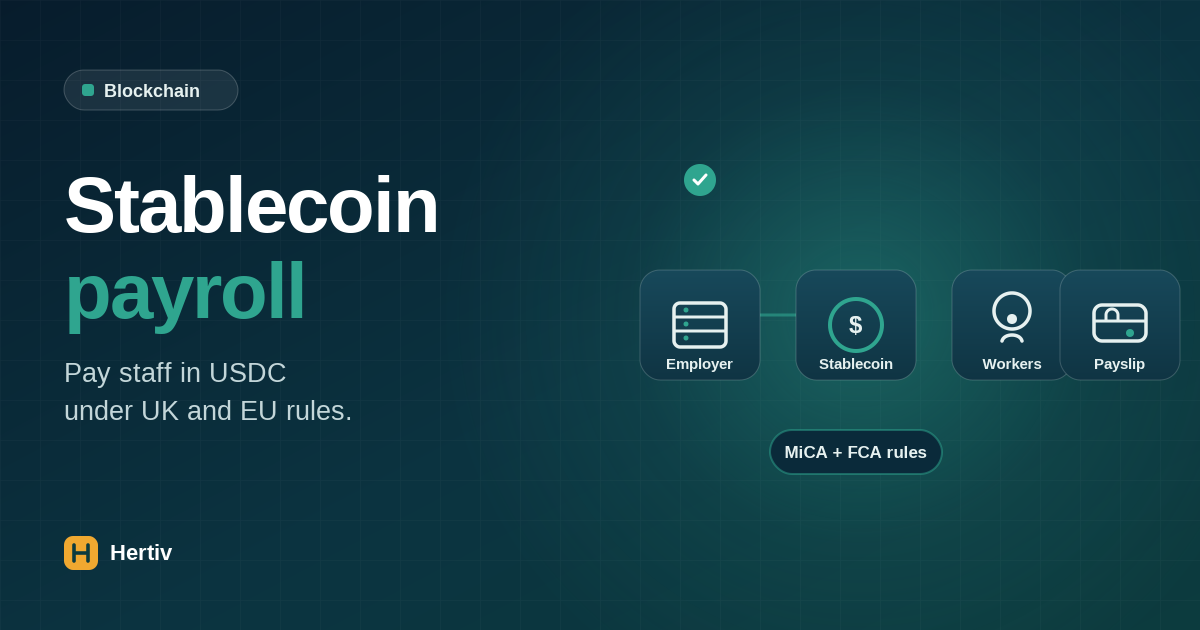
A stablecoin payroll platform is a service that pays workers in a stablecoin, usually USDC or USDT, instead of or alongside a bank transfer. The employer funds payroll in fiat or stablecoins, the platform calculates net pay after tax and deductions, and the worker receives the stablecoin in a wallet they control.
The important point is that the stablecoin is only the delivery rail. Gross pay is still set in pounds or euros, tax is still withheld in fiat, and the payslip still shows the local currency amounts.
What changes is how the net pay travels from the employer to the worker, which can be faster and cheaper than a cross-border bank transfer, especially for contractors in countries with slow banking. For the wider picture of business stablecoin use, see stablecoins for B2B payments.
Platforms come in four shapes:
| Model | How it works | Who it fits |
|---|---|---|
| Native payroll platform | Stablecoin pay is the core product | Crypto-native teams paying globally |
| Employer of record with crypto payout | Employer hires through the platform, worker chooses stablecoin pay | Companies hiring abroad without a local entity |
| Mainstream payroll with crypto withdrawal | Employer pays in fiat, worker converts part of net pay | Teams that want crypto as an option, not the default |
| Treasury tool plus payroll export | Payroll software exports amounts, treasury sends stablecoins | Finance teams that already run their own payroll |
Most teams start with one model and switch later. A small remote team may start with a native platform, then move to an employer of record once it hires full-time staff abroad. The payroll logic stays the same; only the legal wrapper changes.
How does a stablecoin payroll run work?
A stablecoin payroll run follows the same steps as a normal payroll run, with a conversion and a wallet transfer added at the end. The employer sets pay in local currency, the platform works out tax and deductions, and then the net amount is converted and sent.
A workable sequence:
- Set gross pay in local currency. The contract states pay in pounds or euros, so tax and employment rights stay clear.
- Run payroll as usual. The platform or the employer's payroll software calculates tax, social charges and deductions.
- Fund the run. The employer sends fiat by bank transfer or stablecoins from its treasury to the platform.
- Convert net pay. The platform converts the net amount to the chosen stablecoin at the agreed rate.
- Send to wallets. Each worker receives the stablecoin in their wallet, usually on a low-fee network such as Arbitrum or Base.
- Record and report. The platform issues payslips and tax records in local currency, as any payroll system would.
Workers usually choose how much of their pay arrives as stablecoin and how much as fiat. A common split is most of the pay in fiat to a bank account, with a share in stablecoins for saving or spending online. The split can change each pay cycle, which suits contractors whose costs vary month to month.
What are the rules in the EU?
In the EU, stablecoin payroll runs under MiCA, the Markets in Crypto-Assets Regulation, Regulation (EU) 2023/1114. The stablecoin rules have applied since 30 June 2024, and they decide which stablecoins a payroll platform can use and how those coins must be backed.
MiCA splits stablecoins into two types. E-money tokens track a single official currency, such as the euro or the dollar, and may only be issued by a credit institution or an e-money institution. Asset-referenced tokens track a basket of assets or currencies and face their own authorisation rules. In both cases the issuer must hold reserves, publish a white paper and let holders redeem at par value.
For payroll, three MiCA points matter most. First, the stablecoin used must be a compliant e-money token or asset-referenced token, not an unregulated coin. Second, issuers may not pay interest on e-money tokens, so a payroll balance does not earn a return by itself. Third, a platform that holds or transfers stablecoins for customers is providing crypto-asset services and needs authorisation under MiCA. What a stablecoin is explains the token types in more detail.
One practical effect is already visible: regulated EU platforms have stopped offering stablecoins that do not meet MiCA, so a payroll platform operating in the EU will usually pay in euro-pegged coins or in MiCA-compliant dollar coins. Ask any platform which coins it uses and why before you sign up.
What are the rules in the UK?
In the UK, stablecoin payroll is moving into a new regime built under the Financial Services and Markets Act. The Treasury brought cryptoasset activities, including stablecoins, inside the FCA's perimeter with the FSMA (Cryptoassets) Regulations 2026, and the FCA published its final rules and guidance on 30 June 2026.
The full regime applies to firms authorised under FSMA on or after 25 October 2027, which gives platforms a runway to prepare. The rules cover stablecoin issuance, backing assets held in trust, redemption rights and the capital firms must hold. A payroll platform that issues or custodies stablecoins for UK workers will need to fit inside that regime once it bites.
Until then, UK payroll in stablecoins still has to respect existing law. Wages must be paid in a lawful way, tax must be withheld through PAYE, and the employer stays responsible for employment rights whatever rail the money travels on. A stablecoin does not change whether someone is an employee or a contractor, and it does not change the tax due.
For the tax and treasury side of paying in stablecoins, see stablecoin treasury and settlement.
The UK and EU regimes are close in spirit but different in detail, so a platform that serves both regions must handle two rulebooks. That is one reason many UK and EU teams pick a platform that already operates across both, rather than building their own flow.
Which type of platform fits which team?
The right platform depends on whether you pay employees or contractors, how many countries you cover, and who owns tax compliance. A platform that handles tax and employment for you costs more than one that only moves money, but it also carries more of the risk.
The platforms employers actually use fall into a few groups:
| Question | European Union | United Kingdom |
|---|---|---|
| Main rulebook | MiCA, Regulation (EU) 2023/1114 | FSMA cryptoasset regime, FCA rules |
| Stablecoin rules in force | 30 June 2024 | Final FCA rules published 30 June 2026, applying from 25 October 2027 |
| Who can issue a stablecoin | Credit institution or e-money institution | Authorised issuer under the new regime |
| Backing | Reserves held 1:1, redemption at par | Backing assets held in trust, redemption rights set by FCA rules |
| Interest on holdings | Issuers may not pay interest on e-money tokens | Interest treatment set by FCA rules |
Bitwage has run crypto payroll since 2014 and works as an add-on to an employer's existing payroll, so withholding stays with the employer's payroll provider.
Rise launched in April 2022 with stablecoin payroll as its core product and combines contractor payments with an employer of record service.
Deel, the largest contractor platform, opened stablecoin salary payouts to its employer of record and global payroll employees in the US and 25 Eurozone countries in June 2026. Remote pays contractors in USDC to wallets on supported networks. Each takes a different slice of the problem, so compare them on tax cover and country reach, not only on the coins they pay.
When you compare platforms, ask five questions: which stablecoins and networks are supported, who calculates and files tax, whether workers can split pay between fiat and stablecoin, what happens if a payment fails or a wallet address is wrong, and what the pricing is. Pricing varies by plan and by worker type, so check the vendor's own pricing page rather than trusting a roundup. Stablecoin rails for exchanges shows how the underlying transfers work.
Example (hypothetical): paying five contractors across the EU
Example (hypothetical): a small UK company pays five contractors in three EU countries, each on 2,000 euros a month. The finance lead wants to know whether stablecoin pay saves anything against international bank transfers.
First, the monthly total: 5 contractors times 2,000 euros is 10,000 euros a month, or 120,000 euros a year. Bank transfers to three countries cost 15 euros each, so 5 times 15 is 75 euros a month in transfer fees, or 900 euros a year.
With a stablecoin payroll platform, the same five payments travel on a low-fee network at 2 euros each, so 5 times 2 is 10 euros a month, or 120 euros a year. The saving on transfer fees is 75 minus 10, which is 65 euros a month, or 780 euros a year.
That saving is real but small next to the payroll total, and it is not the whole story. The platform charges its own fee, which the team must add back.
The finance lead still pays for tax filing in three countries. The bigger gain is speed: the contractors receive pay the same day instead of waiting two or three days for a bank transfer, which matters more to them than the 65 euros a month it saves the company.
What are the common mistakes?
The most common stablecoin payroll mistakes are treating the stablecoin as the salary itself, skipping tax advice, and picking a platform on price alone. Each one creates risk that a cheaper fee cannot fix.
- Denominating pay in stablecoins. Set pay in pounds or euros in the contract, so tax, holiday pay and notice periods stay clear. The stablecoin is the rail, not the salary.
- Skipping tax advice. Crypto pay still triggers payroll tax, social charges and reporting in the worker's country. Get advice before the first run, not after.
- Using a non-compliant stablecoin. In the EU, the coin must meet MiCA. Ask the platform which coins it uses and why.
- Paying to an unchecked wallet address. A mistyped address can send pay to a stranger. Confirm each address with the worker and test with a small amount first.
- Ignoring the worker's choice. Some workers want fiat only. Stablecoin pay should be an option the worker picks, not a condition of the job.
One last check: confirm the platform holds the right permissions for your countries before you move anyone onto it. A platform that works in the US may not be authorised in the EU or the UK, and the employer's duties do not move to the platform. Stablecoin payment infrastructure is a good starting point if you want to build rather than buy.
Key takeaways
- Stablecoin payroll changes how net pay travels, not how pay is calculated
- In the EU, MiCA has governed stablecoins since 30 June 2024
- In the UK, FCA final rules were published in June 2026 and apply from October 2027
- Set pay in local currency and let workers choose the stablecoin share
- Check tax cover and country reach before comparing fees
Frequently asked questions
Can an employer pay a full salary in stablecoins?
In most cases no, or not sensibly. Pay should be set and taxed in local currency, with the stablecoin used only to deliver net pay. Some contractors take all of their pay in stablecoins, but employees usually take at least part in fiat for rent, tax and everyday costs.
Do workers pay tax on stablecoin salary?
Yes. Tax is calculated on the local currency value of the pay, and the employer or the platform withholds it through the normal payroll process. Receiving pay in a stablecoin does not reduce the tax due, and the worker may also need to report the receipt.
Which stablecoins do payroll platforms use?
Most platforms pay in USDC or USDT, and some offer euro-pegged coins for EU workers. In the EU, the coin should be MiCA-compliant, so ask the platform which coins it uses and on which networks before you choose.
Is stablecoin payroll legal in the UK?
Paying workers in stablecoins is not banned, but the employer must still meet wage, tax and employment law, and the platform must fit the FCA regime once it applies from October 2027. Get advice from an employment lawyer before the first payroll run.
What happens if a stablecoin loses its peg?
A stablecoin is designed to hold its value against a fiat currency, but a de-peg is possible. Platforms usually convert and send quickly so workers hold the coin only briefly, and workers can convert to fiat at once. The risk is one reason pay is set in fiat.
How much does stablecoin payroll cost?
Pricing varies by platform, worker type and country, and most vendors charge per worker per month or per payout. Check the vendor's own pricing page for current figures, and compare the full cost including tax filing, not only the transfer fee.


