Stablecoin Payment Rails: How They Work
Stablecoin payment rails move dollar-pegged tokens between wallets, businesses and banks in minutes. Here is how settlement, ramps and fees work.
On this page
Short answer
Stablecoin payment rails are the systems that move stablecoins, tokens pegged to a currency such as the US dollar, from a sender to a receiver and settle the payment. They combine a blockchain for settlement, wallets for holding funds, and fiat on-ramps and off-ramps for converting to and from bank money. A payment usually settles in minutes and costs a small network fee.
What are stablecoin payment rails?
Stablecoin payment rails are the infrastructure that carries stablecoin payments from one party to another and records the transfer as final. A rail is not one product: it is the combination of a blockchain network, the wallets or accounts at each end, and the services that convert between stablecoins and bank money.
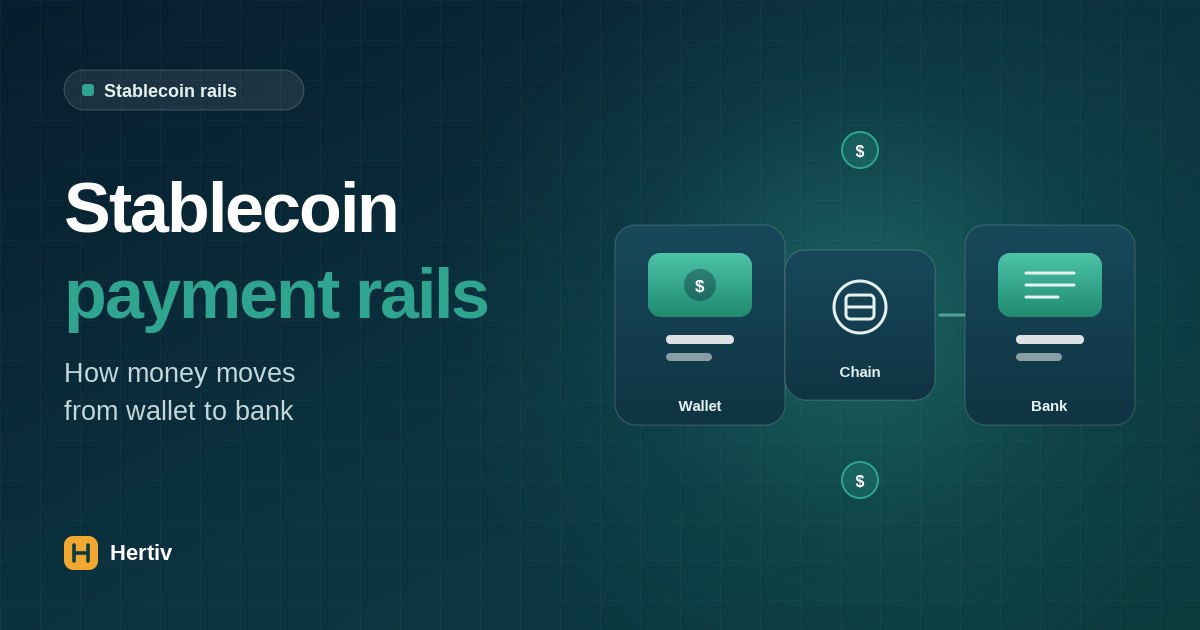
Think of a rail as the route money travels. A card payment travels over a card network, a bank transfer over a banking network, and a stablecoin payment over a blockchain plus the services around it. The blockchain records the transfer, while wallets, exchanges and payment processors handle the steps before and after.
Businesses use these rails to pay suppliers, receive customer payments and move funds between countries. Individuals use them to send money to family or to pay for services online. In each case the stablecoin keeps its peg to a fiat currency, so the amount sent is the amount that arrives, minus fees. If the basics are new, start with what a stablecoin is before reading on.
How does a stablecoin payment move?
A stablecoin payment moves through a short chain of steps, and each step has a party responsible for it. The sender starts the payment, the blockchain settles it, and the receiver's service turns it into usable money.
- Fund the wallet. The sender buys or receives stablecoins into a wallet, usually through an exchange or a payment provider.
- Start the transfer. The sender enters the receiver's wallet address and the amount, and confirms the payment in the wallet.
- Settle on the chain. The blockchain checks the sender has the funds, records the transfer, and confirms it within seconds or minutes.
- Credit the receiver. The receiver's wallet or payment service shows the funds and may convert them to local currency.
- Withdraw if needed. The receiver moves the money to a bank account through an off-ramp, or keeps it in stablecoins for the next payment.
Settlement time depends on the chain. Some chains confirm in seconds, others take a few minutes. The receiver can see the payment as soon as the chain confirms it, and most payment services wait for a small number of confirmations before crediting the account.
What are the main types of stablecoin rails?
Stablecoin rails come in several forms, and each one fits a different kind of payment. The table below sets out the main types, how they move money, and where each one works best.
| Rail | How it moves money | Best for | Watch out |
|---|---|---|---|
| On-chain transfer | Wallet to wallet on a blockchain | Direct payments between known parties | Wrong network can lose funds |
| Exchange rails | Internal ledger inside an exchange | Fast transfers between exchange users | Funds sit with the exchange |
| Card and bank rails | Stablecoins converted to card or bank payments | Paying merchants who take fiat only | Conversion fees and bank delays |
| Bridge rails | Stablecoins moved between blockchains | Reaching apps on another chain | Bridges add risk and fees |
Most businesses use more than one rail. A company might receive stablecoins on-chain, hold them with an exchange, and pay suppliers through a card rail. The rails that swap one stablecoin for another are a separate piece of the picture; see how stablecoin swap rails work for that part.
How do fiat on-ramps and off-ramps work?
An on-ramp turns bank money into stablecoins, and an off-ramp turns stablecoins back into bank money. Exchanges, payment processors and some banks run these ramps, and they check identity before they move money.
The ramp is usually the slowest and most expensive part of the journey. A transfer between wallets can settle in minutes, while a withdrawal to a bank account can take hours or until the next business day, depending on the bank and the country involved.
Ramps also set the rules for who can use the rail. A business that pays suppliers in another country needs a ramp that supports that currency and that region, and it needs to pass the provider's identity and compliance checks before the first payment goes out.
What do stablecoin rails cost?
Stablecoin rails do not have one price. The total cost is made of several small charges, and each one goes to a different party. The table below lists the charges to look for.
| Cost | What it covers | How it is charged |
|---|---|---|
| Network fee | Paying the chain to record the transfer | Small flat fee, varies with congestion |
| Ramp fee | Converting between bank money and stablecoins | Percentage or flat fee set by the provider |
| Spread | Difference between buy and sell price | Small on liquid pairs, wider on thin ones |
| Service fee | The payment processor's own charge | Often a percentage of the payment |
Fees add up across a payment, so compare the full cost, not one line. A rail with no network fee can still be expensive if the ramp charges a wide spread, and a cheap ramp can still be slow if the bank leg takes a day. For business-to-business use, see how stablecoins work in B2B payments.
Example (hypothetical): paying a supplier abroad
Example (hypothetical): a small design studio in the UK pays a supplier in the Philippines $2,000 for a month of work. The studio buys $2,000 of a dollar-pegged stablecoin through its payment provider, paying a ramp fee of 0.5%, which is $10. The transfer itself costs a network fee of $1.50.
The supplier receives $2,000 in stablecoins within minutes and converts it to pesos through a local off-ramp charging 0.8%, which is $16. The total cost is $10 + $1.50 + $16 = $27.50, and the supplier has the money the same day. A bank wire for the same payment would have cost a flat fee plus a currency spread, and taken two to three business days.
What are the common mistakes?
The most common mistakes with stablecoin payment rails are sending on the wrong network, ignoring the off-ramp cost, and trusting a provider without checking it first.
- Sending on the wrong network. The same stablecoin exists on many chains, and a payment sent on a chain the receiver does not support can be lost.
- Forgetting the off-ramp cost. The transfer fee is only part of the price; conversion to bank money is often the larger charge.
- Treating a stablecoin as a bank balance. A stablecoin is only as sound as its issuer and its reserves, so check both before holding a large balance.
- Skipping identity checks. Ramps need identity documents, and a payment can be held up if the checks are not done in advance.
- Holding large balances on an exchange. Funds on an exchange belong to the exchange until withdrawn, so move working balances out regularly.
Key takeaways
- Stablecoin payment rails combine a blockchain, wallets and fiat ramps into one route for money
- Settlement usually takes minutes, but the bank leg can take hours or a day
- The full cost is network fee plus ramp fee plus spread, not one line item
- Sending on the wrong network or to an unsupported address can lose the payment
- Check the provider's licences, reserves and payout times before moving real money
Frequently asked questions
Is a stablecoin payment rail the same as a blockchain?
No. A blockchain is the settlement layer that records the transfer, while a payment rail is the whole route: the chain, the wallets at each end, and the ramps that convert to and from bank money. One chain can support many rails, and one rail can use several chains.
How long does a stablecoin payment take?
A transfer between wallets usually settles in seconds or minutes, depending on the chain. The full journey takes longer when a bank is involved, because withdrawals to a bank account can take hours or until the next business day.
Do I need a bank account to use stablecoin rails?
No, you can hold and send stablecoins with only a wallet. You need a bank account only when you want to convert stablecoins into fiat money, or to buy stablecoins with bank money in the first place.
What happens if I send stablecoins to the wrong address?
In most cases the payment cannot be reversed, because blockchain transfers are final once confirmed. If the address belongs to an exchange or a payment provider, contact its support team; if it is an unknown wallet, the funds are usually lost.
Are stablecoin payments reversible?
No. Once a blockchain confirms a stablecoin transfer, it cannot be undone by the sender. This is why test payments and careful address checks matter, and why businesses use approval rules for large transfers.
Which stablecoin should a business use for payments?
Choose by liquidity, how openly the issuer reports its reserves, and which chains and ramps support it. A stablecoin that is easy to buy, send and convert in your markets is worth more than one with a slightly lower fee. Check the issuer's own pages for current details.


