What Is a Stablecoin Payment Gateway and How Does It Work?
A stablecoin payment gateway lets a business accept stablecoins and settle in coins or fiat. Here is how it works, what it costs and what to check first.
On this page
Short answer
A stablecoin payment gateway is a service that lets a business accept stablecoins such as USDT or USDC and settle in coins or in fiat currency. It handles the wallet, the exchange rate, the blockchain confirmation and the payout, so the merchant needs no crypto infrastructure of its own.
What is a stablecoin payment gateway?
A stablecoin payment gateway is a service that accepts stablecoin payments for a business and settles them in coins or in fiat currency. A stablecoin is a token designed to hold a steady value, usually one token to one dollar, so the price a customer sees is the price the merchant receives.
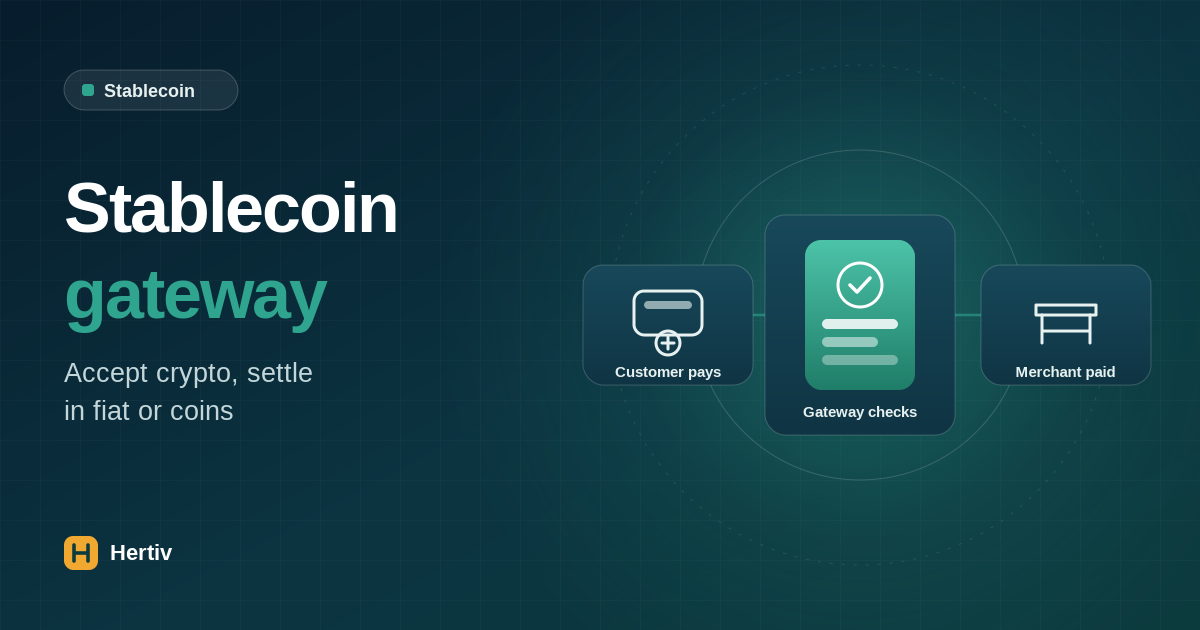
The gateway does the work the merchant would otherwise have to build: it shows a payment address or QR code, watches the blockchain for the payment, confirms it, converts it if needed, and pays the merchant. Some gateways pay out in the same stablecoin; others convert to fiat and send it to a bank account.
It differs from a crypto exchange. An exchange is where a person buys and sells coins. A gateway is where a business takes payment. It also differs from a wallet, which only holds coins; a gateway adds invoicing, refunds, reporting and settlement.
Businesses use gateways for online shops, subscriptions, invoices and cross-border payments, anywhere a card payment is slow or expensive. See what a stablecoin is for the token itself before choosing a gateway.
How does a stablecoin payment work?
A stablecoin payment follows six steps, and the gateway handles most of them. The customer sees a price, the gateway creates a payment request, the customer sends the coins, the blockchain confirms it, and the merchant gets paid.
- The merchant raises an invoice. The gateway creates a payment request with an amount, a coin and a wallet address, usually shown as a QR code at checkout.
- The customer sends the stablecoins. The customer pays from a wallet or an exchange account, on the chain the gateway supports.
- The gateway watches the chain. It waits for enough confirmations to be sure the payment cannot be reversed.
- The payment is matched. The gateway matches the payment to the invoice by amount and address, and marks the order as paid.
- Conversion happens if needed. If the merchant wants fiat, the gateway converts the coins at the quoted rate.
- Settlement lands. The merchant receives coins in a wallet or fiat in a bank account, on the schedule the gateway offers.
The whole flow usually takes minutes, not days. That is the main reason businesses look at stablecoins for cross-border payments, where a bank wire can take two or three working days.
What features should a gateway have?
A gateway should cover the coins, chains and payout options a merchant actually needs, and it should handle refunds and reporting without manual work. The table below lists the features to check.
| Feature | What to check | Why it matters |
|---|---|---|
| Coins and chains | USDT, USDC and the chains you trade on | Customers pay on the chain they already use |
| Settlement choice | Coins, fiat, or a split of both | You choose when to hold coins and when to convert |
| Refunds | Full and partial refunds in coins or fiat | Returns are part of normal trade |
| Reporting | Exportable records with rates and fees | Bookkeeping and tax need a clean trail |
| Compliance tools | Screening, limits and record keeping | Regulators expect checks on larger payments |
Two features are easy to miss. The first is the rate lock: a gateway should fix the exchange rate at checkout, so a price move during the payment does not eat the margin. The second is the payout schedule, since some gateways settle daily and others hold funds for days.
See the stablecoin payment gateways worth comparing for the providers that cover these features.
How do merchants settle: coins or fiat?
Merchants settle in coins, in fiat, or in a mix of the two. Settling in coins keeps the payment on the blockchain, which suits a business that pays suppliers or staff in stablecoins. Settling in fiat sends the money to a bank account, which suits a business that pays rent, tax and salaries in local currency.
Most gateways let a merchant split settlement, for example 80% in fiat and 20% in coins. That keeps the books simple while leaving a small coin balance for suppliers who accept it.
Volatility is not the main risk with a stablecoin, since the token tracks the dollar. The real risk is the rate at conversion and the fee on the payout. A gateway that converts at a poor rate costs more than a gateway with a higher headline fee and a fair rate, so both numbers matter.
Tax treatment also matters. In many places a stablecoin payment is still a sale in local currency for tax purposes, and the gateway's records are what the bookkeeper needs. Check the rules in your country before taking the first payment.
What does a gateway cost?
A gateway usually charges a percentage of each payment, plus a network fee for the blockchain transaction and sometimes a monthly fee. The percentage is the number to compare, but the network fee and the conversion rate change the real cost.
Network fees depend on the chain. A payment on a low-fee chain costs a few cents, while a payment on a busy chain can cost several dollars at peak times. Some gateways let the merchant choose which chains to accept, which is how the cost is controlled.
Monthly fees are common on business plans that add invoicing, team access and priority support. A small shop can often start on a pay-per-payment plan and move to a monthly plan once volume grows.
Pricing changes often, and gateways publish it on their own pages. Check the current fee, the conversion rate and the payout schedule on the vendor site before signing up, and run one small real payment before routing all orders through it. For the business case, read how stablecoins work for B2B payments.
Example (hypothetical): a shop takes its first stablecoin order
Example (hypothetical): an online shop sells a $200 order to a customer abroad. The gateway charges 1% and the network fee is $1. The customer pays $200 in USDC, the gateway takes $2, the network takes $1, and the shop receives $197 in its wallet.
The same order by card would cost about 3% plus a cross-border fee, roughly $8 in total, and take two days to settle. The stablecoin payment settles in under ten minutes and costs $3, so the shop saves about $5 on this order.
The saving grows with volume. At 500 such orders a month, the shop saves about $2,500 a month against card fees. The shop still keeps cards for customers who want them; stablecoins are an extra option, not a replacement for the checkout.
What are the common mistakes?
The most common mistakes are accepting the wrong chains, ignoring refunds, and skipping the bookkeeping. Each one shows up in the first month of real payments.
- Accepting every chain. Each extra chain adds support work and payout complexity. Start with the one or two chains your customers actually use.
- No refund process. Returns happen, and a gateway without refunds forces manual coin transfers that are easy to get wrong.
- Ignoring the conversion rate. A fair fee with a poor rate costs more than a higher fee with a fair rate. Check both numbers.
- Skipping the books. Every payment needs a record with the rate and the fee, or the tax return becomes guesswork.
- Forgetting the customer. Some customers have never used a wallet. A clear checkout page with a QR code and a short explanation matters more than another feature.
A gateway is plumbing, not a strategy. It earns its place when it makes a real payment cheaper or faster, and it should be judged on the first ten real orders, not on the sales page. See how stablecoin payment rails work for what happens behind the gateway.
Key takeaways
- A stablecoin payment gateway accepts coins and settles in coins or fiat, so the merchant needs no crypto infrastructure
- The payment flow is invoice, send, confirm, match, convert and settle, usually in minutes
- Rate lock, refunds and payout schedule matter as much as the headline fee
- Settling in coins suits businesses that pay in coins; fiat suits businesses that pay in local currency
- Check the fee, the conversion rate and the payout time on the vendor site before routing orders
Frequently asked questions
Do customers need a crypto wallet to pay?
Yes. A stablecoin payment comes from a wallet or an exchange account, so the customer needs one of those. The gateway shows a QR code and an address, and the customer sends the coins from their own wallet.
Is a stablecoin payment reversible?
No, in the same way a bank transfer is hard to reverse. Once the blockchain confirms the payment, it stays. That is why refunds must be handled by the merchant or the gateway, not by the chain.
Which stablecoins do gateways accept?
Most accept USDT and USDC, the two largest dollar-pegged stablecoins, and some add others such as DAI or regional coins. Check which coins and chains your customers actually use before choosing.
Do I need a licence to accept stablecoins?
It depends on your country and on whether you hold customer funds. Accepting payments through a licensed gateway is usually simpler than holding coins yourself, but check the rules where your business is based.
How fast is a stablecoin payment?
Usually minutes, once the blockchain confirms it. The exact time depends on the chain and on how many confirmations the gateway waits for, so ask the gateway before promising a delivery time.
Can a gateway pay out in fiat?
Yes. Most gateways convert the coins and send fiat to a bank account, and many let you split settlement between coins and fiat. Check the conversion rate and the payout schedule on the vendor site.


