What Are NFT Collectibles and How Do They Work?
NFT collectibles are one-of-a-kind tokens that prove ownership of a digital item, from profile pictures to trading cards. Here is how they work and how to judge one.
On this page
Short answer
An NFT collectible is a unique token on a blockchain that proves ownership of one specific digital item, such as a profile picture, a trading card or a piece of digital art. Collectors buy them for the art, the rarity and the community, and the token's public history shows who owned it and what they paid.
What is an NFT collectible?
An NFT collectible is a unique token on a blockchain that proves ownership of one specific digital item, such as a profile picture, a trading card or a piece of digital art. The token is the proof: it records who owns the item, who owned it before, and what rights the issuer attached to it.
Collectibles are the oldest and largest use of NFTs. They are bought and sold because people want to own them, show them off and trade them, in the same way people collect stamps, cards or sneakers. The difference is that the ownership record is public and the item can move between wallets and marketplaces in minutes.
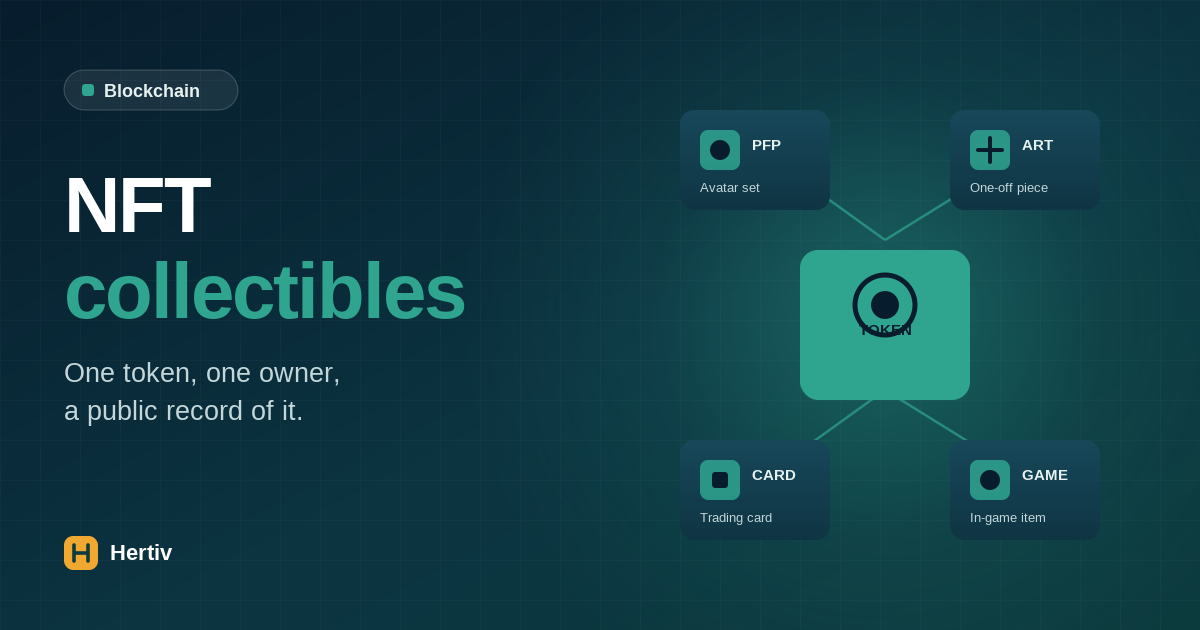
| Type | What it is | Why people collect it |
|---|---|---|
| Profile pictures | A set of character images used as avatars | Identity and membership in a community |
| Digital art | One-off or small-edition artworks | The artist, the style and the edition size |
| Trading cards | Cards with stats, rarity and a set to complete | Completing sets and trading duplicates |
| Generative art | Art made by code, minted at random | Each piece is one of a kind by design |
| Game items | Characters, skins and gear for a game | Use in play and trade outside the game |
Not every NFT is a collectible. An NFT can also be a ticket, a membership pass or a receipt for a service. A collectible is an NFT whose main value is that people want to own and trade it, not that it gives access to something else. For the general definition, see what an NFT is.
How is a collectible different from other NFTs?
A collectible differs from other NFTs in what the buyer is paying for. With a collectible, the value is in the item itself: the art, the rarity, the artist and the community around the set. With a utility NFT, the value is in what the token gives you, such as entry to an event or a discount.
That difference changes how you judge one. A collectible is judged the way any collectible is judged: is the set coherent, is the supply limited, does the artist or team keep building, and do people still trade it months after launch. A utility NFT is judged by whether the benefit is worth the price.
Most collectibles sit somewhere in the middle. A profile-picture set may also give holders a vote in a community, and a game item is both a collectible and a tool inside the game. The label matters less than the question: would people still want this if the extra benefit disappeared tomorrow.
Collectibles also differ from ordinary digital files in one practical way: the token is scarce by design. Anyone can copy the image, but only one wallet holds the token, and the chain shows the full history of who held it and what they paid.
What makes a collectible worth something?
A collectible is worth what the next buyer will pay for it, and that price rests on four things a buyer can check before spending anything. The first is scarcity: how many pieces exist in the set and how many of the rare traits. The second is the creator: an artist or team with a track record holds value better than an unknown launch.
The third is the community. Collectibles with an active group of holders, regular trading and a team that keeps shipping tend to hold up, while a set whose chat has gone quiet usually fades. The fourth is liquidity: how many sales happen each week and how close the buy and sell prices sit. A collectible that never trades is hard to sell when you need to.
None of these is a promise. Prices in this market move fast, and a set that looks strong today can lose most of its value if the team stops working or the wider market turns. That is why the checks below matter more than any single signal.
One warning sign is a set where most of the supply sits in a few wallets. If three wallets hold half the pieces, a single sale can move the floor price hard. A healthy set spreads ownership across many holders.
How do you buy an NFT collectible?
Buying a collectible follows the same five steps on most marketplaces, whether you are spending a little or a lot. Set up the wallet first, then check the collection, then the price, then buy, then keep the token safe.
- Set up a wallet for the chain the collection lives on and fund it with the chain's currency.
- Find the collection on a marketplace and confirm the contract address from the project's official page.
- Check the floor price, recent sales and how many pieces are listed.
- Buy the piece you want, or place an offer below the asking price.
- Move the token to your own wallet and keep the recovery phrase offline.
Confirming the contract address matters more than anything else. Fake copies of popular collections are common, and they look identical in a marketplace search. If the address does not match the project's official page, do not buy. For the marketplace side, the NFT marketplace use cases guide explains where collectibles trade.
Before you buy, check the royalty: the share of each resale that goes to the creator. Royalties are set by the collection and usually run from 2.5% to 10% of the sale price, and they come out of what the seller receives.
Example (hypothetical): buying your first collectible
Example (hypothetical): a buyer wants one piece from a 5,000-piece profile-picture set. The floor price is $120, the collection charges a 5% royalty, and the marketplace takes a 2.5% fee. The network fee to move the token is $8.
The buyer pays $120 for the piece, plus $8 in network fees, so $128 leaves the wallet. The royalty and the marketplace fee are paid by the seller, not the buyer, so they do not add to this bill. The buyer keeps the token in a wallet and checks the collection's sales each week.
Six months later the buyer decides to sell. The piece sells for $200. The seller pays a 5% royalty of $10 and a 2.5% marketplace fee of $5, so the seller keeps $185. The buyer turned $128 into $185, a gain of $57 before any other costs.
The arithmetic only works because the buyer checked the fees first. On a cheaper chain the $8 network fee might have been under $1, and on a busy day it could have been far more. Fees are the part of the deal most first-time buyers forget to count.
What should you check before buying one?
Check five things before you buy a collectible, and treat a red flag on any of them as a reason to wait. The first is the contract address, confirmed against the project's official page. The second is the sales history: a set with regular sales at prices near the floor is easier to exit than one with a single sale last month.
The third is the team. Look for a named artist or team, a public roadmap and evidence that they kept building after launch. The fourth is the supply: how many pieces exist, how many are listed for sale and how many wallets hold them.
The fifth is where the art lives. The token is on the chain, but the image is usually stored elsewhere, so check that the storage is durable and not a single server that can disappear.
Also check what you actually own. Buying a collectible usually buys the token and a licence to display the art, not the copyright. The creator keeps the right to make more art, use the character and sell merchandise, unless the licence says otherwise. Provenance is the record that proves which token you hold, and the NFT provenance guide explains how that record works.
What are the common mistakes?
The most common mistakes with NFT collectibles are buying a fake, paying too much for a thin market and treating a collectible like an investment. Each one is easy to avoid with a slow first purchase.
- Buying a copy of a collection without checking the contract address
- Paying the asking price when recent sales are far below it
- Buying a set with no sales history, then finding no buyer
- Ignoring the royalty and the marketplace fee when you sell
- Keeping the recovery phrase in a photo or a note on the phone
- Chasing a set because of hype instead of checking the team and the supply
Minting is the step that creates the token, and the how NFT minting works guide covers the costs and the choices a creator faces. Buyers who understand minting read a collection's supply and pricing with far more confidence.
Key takeaways
- A collectible's value is in the item itself, not in a benefit it gives you.
- Scarcity, the creator, the community and trading activity decide what a collectible is worth.
- Always confirm the contract address against the project's official page before you buy.
- Royalties and marketplace fees come out of the seller's side, so count them before you sell.
- Buying usually gives you the token and a display licence, not the copyright.
Frequently asked questions
What is the difference between an NFT and an NFT collectible?
An NFT is any unique token on a blockchain, including tickets, passes and receipts. An NFT collectible is an NFT whose main value is that people want to own and trade it, such as a profile picture, a trading card or a piece of digital art.
Are NFT collectibles a good investment?
They can rise or fall fast, and most sets lose value over time, so treat a collectible as a purchase you enjoy owning rather than a guaranteed return. Check the team, the supply and the sales history before you spend more than you can afford to lose.
How do I know an NFT collectible is real?
Confirm the contract address on the project's official page or social profile and compare it with the listing. Fake copies of popular collections are common, and they look identical in a marketplace search.
What does floor price mean for a collectible?
The floor price is the lowest asking price for any piece in a collection. It is a rough guide to what a collection is worth, but the piece you want may cost far more if it has rare traits.
Do I own the art when I buy an NFT collectible?
Usually you own the token and a licence to display the art, not the copyright. The creator keeps the right to use the character and make more art, unless the licence attached to the token says otherwise.
Where is the image of my NFT collectible stored?
The token lives on the blockchain, but the image is usually stored on a server or a distributed file system, because storing large files on a chain is expensive. Check that the collection uses durable storage before you buy.


