What Is an NFT and Why Did It Become Popular?
An NFT is a unique token on a blockchain that proves ownership of a specific digital item. Its rise came from scarcity, creator income and community.
On this page
Short answer
An NFT, or non-fungible token, is a unique token on a blockchain that records who owns a specific digital item, such as an image, a song, a game item or a ticket. Each NFT is one of a kind, so it cannot be swapped one-for-one with another NFT. The token is the proof of ownership; the item itself is usually a file stored elsewhere.
What is an NFT?
An NFT is a token on a blockchain with a unique identity. Fungible tokens, such as a currency, are all identical: one unit is the same as any other. An NFT is different: each one has its own record, its own history and its own owner. That is what "non-fungible" means, and it is the whole point of the technology.
The token itself is small. It holds an identifier, a link to the item's data, and a record of who owns it and who owned it before. The item it points to, such as an image or a video, is usually stored on a server or a distributed file system, not on the chain, because storing large files on a chain is expensive.
Owning the NFT means owning the token and the rights the issuer attached to it, which may be nothing more than the right to say you own it.
An NFT is created by minting, which means writing its record onto a chain. Minting usually follows a token standard, such as ERC-721 on Ethereum, which sets out how the token behaves, how it moves between wallets, and how marketplaces read it. For the minting steps, see how NFT minting works.
How does an NFT work?
An NFT works in four steps: creation, minting, ownership and transfer. An artist or a developer creates the item, mints it as a token on a chain, and the token appears in a wallet. From then on, the chain records every move of that token, so anyone can check who owns it and what it sold for before.
- Create the item. Make the image, song, video or game asset, and decide how many copies will exist.
- Mint the token. Write the token onto the chain, linking it to the item's data and setting any rules, such as a royalty on resale.
- Hold it in a wallet. The token sits in the owner's wallet, which proves ownership without a central registry.
- Trade it. The owner lists the token on a marketplace, and a buyer pays for it; the chain updates the owner automatically.
Smart contracts run the rules. A contract can say that the creator gets a share of every resale, or that only the owner can use a game item, and the chain enforces that rule when the token moves. The rules are only as good as the contract that was written, so a badly written contract can lock an item or send fees to the wrong place.
The chain does not check whether the item is original. Anyone can mint a copy of someone else's image, and the token will still be unique on the chain. Buyers check the creator's identity and the collection's history before paying, because the token proves ownership of a record, not that the record is genuine.
Why did NFTs become so popular?
NFTs became popular because they made digital ownership feel real for the first time. Before NFTs, a digital image could be copied by anyone, so owning one meant little. An NFT gave the owner a public, checkable record that they owned a specific copy, and that record could be bought, sold and shown to others.
Four forces drove the rise. First, scarcity: a creator could limit an edition to a fixed number, which made each copy feel rare. Second, creator income: artists could earn a share of every resale, which was new for digital work.
Third, community: owning an NFT often meant joining a group, with access to events, chats or future drops. Fourth, speculation: prices rose fast, which drew in buyers hoping to sell for more, and the headlines drew in more buyers still.
The popularity also came from timing. NFT marketplaces became easy to use just as social media made digital identity matter more, and as games and art moved online. A profile picture, a game item or a concert ticket that could be owned, traded and verified fitted that moment. For the wider uses, see NFT use cases.
What can NFTs be used for?
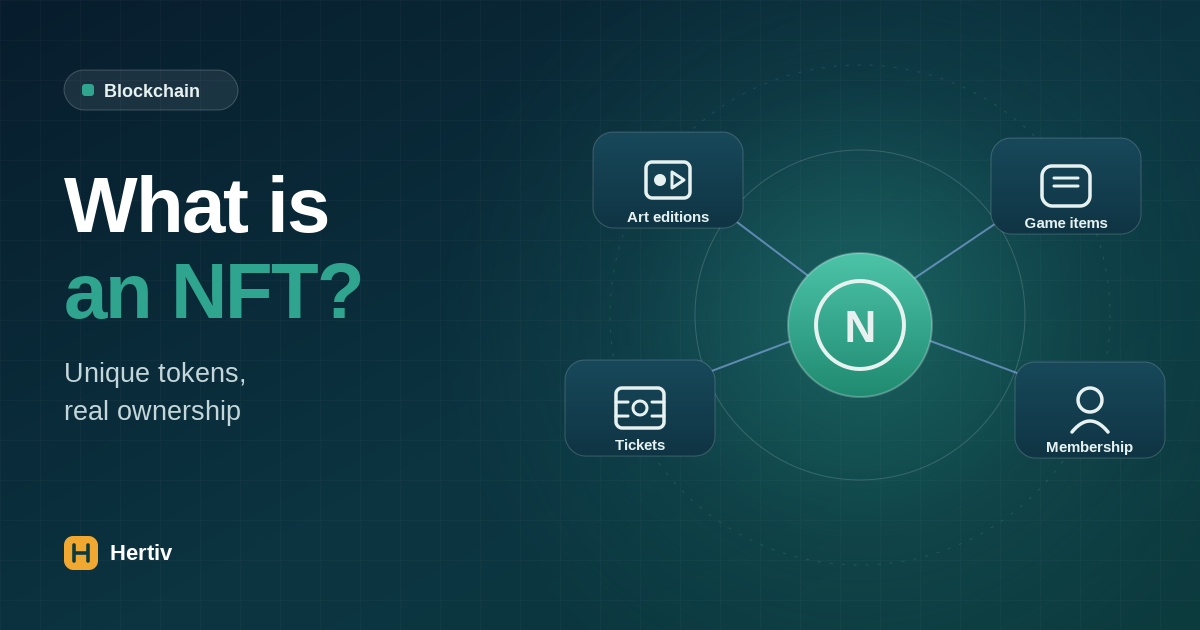
NFTs are used wherever a unique, checkable record of ownership is useful. The table below shows the main uses, what the token proves, and who it helps.
| Use | What the token proves | Who it helps |
|---|---|---|
| Digital art | Ownership of a specific edition | Artists and collectors |
| Game items | Ownership of a weapon, skin or character | Players and studios |
| Tickets | Ownership of a seat at an event | Organisers and fans |
| Membership | Access to a club or community | Brands and members |
| Music | Ownership of a track or album edition | Musicians and fans |
| Identity and certificates | That a person holds a credential | Schools and employers |
Art and collectibles got the attention, but the quieter uses may last longer. A ticket as an NFT can be checked at the door without a paper stub, and a resale can be controlled so the price stays fair. A certificate as an NFT can be verified by an employer without calling the school. These uses work because the token is a record, not because the token is valuable on its own.
Some uses are still experiments. An NFT for a house deed or a medical record needs laws and systems that do not exist yet in most places, so those ideas remain promises rather than products. A buyer should ask whether the NFT adds anything a database could not do, and if the answer is no, the token is decoration.
What are the risks of NFTs?
The risks of NFTs are price swings, scams, and dependence on platforms that can change or disappear. An NFT can lose most of its value in weeks, and the market for many collections is thin, so a seller may find no buyer at all. That is the first risk to understand before buying.
- Price volatility. NFT prices move fast and can fall to near zero, because value depends on demand for a specific collection.
- Scams and copies. Anyone can mint a copy of another person's work, and fake collections are common on marketplaces.
- Platform dependence. The item's file usually lives on a server, so if the server closes, the token may point to nothing.
- Legal uncertainty. Owning an NFT rarely means owning the copyright, and the rights that come with a token are often unclear.
- Wallet security. If a wallet is compromised, the NFTs in it can be moved in seconds and are hard to recover.
The most common loss is not a hack but a bad buy: paying a high price for a collection that nobody wants a month later. A buyer should treat an NFT like any other collectible, and only spend money they can afford to lose. For a sober look at the long term, see the real potential of NFTs.
Example (hypothetical): an artist sells 100 editions
Example (hypothetical): an artist mints 100 editions of a digital artwork at $50 each. All 100 sell, so the artist earns 100 times $50, or $5,000, before fees. The marketplace takes a fee on each sale, and the chain charges a minting cost, so the artist's net is less than $5,000, but the first sale is the simple part.
Six months later, 20 of the editions change hands on the marketplace at an average price of $80 each. The artist set a 10% royalty, so each resale pays the artist 10% of $80, or $8. Twenty resales pay 20 times $8, or $160. The artist's total from first sales and royalties is $5,000 plus $160, or $5,160, before fees.
The royalty is the part that makes NFTs different from a normal sale. In a normal sale, the artist earns once. With an NFT royalty, the artist earns a little on every resale, as long as the marketplace enforces the royalty. Some marketplaces let buyers skip royalties, so the artist should check that the marketplace they use actually pays them.
What are the common mistakes?
The most common NFT mistakes are buying for the hype, ignoring the rights, and trusting a marketplace without checking it.
- Buying because prices are rising. A collection that is rising because of hype can fall just as fast, and the last buyer holds the loss.
- Assuming you own the copyright. Most NFTs give no copyright and no right to reproduce the work, so read the terms before paying.
- Ignoring where the file lives. If the image is on a server that closes, the token points to a dead link.
- Skipping wallet security. A wallet without a hardware key or a safe backup can be emptied in one bad click.
- Believing every collection has value. Most NFT collections fade, and only a few keep buyers over time.
Key takeaways
- An NFT is a unique token that records ownership of a specific digital item on a chain
- Scarcity, creator royalties, community access and speculation drove the NFT rise
- Tickets, memberships and certificates may outlast art as the most useful NFT uses
- Owning an NFT rarely means owning the copyright, and the file it points to can disappear
- Treat an NFT like a collectible: only spend money you can afford to lose
Frequently asked questions
What is the difference between an NFT and a cryptocurrency?
A cryptocurrency is fungible, so one unit is the same as any other and can be swapped freely. An NFT is unique, so each token has its own identity, history and owner, and cannot be swapped one-for-one with another NFT.
Do I own the image if I buy an NFT?
Usually not. Buying an NFT normally gives you the token and whatever rights the issuer attached to it, which is often just the right to hold and resell the token. The copyright stays with the creator unless the terms say otherwise.
Can anyone create an NFT?
Yes. Anyone with a wallet can mint an NFT on a marketplace, which is why copies and fakes are common. Buyers check the creator's identity and the collection's history before paying, because minting is open to everyone.
Why are some NFTs worth so much?
Value comes from scarcity, the creator's reputation, the community around the collection, and demand from buyers. Some prices also reflect speculation, which is why values can fall sharply when interest fades.
What happens to my NFT if the marketplace closes?
The token stays on the chain, because the chain is separate from the marketplace. But the image file may live on a server the marketplace ran, so the token can end up pointing to nothing. Check where the file is stored before buying.
Are NFTs still popular?
Trading volumes fell from their peak, but NFTs are still used for art, games, tickets and memberships. The hype faded; the uses where a unique ownership record genuinely helps have continued.


