NFT Marketplace Use Cases: What People Buy and Sell
NFT marketplaces are where unique tokens change hands: art, music, tickets and game items. Here are the use cases that work in the real world.
On this page
Short answer
An NFT marketplace is a website or app where people buy, sell and trade unique blockchain tokens. It works in the real world wherever a unique item needs a buyer and a seller to find each other, agree a price, and transfer ownership without a middleman holding the item. Art, music, tickets, game items and collectibles are the cases that hold up.
What is an NFT marketplace?
An NFT marketplace is a website or app where people buy, sell and trade unique blockchain tokens, called NFTs. The marketplace lists the tokens, shows the price, handles the payment, and moves the token from the seller's wallet to the buyer's wallet when the sale completes.
It is different from a token itself. The token is the item, and the marketplace is the shop. A marketplace can sell art, music, tickets, game items or memberships, and it usually takes a fee on each sale. Some marketplaces are open to anyone, while others only list items from approved creators.
The marketplace does not usually hold the item. It holds the listing and the payment rules, and the token stays in a wallet until it is sold. For the token side of the same subject, NFT use cases explains what the tokens themselves are good for.
Which NFT marketplace use cases work in the real world?
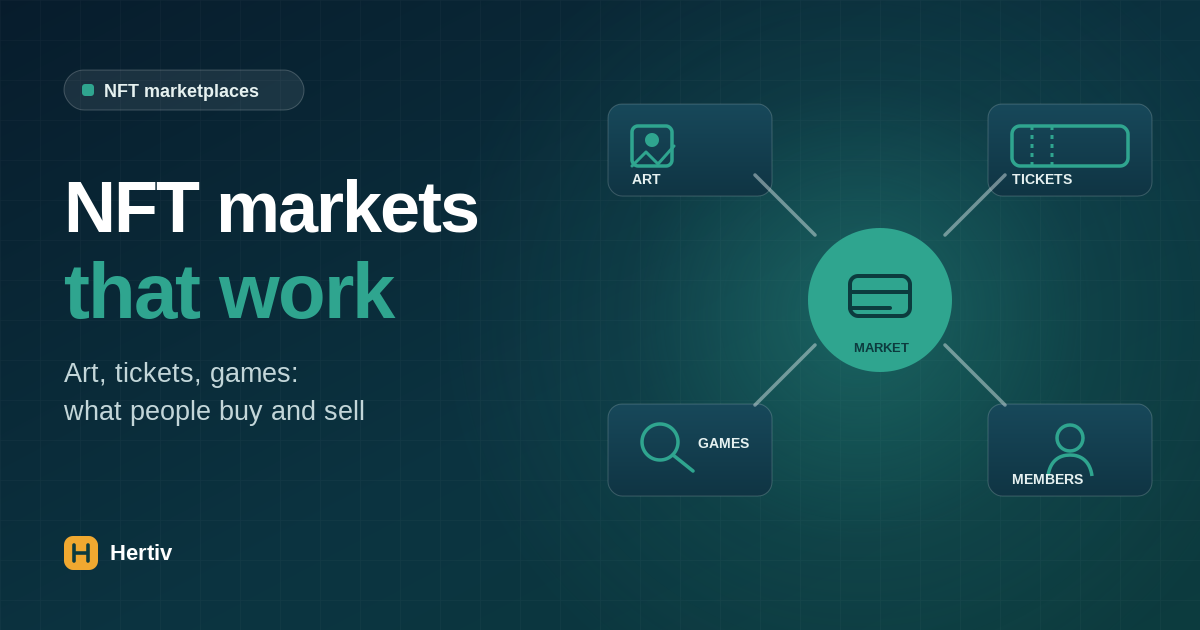
The marketplace use cases that work are the ones where buyers and sellers already exist and the token adds something a normal listing cannot. The table below shows the main ones and what the marketplace actually does in each.
| Use case | What is traded | What the marketplace adds |
|---|---|---|
| Digital art | Artworks and editions | Provenance and resale royalties |
| Music and media | Songs, albums, videos | Direct sales to fans |
| Tickets | Event tickets | Transfer rules and fraud checks |
| Game items | Skins, weapons, land | Trading across players |
| Collectibles | Cards, figures, memorabilia | Verified scarcity |
| Memberships | Access passes | Gated entry and resale |
The rest of this article looks at each group in turn, then explains how to judge whether a marketplace idea is worth building.
Art and collectibles
Digital art was the first marketplace use case to reach a wide audience, because art is already bought and sold through galleries and auctions, and the marketplace replaces the gallery with a listing page. The buyer gets a token that proves which edition they own, and the artist can set a royalty that pays them on every resale.
Collectibles work the same way. A trading card, a digital figure or a piece of memorabilia has value because it is scarce and because other people want it. The marketplace shows the scarcity, the ownership history and the price, which is the information a collector needs before buying.
The risk is that art and collectibles depend on taste and on demand that can fall quickly. A marketplace that only sells art needs a steady flow of new buyers, or the listings sit unsold. That is why most art marketplaces also sell editions and open editions, which are cheaper and sell in larger numbers.
Music, tickets and memberships
Music marketplaces let artists sell songs, albums and videos directly to fans, without a label or a streaming service taking most of the money. The fan buys a token that proves they own a limited edition, and the artist can add extras such as early access, a signed copy or a meeting.
Tickets are the most practical marketplace use case, because a ticket is already a unique item with a seat, a date and a price. A marketplace can enforce resale rules, such as a maximum price or a ban on resale, and check ownership at the gate with a wallet. For the ticketing angle in detail, what is NFT ticketing explains how it works.
Memberships use the same idea for access. A token can gate entry to a community, a content library or a service, and the holder can sell the membership to someone else when they leave. The marketplace is where that resale happens, and the issuer sets the rules for it.
Game items and virtual worlds
Game items are the largest marketplace use case by volume, because players already buy and sell skins, weapons and virtual land, and the marketplace gives them a place to do it outside the game. A player who earns a rare item can sell it to another player, and the game studio can take a fee on each trade.
Virtual worlds extend the same idea to land and buildings. A plot of virtual land is a unique token, and the marketplace is where it is bought, sold and rented. The value depends on how many people use the world, so a marketplace for a quiet world has little to sell.
The risk is that the game or the world can change its rules, close, or lose its players, and the items lose their value with it. A marketplace for game items is only as strong as the game behind it, so buyers should check whether the game is still growing before spending money.
Example (hypothetical): a small gallery opens a marketplace
Picture a small gallery that sells 40 artworks a month through its website. It lists each artwork as a token on a marketplace, with a price of $250 and a royalty of 10% on resales. In the first month it sells 40 artworks, which is $10,000 in sales, and the marketplace takes a 2.5% fee, which is $250.
Over the next six months, 10 of those artworks are resold at an average price of $400. The resales total $4,000, the marketplace takes $100 in fees, and the gallery earns $400 in royalties, which it would not have earned from a normal sale.
The gallery's total income from the marketplace is $10,000 in first sales plus $400 in royalties, which is $10,400, against $350 in marketplace fees. The royalty is the reason the marketplace pays off: without it, the gallery would have earned the same $10,000 from its own website and paid no fee at all.
What are the common mistakes?
The most common mistakes when building or using an NFT marketplace are listing items nobody wants, ignoring the fees, and assuming the token proves more than it does.
- Listing without demand. A marketplace with no buyers is a shop with no customers. Build the audience first, then the marketplace.
- Ignoring the fees. Marketplace fees, chain fees and royalty payments add up. A sale that looks profitable can lose money once all three are counted.
- Assuming the token proves authenticity. The token proves control of a token, not that the artwork is original or the seller is honest. Check the creator before buying.
- Skipping the transfer rules. If resale rules are not set before launch, buyers will resell in ways the creator did not intend, and the marketplace will have to fix it later.
- Building for every use case at once. A marketplace that tries to sell art, music, tickets and game items from day one does none of them well. Start with one group.
For the development side of the same idea, NFT marketplace development trends shows what marketplace builders are adding now.
Key takeaways
- An NFT marketplace is a shop for unique tokens, not the token itself
- Art, music, tickets, game items, collectibles and memberships are the use cases that hold up
- Royalties on resale are the main reason a marketplace pays off for creators
- A marketplace is only as strong as the buyers, the game or the world behind it
- Start with one group of items and one audience, not every use case at once
Frequently asked questions
What is the difference between an NFT and an NFT marketplace?
An NFT is a unique token on a blockchain that represents an item or a right. A marketplace is the website or app where those tokens are listed, bought and sold. The token is the item, and the marketplace is the shop.
What do people actually buy on NFT marketplaces?
Digital art, collectibles, music, event tickets, game items, virtual land and membership passes are the main categories. Art and game items have the most activity, while tickets and memberships are the most practical, because they map to a clear right.
How do NFT marketplaces make money?
They take a fee on each sale, usually a small percentage of the price, and sometimes a listing fee. Some also charge for featured listings or for minting the token. The fee is taken from the sale price when the trade completes.
Are NFT marketplaces safe to use?
They are as safe as their checks. A marketplace that verifies creators, holds payments in escrow until the token moves, and enforces transfer rules is safer than one that lists anything. Buyers should still check the creator before buying.
Do I need a marketplace to sell an NFT?
No, a token can be sold directly between two wallets. A marketplace is useful because it brings buyers and sellers together, shows the price and the history, and handles the payment and the transfer in one place.
Why do some NFT marketplaces fail?
Most fail because they have no buyers, so listings sit unsold. Others fail because they list fakes, charge fees that eat the sale, or try to cover every use case at once and do none of them well.


