What Is NFT Ticketing, and How Does It Work?
NFT ticketing turns an event ticket into a token on a blockchain, so the organiser can prove it is real and control how it is resold.
On this page
Short answer
NFT ticketing is the use of non-fungible tokens as event tickets, where each ticket is a unique token recorded on a blockchain. The ticket lives in the buyer's wallet, the door staff check the token instead of a paper code, and the organiser can see every resale and take a cut of it. It replaces the barcode with a record that cannot be copied.
What is NFT ticketing?
NFT ticketing is a way of issuing event tickets as non-fungible tokens, or NFTs, on a blockchain. Each ticket is a unique digital record: it names the event, the seat or section, and the owner, and it can only exist once. The buyer keeps it in a crypto wallet, and the door staff scan the wallet's token to let them in.
It differs from a normal e-ticket in one key way. A barcode can be copied and sold many times, which is how fake tickets reach buyers. An NFT ticket cannot be duplicated: the blockchain record shows exactly one owner, so a copy has no value. That single fact is the whole point of the idea.
The organiser issues the tickets through a smart contract, which is a small program on the blockchain that sets the rules: how many tickets exist, what they cost, and what happens on resale. Once the contract is live, the rules run the same way for every buyer, and no one can quietly print extra tickets.
How does NFT ticketing work?
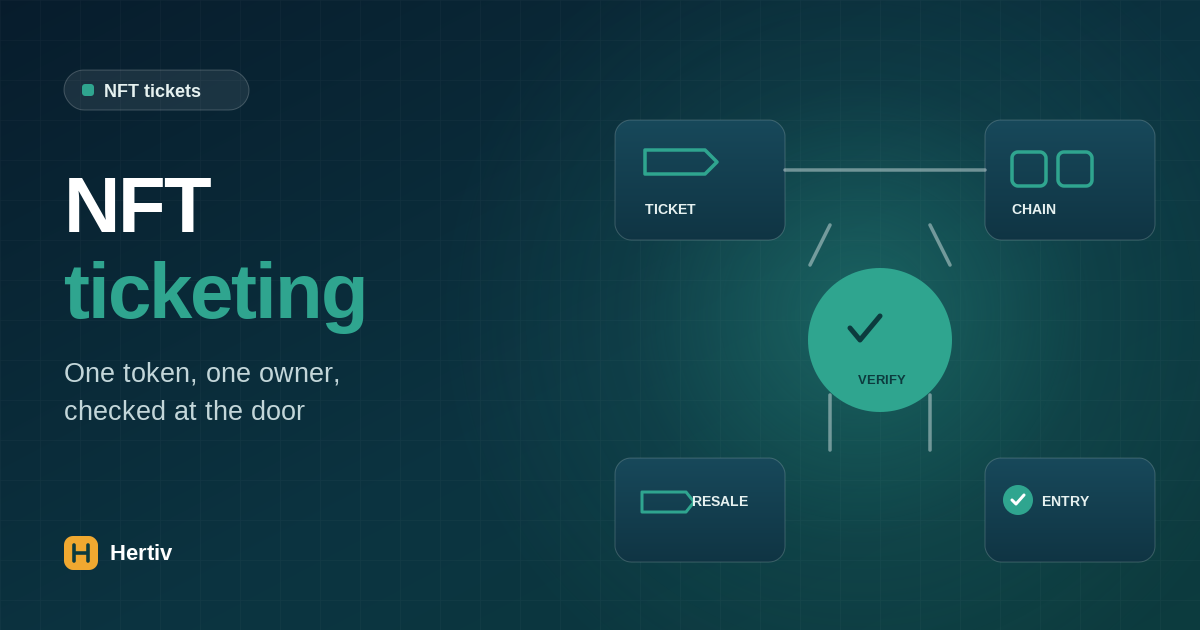
The process has five steps, and each one is a normal ticketing step with a blockchain record behind it.
- The organiser creates a smart contract. It sets the event details, the number of tickets, the price and the resale rules, then publishes it to a blockchain.
- Tickets are minted. Minting creates one token per ticket and records it on the chain. Each token carries the seat, the section and the event details.
- Buyers purchase with a wallet. The buyer pays in crypto or, on many platforms, by card, and the token moves into their wallet.
- Entry is checked at the door. Staff scan the wallet or a code tied to the token, and the system checks the blockchain to confirm the holder is the real owner.
- Resale follows the contract rules. If the owner resells, the token moves to the new buyer, and the contract can cap the price and send a share to the organiser.
Most platforms hide the wallet step from casual buyers: the ticket appears in an app, and the blockchain record sits underneath. For the background on the tokens themselves, how tokenization works explains the same idea for other assets.
What problems does NFT ticketing solve?
NFT ticketing solves three problems that normal ticketing handles badly: fake tickets, uncontrolled resale, and lost ticket history.
| Problem | Normal ticketing | NFT ticketing |
|---|---|---|
| Fake tickets | Barcodes can be copied | One token, one owner |
| Scalping | Price caps are hard to enforce | Contract caps the resale price |
| Organiser revenue | Nothing from resale | Contract sends a share on resale |
| Proof of attendance | Ticket is thrown away | Token stays as a record |
| Fan rewards | Separate loyalty system | Token can carry perks |
The resale share is the part organisers care about most. On a normal resale market, the organiser earns nothing when a ticket changes hands for five times the face value. With an NFT ticket, the contract can send a fixed share of each resale back to the organiser, and the price cap keeps the resale fair for fans.
The proof-of-attendance point matters for artists and teams too. A ticket that stays in a wallet after the event is a record that the fan was there, and the organiser can offer that group early access or discounts later, without building a separate loyalty system.
What are the limits and risks?
NFT ticketing has real limits, and a team that ignores them will annoy its audience.
- Wallets are still a barrier. Many buyers have never used a crypto wallet, and a checkout that demands one will lose sales. Platforms that hide the wallet behind a normal card payment work better for mainstream events.
- Fees can spike. Minting thousands of tickets on a busy chain can cost more than expected, and the fee is paid whether the event sells out or not.
- Resale rules need the law. A contract cap is only useful if the local rules allow it, and refund rules for cancelled events still come from consumer law, not from code.
- Loss of access is a real problem. A buyer who loses their wallet can lose their ticket, so the platform needs a recovery path that normal ticketing already has.
- It does not stop all fraud. A scammer can still sell a screenshot of a ticket to someone who does not check the chain. The check at the door is what protects the buyer, not the token alone.
The honest test is the audience. If the crowd is comfortable with wallets and apps, NFT ticketing adds real value. If the crowd is not, the same money spent on better entry scanning and a fair resale market does more good.
Example (hypothetical): a music festival tries NFT tickets
Picture a festival with 5,000 tickets at $80 each. The organiser mints 5,000 tokens and sells them through a platform that takes card payments and creates a wallet for each buyer behind the scenes.
Before the event, 800 tickets are resold. The contract caps resale at $100 and sends 10% of each resale to the organiser. That is 800 resales at an average of $95, which is $76,000 in resale value, and the organiser's share is $7,600. On a normal resale market, the organiser would see none of that.
At the door, staff scan each buyer's token. Twelve people arrive with copied screenshots from a scam listing, and the scan rejects them because the token belongs to someone else. The festival refunds those twelve through its normal support channel and reports the listing. The lesson is that the token helps only because the door check reads the chain.
After the event, the organiser offers the 5,000 holders early access to next year's tickets. About 1,200 take it up, which is a stronger presale than the festival had the year before. The token record made that offer possible without a separate mailing list.
What are the common mistakes?
The most common mistakes when trying NFT ticketing are forcing wallets on buyers, ignoring fees, and trusting the token instead of the door check.
- Forcing a wallet on every buyer. If the checkout needs a wallet install, many buyers give up. Use a platform that takes card payments and handles the wallet for them.
- Ignoring minting fees. Budget the fee for every ticket, not just the sold ones, and check the fee on the chain you plan to use before you commit.
- Trusting the token alone. A token only helps if the door check reads the chain. A screenshot of a ticket is still a scam, and staff need to know that.
- No recovery path. Plan what happens when a buyer loses access to their wallet, before the first ticket is sold.
- Overpromising the perks. A token that promises lifetime access or rare rewards becomes a liability if the event cannot deliver them.
For the smart contract side of the setup, what smart contract development means explains how the ticket rules are written and tested.
Should your event use NFT ticketing?
Use NFT ticketing when fake tickets and scalping are real problems for your event, and your audience is comfortable with apps and wallets. It fits music festivals, sports fixtures and conferences where resale is common and the organiser wants a share of it.
Skip it when the audience is broad and the event is small. A local theatre or a community fair gains little from tokens, and the wallet step will cost more sales than the resale share earns back. A better ticket platform and a clear refund policy do more for those events.
The middle path is the most common: run NFT tickets for one tier, such as VIP or early-bird, and keep normal tickets for the rest. That gives the organiser the resale data and the fan record without asking every buyer to learn a new tool. If that tier sells well and the door queues stay short, expand it next time.
Whatever you choose, what Web3 means is a useful starting point for the wider idea of owning digital records on a shared ledger.
Key takeaways
- NFT ticketing turns each ticket into a unique token that cannot be copied
- The smart contract sets the ticket count, the price and the resale rules
- The organiser can cap resale prices and earn a share of each resale
- Wallets, fees and lost access are the main limits for mainstream events
- The door check, not the token alone, is what stops fake tickets
Frequently asked questions
What is the difference between an NFT ticket and a normal e-ticket?
A normal e-ticket is a barcode that can be copied and sold many times, so a buyer cannot tell if it is real until the door. An NFT ticket is a unique token on a blockchain with one owner at a time, so the door check can confirm who holds it. The token also carries the resale rules.
Do buyers need a crypto wallet to use NFT tickets?
Not always. Many ticketing platforms take card payments and create a wallet for the buyer behind the scenes, so the ticket appears in an app like a normal ticket. The blockchain record still exists underneath. Platforms that demand a wallet install up front lose buyers, Check how the checkout works before you choose a platform.
Can NFT tickets stop scalping?
They can limit it, but not stop it entirely. The smart contract can cap the resale price and send a share of each resale to the organiser, which removes most of the profit from scalping. But a scammer can still sell a screenshot to someone who does not check the chain, so the door check matters as much.
What happens to my NFT ticket if the event is cancelled?
The same consumer rules apply as for a normal ticket: the organiser refunds the buyer. The smart contract can automate the refund, sending the payment back to the wallet that holds the ticket, but the organiser still has to set that up. Check the refund policy before you buy.
Which events use NFT ticketing today?
Music festivals, sports fixtures and conferences are the main users, because those events have the worst scalping and the most resale. Some teams also use NFT tickets for season passes, where the token doubles as a membership record. Smaller community events rarely use them, because the wallet step costs more than it saves.
Is NFT ticketing expensive to set up?
The setup cost is the smart contract, the platform and the minting fees for every ticket, and the fees depend on the blockchain used. For a large event the cost per ticket is small, but for a small event it can be a large share of the price. See the vendor site for current pricing.


