What Is NFT 2.0 Development and How Do You Build for It?
NFT 2.0 development builds tokens that change, split or pay out over time, moving past static image NFTs. Learn the building blocks and a build plan.
On this page
Short answer
NFT 2.0 development is the practice of building non-fungible tokens that can change, combine, split or pay out over time, instead of the static image-and-metadata tokens of the first NFT wave. It covers dynamic metadata, semi-fungible tokens, token-bound accounts and programmable royalties.
What is NFT 2.0 development?
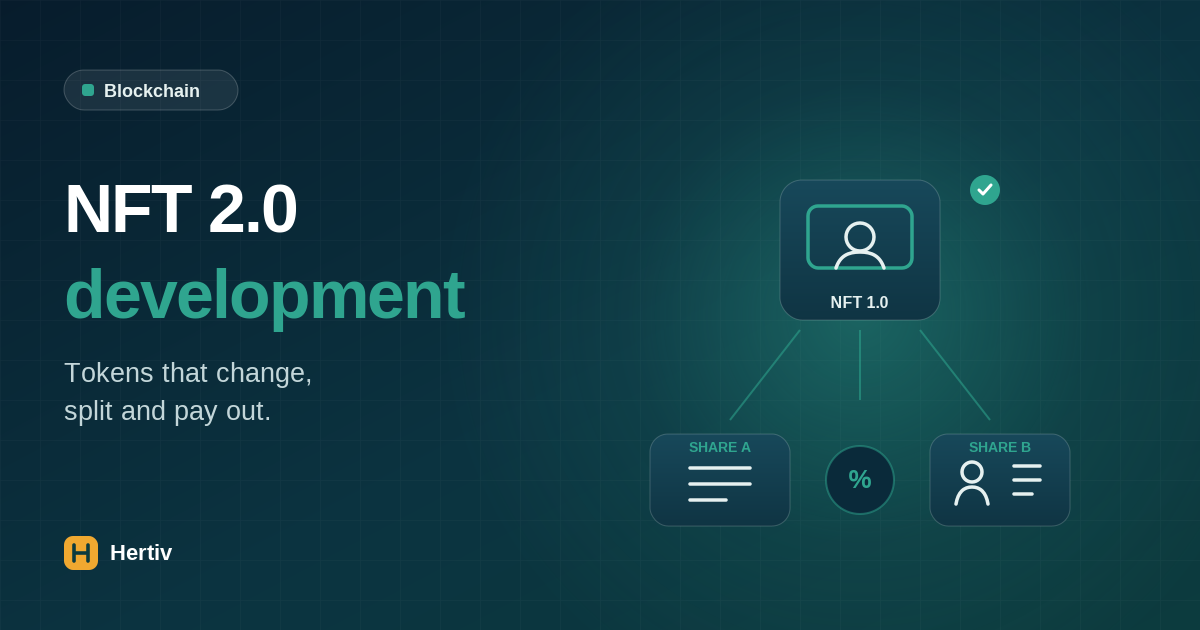
NFT 2.0 development is the practice of building non-fungible tokens that can change, combine, split or pay out over time, instead of the static image-and-metadata tokens of the first NFT wave. Where an early NFT was a fixed picture with a fixed owner, a 2.0 token can level up in a game, split into shares, merge with another token or pay its holders automatically.
The shift is from collectible to component. First-wave NFTs proved that unique digital ownership works. The next wave treats the token as a small piece of software: it holds state, reacts to events and connects to other contracts. That is why the work now looks more like product engineering than art drops.
| Feature | NFT 1.0 | NFT 2.0 |
|---|---|---|
| Metadata | Fixed at mint | Updates with events |
| Fungibility | Unique, one of one | Semi-fungible or fractional |
| Behaviour | Static image | Reacts to use |
| Ownership | One wallet | Shared or split |
| Royalties | Fixed share | Programmable rules |
| Links to other assets | None | Holds or points to them |
NFT 2.0 is a label for a direction, not a single standard. A project counts as 2.0 when its tokens do something after mint, and the build work is choosing which of those behaviours the product actually needs.
What makes an NFT '2.0'?
An NFT counts as 2.0 when it has at least one behaviour that a static token cannot do. The five building blocks below cover most of what teams are actually shipping, and a project usually needs one or two of them, not all five.
- Dynamic metadata. The token's image or traits change when something happens: a game item gains a level, a membership card shows a new tier, a ticket becomes a receipt after the event.
- Semi-fungible tokens. Tokens that behave like copies in a batch but carry individual traits, useful for game items, tickets and vouchers. See semi-fungible vs NFT token development for the trade-offs.
- Token-bound accounts. The NFT itself owns a wallet, so it can hold other tokens, earn rewards or sign actions on behalf of its owner.
- Fractional ownership. One token split into many shares, so a group can own an expensive asset together and trade their shares.
- Programmable royalties and payouts. Rules in the contract that split each sale or payment between creators, holders and the platform, without a middleman.
Dynamic metadata is the most common starting point, because it changes the product without changing the ownership model. Fractional ownership and token-bound accounts add the most complexity and need the most testing. Learn how metadata updates work in what dynamic NFTs are.
Which standards and chains do developers use?
Developers building NFT 2.0 projects start from the established token standards and add the behaviour on top. ERC-721 covers unique tokens, ERC-1155 covers semi-fungible batches, and newer standards cover the behaviours that neither of those was built for.
The standards that come up most often are ERC-404, which mixes fungible and non-fungible behaviour so a token can split into tradable shares and recombine, and ERC-6551, which gives an NFT its own account. Off-chain data, such as a game result or a real-world event, usually reaches the contract through an oracle that reports the result on-chain.
Chain choice follows the product. High-traffic games and consumer apps tend to pick a low-fee chain or a layer 2, because dynamic tokens update often and each update costs gas. High-value art and collectibles tend to stay on Ethereum mainnet, where liquidity and marketplace support are strongest.
Check how to create an ERC-404 NFT token for the mechanics of the split-and-recombine pattern, and keep the contract surface small: every extra behaviour is another thing to audit.
How to build an NFT 2.0 project
You build an NFT 2.0 project by defining the behaviour first, then choosing the standard that fits it, then building and testing the contracts before anything is minted or sold.
- Define the behaviour. Write down exactly what changes after mint: what triggers it, what the new state is, and who can trigger it.
- Choose the standard. Match the behaviour to ERC-721, ERC-1155, ERC-404 or a token-bound account, and check that wallets and marketplaces support it.
- Design the metadata. Decide what lives on-chain, what lives in storage, and how an update is verified before the metadata changes.
- Build the contracts. Keep the logic small and readable, with clear access rules for who can update, split or pay out.
- Test the behaviour. Run through every state change on a test network, including the failure cases: a failed oracle update, a split that does not recombine, a payout that runs out of funds.
- Audit, then launch small. Get an independent review of the contracts, mint a small batch, and watch real usage before opening the full sale.
Most of the work is in step one. Teams that skip the behaviour definition end up with a token that does everything in the pitch and nothing reliably in production.
Example (hypothetical): a game item that levels up
Example (hypothetical): a game studio builds an NFT sword that gains a level each time its owner wins ten battles. The studio mints 1,000 swords, and minting costs $2 of gas per token, so the mint costs $2,000 in total.
During the first season, 500 swords level up. Each level-up costs the player a $5 upgrade fee, so upgrade fees bring in 500 times $5, which is $2,500. On the secondary market, 1,000 swords change hands at an average price of $40, giving $40,000 of volume, and the contract takes a 5% royalty, which is $2,000.
Upgrade fees plus royalties come to $4,500 against the $2,000 mint cost. The arithmetic is simple on purpose: the point is that the token's behaviour, not the mint, is what produces ongoing value, and the team can forecast it from three numbers: how many items update, how often they trade, and what the royalty rate is.
What are the risks and limits?
The risks of NFT 2.0 development are complexity, cost and support. Every behaviour added to a token is another path through the contract, and a bug in a split, merge or payout rule can lock funds or break ownership in ways a static NFT never could.
Gas is a practical limit. Dynamic tokens update often, so a design that updates on every action can cost more in fees than the update is worth, especially on a busy mainnet. Batching updates, moving to a layer 2, or updating only when it matters keeps the economics sane.
Wallet and marketplace support is uneven. Some wallets do not display dynamic traits well, and some marketplaces do not recognise newer standards, so holders may not see what they own. Test the full journey, mint to marketplace listing, on the wallets your audience actually uses before launch.
What are the common mistakes?
The most common NFT 2.0 mistakes are adding behaviour nobody asked for, trusting off-chain data without a check, and launching a large mint before the contracts have been tested under real load.
- Behaviour for its own sake. A token that levels up, splits and pays out sounds impressive and is hard to explain, test and support. Pick one behaviour that serves the product.
- Blind oracle trust. If metadata updates come from an off-chain source, a wrong or delayed feed changes every token. Check the data before it lands on-chain.
- Skipping the audit. Programmable payouts and splits move money. An independent review costs less than a locked contract.
- Ignoring wallet display. If holders cannot see the token's state, they will not value it, however clever the contract is.
- Big-bang mints. Minting thousands of tokens before the behaviour is proven in the wild turns every fix into a migration.
Key takeaways
- NFT 2.0 tokens change, split or pay out after mint; static NFTs do not
- Start with one behaviour, usually dynamic metadata, and add the rest later
- Match the standard to the behaviour and check wallet and marketplace support
- Test every state change, including failures, before minting
- A locked contract costs more than an audit, so review before launch
Frequently asked questions
What is NFT 2.0?
NFT 2.0 is a label for non-fungible tokens that do something after mint: their metadata updates, they split into shares, they hold other assets or they pay out automatically. It describes a direction in NFT development, not one single standard.
Is NFT 2.0 a new token standard?
No. It is built from existing standards such as ERC-721, ERC-1155, ERC-404 and ERC-6551, combined with oracles and contract logic. The new part is the behaviour layered on top of those standards.
Which chain should an NFT 2.0 project use?
It depends on how often tokens update. Products with frequent updates usually pick a low-fee chain or a layer 2, while high-value collectibles often stay on Ethereum mainnet for liquidity and marketplace support.
How much does NFT 2.0 development cost?
Costs vary by scope, so check vendor pages for current rates. The main parts are contract development, an independent audit, metadata and storage setup, and gas for minting and updates. Dynamic tokens add ongoing gas costs that static NFTs do not have.
Do wallets and marketplaces support NFT 2.0?
Support is uneven. Some wallets show dynamic traits well and some do not, and newer standards are not recognised everywhere. Test the mint-to-listing journey on the wallets your audience uses before launch.
What is the biggest risk in NFT 2.0?
Contract complexity. Splits, merges and payouts move money and change ownership, so a bug can lock funds. Keep the contract surface small, test failure cases, and get an independent audit.


