Semi-Fungible vs NFT Token Development: What Differs?
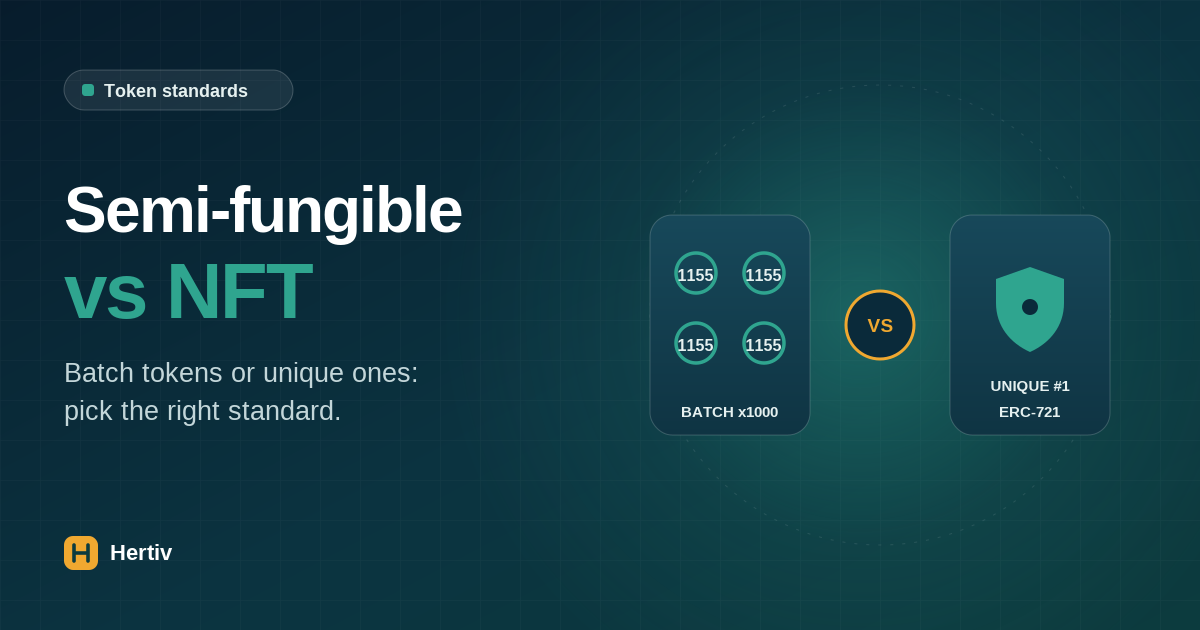
Semi-fungible tokens and NFTs both live on a blockchain, but they suit different jobs: one fits identical items in a batch, the other fits unique items.
On this page
Short answer
Semi-fungible token development builds tokens that are identical within a batch but can become unique later, while NFT development builds tokens that are unique from the start. The choice changes the token standard, the smart contract design and the way items are minted, traded and priced. This guide compares the two paths so you can pick the right one before you write any code.
What is a semi-fungible token?
A semi-fungible token is a blockchain token that behaves like a fungible token at first and like a non-fungible token later. Within one batch, every token is identical and can be swapped for another from the same batch. Once a token is used or redeemed, it can gain unique traits and stop being interchangeable.
The usual example is an event ticket. Before the event, all 1,000 tickets for the same seating area are identical, so any one of them will do. After the event, a ticket could carry a unique record, such as a signed seat or a collectible memory, and then it is no longer interchangeable with the others.
Semi-fungible tokens are normally built on the ERC-1155 standard on Ethereum and similar chains. One contract can hold many token types at once, which keeps the design simpler when a project has several kinds of items. For the contract work involved, see smart contract development.
What is a non-fungible token?
A non-fungible token, or NFT, is a blockchain token that is unique from the moment it is created. Each token has its own ID and its own metadata, so no two tokens are interchangeable, even if they look similar.
The usual examples are digital art, collectibles and game items with distinct traits. A one-of-one artwork and a game sword with a specific set of stats are both NFTs, because swapping one for another would change what the owner holds.
NFTs are normally built on the ERC-721 standard on Ethereum and similar chains. Each token is minted one at a time with its own metadata record, which is why NFT projects often need a system for storing images and traits alongside the contract. The chain choice matters here, and Ethereum development covers the most common starting point.
Semi-fungible vs NFT: how the two compare
The two token types differ in identity, minting, trading and cost, and the table below puts the main differences side by side.
| Factor | Semi-fungible token | Non-fungible token |
|---|---|---|
| Standard | ERC-1155 in most cases | ERC-721 in most cases |
| Identity | Identical within a batch, unique later | Unique from creation |
| Minting | One batch mint for many copies | One mint per token |
| Trading | Batch trades and partial sales | One token per sale |
| Best for | Tickets, game items, vouchers | Art, collectibles, unique assets |
| Contract count | One contract, many types | Often one contract per collection |
Neither type is better in general. The right choice depends on whether the items are identical at the point of sale or unique from the start.
How semi-fungible token development works
Semi-fungible token development starts by defining the token types and the rules for when a token changes from fungible to unique, then builds one contract that manages them all.
- Define the token types. List each item type, how many copies exist, and what makes a token unique after it is used.
- Pick the standard and chain. ERC-1155 on Ethereum is the common choice; check fees and wallet support on your target chain first.
- Write the contract. Build minting, batch transfer and burn functions, plus the rule that marks a token as redeemed or unique.
- Store the metadata. Decide what lives on-chain and what lives off-chain, and how the app reads it.
- Test the lifecycle. Test minting a batch, transferring part of it, redeeming one token and confirming the rest stay fungible.
- Audit and launch. Get the contract reviewed, then launch with a small batch before scaling up.
Batch operations are the main advantage here: one transaction can mint or move many copies, which keeps the process simpler than minting each item on its own.
How NFT development works
NFT development starts by defining what makes each token unique, then builds a contract that mints one token at a time with its own metadata record.
- Define uniqueness. Decide what makes each token different: artwork, traits, serial number or a mix of these.
- Pick the standard and chain. ERC-721 on Ethereum is the common choice; other chains offer lower fees but different wallet and marketplace support.
- Write the contract. Build minting, ownership and transfer functions, plus rules for royalties or access if the project needs them.
- Prepare the metadata. Create the images and trait data, store them reliably, and link each token ID to its record.
- Test minting and trading. Test single mints, transfers, marketplace listings and the metadata display in wallets.
- Audit and launch. Get the contract reviewed, then mint a small test set before opening sales to the public.
The metadata work is often larger than teams expect. A collection of 1,000 unique items needs 1,000 metadata records, each checked for errors, while a semi-fungible batch needs far fewer. For the app around the contract, see dApp development.
Example (hypothetical): 1,000 event tickets
Example (hypothetical): an organiser sells 1,000 tickets for a concert, all for the same seating area and the same price.
As semi-fungible tokens, the 1,000 tickets are minted as one batch in a single contract, and buyers can trade any ticket for any other ticket from the same batch. After the concert, 100 tickets are marked as collectible editions with a unique record each, while the other 900 stay plain.
As NFTs, the same 1,000 tickets would need 1,000 separate mints, one per ticket, each with its own metadata record. That is 1,000 mint operations instead of one batch mint, and 1,000 metadata records instead of one batch record plus 100 collectible records. The semi-fungible path fits here because the tickets are identical at the point of sale.
What are the common mistakes?
The most common mistakes in token development are picking the standard before understanding the item, skipping the audit, and treating metadata as an afterthought.
- Choosing the standard first. Teams that start with ERC-721 or ERC-1155 before defining the item often rebuild the contract later.
- Ignoring the redemption step. A semi-fungible design needs a clear rule for when a token becomes unique, or the lifecycle breaks.
- Weak metadata storage. If images or traits disappear, the token loses its meaning, so the storage plan matters as much as the contract.
- Skipping the audit. Token contracts handle value directly, so an unreviewed contract is a risk to every holder.
- Assuming one contract fits all. A project with both unique art and batch tickets may need two contracts, not one.
If you are unsure which standard fits, start from the item: identical at sale means semi-fungible, unique at sale means NFT. A partner for blockchain development can help you test the choice with a small pilot before you commit.
Key takeaways
- Semi-fungible tokens are identical in a batch and can become unique after use
- NFTs are unique from creation, one token at a time, usually on ERC-721
- One ERC-1155 contract can hold many token types; NFT collections often need one contract each
- Batch minting suits tickets and game items; single minting suits art and collectibles
- Define the item first, then pick the standard, then audit the contract
Frequently asked questions
When should I use a semi-fungible token instead of an NFT?
Use a semi-fungible token when the items are identical at the point of sale and only become unique later, such as event tickets, game consumables or vouchers. Use an NFT when each item is unique from the start, such as a one-of-one artwork or a game item with distinct traits.
What is ERC-1155?
ERC-1155 is a token standard that lets one smart contract manage many token types at once, including both fungible and non-fungible tokens. It supports batch minting and batch transfers, which is why it is the usual choice for semi-fungible tokens. ERC-721, by contrast, handles one unique token at a time.
Can a semi-fungible token become a full NFT?
Yes, in practice. A semi-fungible token can gain unique traits after it is used or redeemed, at which point it stops being interchangeable with the rest of its batch. The contract needs a clear rule for that change, or holders will not know what their token represents.
Are semi-fungible tokens cheaper to mint than NFTs?
They often are, because one batch mint can create many copies in a single transaction, while NFTs usually need one mint per token. The saving depends on the chain, the batch size and the network fees at the time, so test with a small batch before you commit to a large one.
Do marketplaces support semi-fungible tokens?
Support varies by marketplace and chain, so check before you build. Major marketplaces handle ERC-721 NFTs widely, while ERC-1155 support is common but not universal. If your buyers use a marketplace that does not list your token type, they will struggle to trade it.
Do I need an audit for a token contract?
Yes. Token contracts hold value and are public, so any flaw can be found and used by anyone. A review by an experienced auditor before launch is standard practice for both semi-fungible and NFT contracts, and it should cover minting, transfers and the redemption rules.


