What Are Dynamic NFTs, and How Do They Work?
A dynamic NFT is a token whose metadata can change after minting, driven by smart contract rules and outside data. Here is how dNFTs work and where they are used.
On this page
Short answer
A dynamic NFT is a token whose image, traits or stats can change after minting, following rules in its smart contract and data from outside sources such as oracles. Static NFTs stay fixed, while dynamic ones update when events happen, which makes them useful for games, sports collectibles, loyalty passes and records tied to real-world assets.
What is a dynamic NFT?
A dynamic NFT (dNFT) is a non-fungible token whose metadata or appearance can change after it is minted, following rules written into its smart contract. A static NFT keeps the same image and traits forever, while a dynamic one can update when something happens on or off the chain.
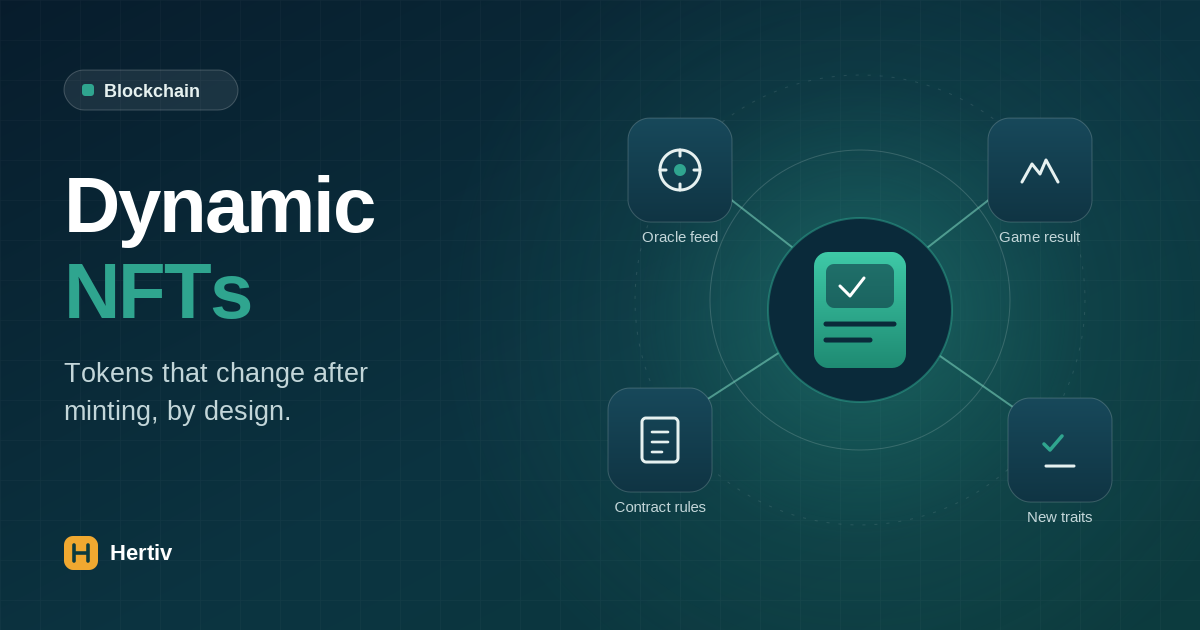
The change is driven by data. A smart contract reads a trigger, such as a game result, a sports score or a sensor reading, and then updates the token's metadata. The token itself stays the same asset on the same chain; only what it shows or records changes.
| Feature | Static NFT | Dynamic NFT |
|---|---|---|
| Metadata | Fixed at mint | Can change after mint |
| Data source | None after mint | Oracles and contract rules |
| Typical uses | Art, profile pictures | Games, sports, credentials |
| Cost to update | None | Needs a transaction |
| Risk | Metadata link breaks | Oracle or rule fails |
Think of a static NFT as a printed trading card and a dynamic NFT as a scorecard that updates after each match. The card is still yours, but the numbers on it move.
How does a dynamic NFT change?
A dynamic NFT changes when its smart contract receives new data and runs the update rules written into it. The contract is the source of truth: it decides what can change, when it can change, and who is allowed to trigger the change.
A typical update follows four steps:
- An event happens. A player wins a match, a sensor records a reading, or a deadline passes.
- Data reaches the chain. An oracle service carries the outside data on chain, or the event is recorded directly by a contract call.
- The contract checks its rules. It confirms the data is valid and the update is allowed under the token's rules.
- Metadata updates. The token's stored traits, image link or stats change, and the change is recorded on chain.
Oracles matter because blockchains cannot read outside data on their own. If the oracle feed is wrong or stops, the token stops updating correctly, which is why the choice of data source is part of the design, not an afterthought. Smart contract development covers how these rules are written and checked.
What can change inside a dynamic NFT?
Almost any part of a dynamic NFT's metadata can change, as long as the contract allows it. The most common changes are the image, the trait values, the stats and the access rights tied to the token.
- Image or artwork. A game item can gain a new look after a level-up, or a collectible can change with the season.
- Traits and stats. Numbers such as strength, rarity or score can rise or fall with real events.
- Access rights. A token can open a door, a file or a feature only while a condition holds, then close it again.
- Linked records. A token can point to new documents, such as a certificate, a warranty or a service history.
- Status. A token can move between states such as active, paused, expired or redeemed.
What cannot change is the token's identity: its contract address and token ID stay the same. That is what lets a marketplace, a wallet and a game all agree they are looking at the same asset, even as its contents change.
Where are dynamic NFTs used?
Dynamic NFTs are used where the value of a token depends on something that changes over time. Games, sports, loyalty programmes and real-world asset records are the clearest fits so far.
- Games. A weapon, character or land plot gains stats and a new look as the player progresses.
- Sports collectibles. A player's card updates with live stats, so a good season makes the card more interesting to hold.
- Loyalty and membership. A pass changes tier as the holder earns points or attends events.
- Real-world assets. A token that stands for a physical item can record its service history, location or condition.
- Credentials. A certificate token can show as valid, suspended or expired based on the issuer's records.
For the minting and marketplace side of these tokens, see NFT marketplace use cases. The dynamic part is an extra layer on top of the same minting and trading flow.
How to build a dynamic NFT
You build a dynamic NFT by writing a contract that stores changeable metadata, connecting a trusted data source, and testing every update path before minting. The build is mostly contract design, not artwork.
- Define what changes. List the traits, images and states that can update, and the events that trigger each one.
- Pick the chain and standard. Choose a chain your users already use and a token standard that supports metadata updates.
- Write the update rules. Put the rules in the contract: who can trigger an update, what data is accepted, and what the new state must be.
- Connect the data source. Use an oracle or a signed feed for outside data, and decide what happens if the feed goes silent.
- Store metadata where it can be read. Keep metadata on chain or on reliable decentralised storage so wallets and marketplaces can show it.
- Audit and test. Have the contract reviewed, then test every trigger, including bad data and missed updates, on a test network.
Budget for update costs as well as minting. Each metadata change is a transaction, so a token that updates often will cost more to run than one that updates rarely.
Example (hypothetical): a game sword that levels up
Example (hypothetical): a small game studio mints 200 swords as dynamic NFTs. Each sword starts at level 1 with 10 attack points, and each completed quest adds 2 attack points.
A player completes 50 quests. That is 50 quests times 2 points, which equals 100 points, so the sword reaches 110 attack points in total. When the total passes 100 points, the contract changes the sword's tier from common to rare and swaps in new artwork.
The studio also sets a cap: no sword can pass 200 attack points, however many quests its owner completes. The cap keeps new players able to compete, and it stops the update rule from running away. Every change is a transaction, so the studio batches updates at the end of each play session instead of after every single quest.
What are the common mistakes?
The most common mistakes with dynamic NFTs are trusting a single data source, hiding the update rules, and forgetting that every update costs money.
- One oracle, no fallback. If the only data feed fails or is fed bad data, every token that depends on it updates wrongly or not at all.
- Hidden update rules. Buyers need to know what can change and who can change it, or the token's value is guesswork.
- Centralised metadata. If the image and traits live on one company server, the token is only as durable as that server.
- Ignoring update costs. A token that updates daily can cost far more to run over a year than the minting cost suggested.
- No pause or fix path. Contracts need a tested way to stop updates when data is wrong, or a bad feed can damage every token at once.
- Unclear ownership of changes. Decide in advance whether the holder, the issuer or an automated rule controls updates, and write it down.
Before minting, read what is NFT minting for the basics, then check the contract and oracle design against the list above.
Key takeaways
- A dynamic NFT changes after minting; a static one stays fixed
- Updates are driven by smart contract rules and outside data carried by oracles
- The token ID stays the same while its metadata, image or stats change
- Games, sports collectibles, loyalty passes and asset records are the clearest uses
- Every update is a transaction, so frequent updates cost more to run
- Buyers should read the update rules and check the data source before buying
Frequently asked questions
How is a dynamic NFT different from a normal NFT?
A normal NFT keeps the same image and traits from minting onwards. A dynamic NFT can change its metadata, image or stats after minting when its smart contract receives new data, such as a game result or a sensor reading. The token itself stays the same asset.
What data changes a dynamic NFT?
Outside data reaches the token through an oracle service or a direct contract call. Common inputs are game results, sports scores, sensor readings, deadlines and user actions. The contract checks the data against its rules before it updates the token.
Can a dynamic NFT change back?
Yes, if the contract allows it. A token can move between states such as active, paused or expired, and a stat can rise or fall. The contract decides which changes are possible, so read its rules before you buy or build one.
Do dynamic NFTs cost more than static NFTs?
Minting costs are similar, but running costs are higher because each metadata update is a transaction. A token that updates daily will cost far more over a year than one that updates rarely, so budget for updates as well as minting.
Are dynamic NFTs safe to buy?
They carry extra risk because their future state depends on the update rules and the data source. Check who can trigger updates, what data feeds the token, where metadata is stored and whether the contract has been reviewed before you buy.
Which blockchains support dynamic NFTs?
Any chain with smart contracts can support them, since the logic lives in the contract rather than the chain. Ethereum, Polygon and Solana are common choices, and the deciding factor is usually where your users and marketplaces already are.


