How to Create an NFT Token on the ERC-404 Standard
ERC-404 ties one fungible token to one NFT, so fractions trade like coins while a whole token holds the NFT. Here is how it works and how to build on it.
On this page
Short answer
An ERC-404 NFT token is a hybrid asset that behaves as both a fungible token and a non-fungible token, because the contract mints an NFT when you hold a whole token and burns it when your balance drops below one. It lets fractions of an NFT trade on exchanges like ordinary tokens.
What is an ERC-404 NFT token?
An ERC-404 NFT token is a hybrid asset that behaves as both a fungible token and a non-fungible token, because the contract mints an NFT when you hold a whole token and burns it when your balance drops below one.
ERC-404 is an experimental token standard on Ethereum that combines ERC-20, the standard for fungible tokens, with ERC-721, the standard for NFTs. It was first implemented by the Pandora project, which launched on 5 February 2024 with 10,000 PANDORA tokens and 10,000 matching Replicant NFTs.
Despite the ERC label, ERC-404 is not an official Ethereum standard. It never went through the formal Ethereum Improvement Proposal process that gave ERC-20 and ERC-721 their numbers, so it is an experiment that other projects have copied, not a finished specification. See what an NFT is for the basics it builds on.
How does the mint-and-burn mechanism work?
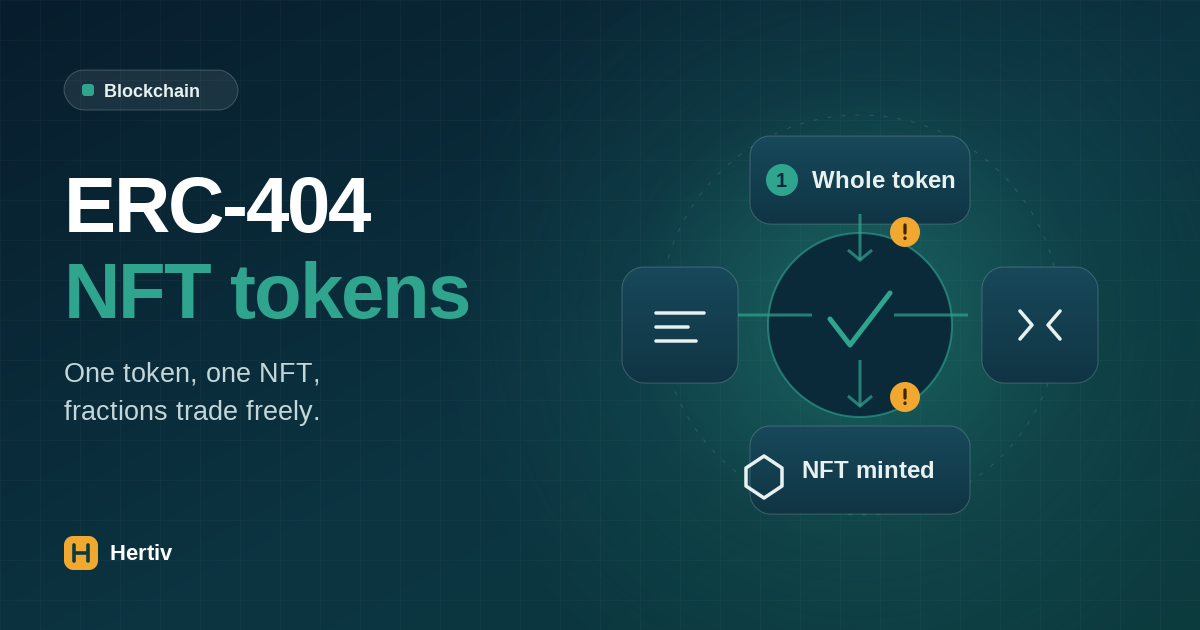
The mint-and-burn mechanism ties the NFT to the token balance: the contract mints an NFT when a wallet reaches a whole token and burns it when the balance falls below one.
Take a collection where one NFT equals one token, and the token can be split into fractions:
- Buy a whole token. The contract mints the matching NFT directly to your wallet.
- Sell part of it. Sell 0.4 of a token and the NFT is burned. You hold 0.6 of a token and no NFT.
- Buy back to a whole token. Once your balance reaches 1.0 again, a new NFT is minted to your wallet.
- Trade fractions freely. Fractions move on decentralised exchanges like any ERC-20 token, without touching an NFT marketplace.
| Your balance | What you hold | What happens |
|---|---|---|
| 1.0 token | 1 token + 1 NFT | NFT is minted to your wallet |
| 0.6 token | 0.6 token, no NFT | NFT is burned on the sale |
| 2.0 tokens | 2 tokens + 2 NFTs | One NFT per whole token |
| 0.0 token | Nothing | All NFTs burned on sale |
The NFT is not a fixed object you keep forever. It appears when your balance crosses a whole unit and vanishes when it drops below one, which is what makes the token tradeable in fractions. For the fungible half of the design, see how to create an ERC-20 token.
What do you need before you start?
Before you start, you need a wallet, test ETH, a contract based on an existing ERC-404 implementation, and a plan for metadata and gas.
| Item | What it is | Why it matters |
|---|---|---|
| Wallet | A self-custody wallet such as MetaMask | Holds tokens, NFTs and test ETH |
| Test ETH | Sepolia testnet ETH from a faucet | Pays gas on the test network |
| Contract code | An open-source ERC-404 implementation | Writing the hybrid logic from scratch is error-prone |
| Metadata and images | JSON files and artwork on IPFS | Defines what each NFT looks like |
| Development tools | Hardhat or Foundry, plus a node provider | Compiles, tests and deploys the contract |
| Gas budget | ETH set aside for deployment and testing | ERC-404 burns and mints on transfers, so gas is higher |
The most important decision is whether to use an existing implementation or write your own. Existing implementations have been used by live projects and reviewed by other developers, while a fresh implementation needs a full audit before it touches real value. For the NFT half of the standard, see what ERC-721 is.
How to create an ERC-404 NFT token, step by step
Creating an ERC-404 NFT token means defining the collection, deploying a hybrid contract, testing the mint-and-burn behaviour, and only then going live.
- Define the collection. Decide the supply, the token name and symbol, and how many NFTs pair with how many tokens.
- Prepare the artwork and metadata. Create the images and a JSON file for each NFT, and upload them to IPFS so the links stay stable.
- Pick an implementation. Choose an open-source ERC-404 contract and read its mint, burn and transfer logic before changing anything.
- Set the token parameters. Configure the supply, the base URI for metadata, and any allowlist or royalty settings the contract supports.
- Deploy to a testnet. Deploy on Sepolia and test every path: buy a whole token, sell a fraction, buy back to a whole.
- Check the gas. Record what each transfer costs, because minting and burning on every whole-token move makes ERC-404 more expensive than a plain ERC-20.
- Audit, then deploy to mainnet. Have the contract reviewed, verify the source on a block explorer, and deploy with a small supply first.
Test step 5 thoroughly. The mint-and-burn logic is the whole point of the standard, and a bug there can mint NFTs to the wrong wallet or burn one that should have stayed. A plain NFT collection is simpler to build; see creating an NFT on Polygon if fractional trading is not essential.
Example (hypothetical): a 100-piece art collection
Example (hypothetical): an artist creates a collection of 100 NFTs, each tied to 1 token, so the total supply is 100 tokens. Each token is priced at 2 ETH, which means selling the whole collection would bring in 100 x 2 = 200 ETH.
A buyer who wants a share buys 0.4 of a token for 0.4 x 2 = 0.8 ETH. At 0.4 of a token they hold no NFT, because the balance is below one whole token. They later buy another 0.6 of a token for 1.2 ETH, so their balance reaches 0.4 + 0.6 = 1.0 token and the contract mints the NFT to their wallet.
When that buyer sells 0.3 of a token, their balance falls to 0.7 and the NFT is burned. The remaining 0.3 of a token can still be traded on a decentralised exchange, and the buyer who collects a full token from fractions receives a newly minted NFT. The collection stays liquid at every step, which is the point of the standard.
What are the risks of ERC-404?
The risks of ERC-404 are that it is experimental, expensive in gas, and supported by fewer wallets and marketplaces than the established standards.
Gas is the first risk. Every transfer that crosses a whole-token boundary mints or burns an NFT, and that work costs gas on top of the transfer itself. Early projects reported noticeably higher transaction costs than plain token transfers, which matters for collections that expect frequent trading.
Support is the second risk. Because ERC-404 is not a formal standard, wallets and marketplaces may not display the NFTs correctly, and some tools treat the tokens as ordinary ERC-20s. The third risk is the standard itself: an implementation can change, a bug can be found in a widely copied contract, and there is no standards body to guarantee compatibility. For how token economics are designed in general, see what tokenomics is.
What are the common mistakes?
The most common mistakes with ERC-404 are treating it as a finished standard, skipping the audit, and forgetting that fractions do not hold an NFT.
- Assuming it is official. ERC-404 has no EIP, so compatibility and support are not guaranteed.
- Deploying without an audit. The hybrid transfer logic is subtle, and a bug affects tokens and NFTs at once.
- Ignoring gas costs. Minting and burning on transfers makes frequent trading expensive.
- Promising NFT ownership to fraction holders. A holder below one whole token owns a fraction, not an NFT.
- Skipping testnet testing. The mint-and-burn paths need real transactions to test, not just code review.
- Choosing ERC-404 by default. If the goal is a normal collection, ERC-721 is simpler, cheaper and better supported.
Key takeaways
- ERC-404 ties one whole token to one NFT through minting and burning
- It is experimental and not an official Ethereum standard; Pandora launched it in February 2024
- Fractions trade on exchanges like tokens; only a whole token holds an NFT
- Gas costs are higher than plain ERC-20 transfers because of the mint-and-burn work
- Test every balance path on a testnet and audit before mainnet
- Use ERC-721 instead when fractional trading is not needed
Frequently asked questions
Is ERC-404 an official Ethereum standard?
No. ERC-404 never went through the formal Ethereum Improvement Proposal process, so it is an experimental standard rather than an official one. It was first implemented by the Pandora project in February 2024 and has since been copied by other projects. Treat it as an experiment, not a settled specification.
Can I sell part of an ERC-404 NFT?
Yes, that is the point. You can sell a fraction of the token on a decentralised exchange, and the NFT is burned when your balance drops below one whole token. Buy the fractions back up to a full token and a new NFT is minted to your wallet.
How is ERC-404 different from fractionalising an NFT with a vault?
A vault locks the NFT in a contract and issues shares against it, which adds a custodian step. ERC-404 builds the fractionalisation into the token itself, so there is no vault and no lock. The trade-off is higher gas costs and weaker support from wallets and marketplaces.
How much does it cost to create an ERC-404 token?
Deployment and testing costs depend on gas prices and how much testing you do, so there is no fixed figure. Expect higher gas than a plain ERC-20 deployment because of the mint-and-burn logic, and budget for an audit before mainnet. See vendor site for current gas and audit pricing.
Do marketplaces support ERC-404 NFTs?
Support varies. Some marketplaces display ERC-404 NFTs, while others treat the tokens as ordinary ERC-20s and do not show the NFT side. Check the marketplaces your buyers use before launching, and test how your collection appears on each of them.
Should I use ERC-404 or ERC-721 for my collection?
Use ERC-721 unless you specifically need fractional trading. ERC-721 is the established standard, costs less gas, and works in every wallet and marketplace. ERC-404 only earns its extra cost when buyers need to trade fractions of an NFT on an exchange.


