What Is ERC-721, and How Does It Work?
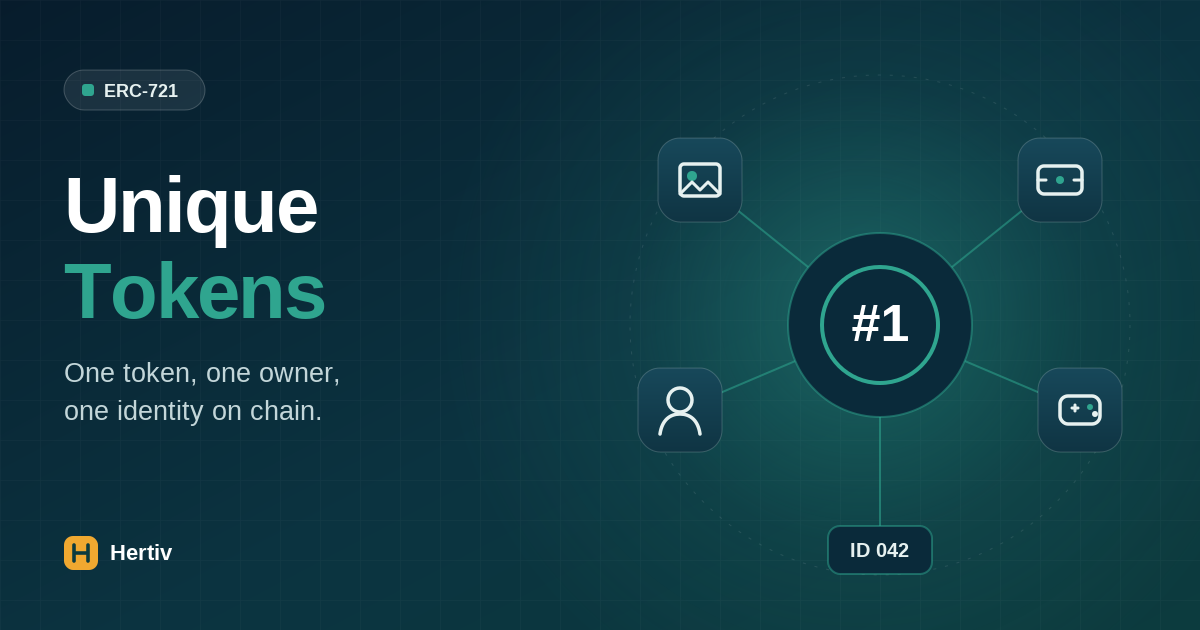
ERC-721 is the Ethereum standard for unique tokens: one token, one owner, one identity. Learn how it works, what it powers, and where it falls short.
On this page
Short answer
ERC-721 is the Ethereum standard for unique, non-fungible tokens. Each token has its own ID and owner, so it can represent one specific thing, such as a ticket, a membership or a piece of digital art, and be traded like any other asset on the chain.
What is ERC-721?
ERC-721 is a standard on Ethereum that defines how unique, non-fungible tokens are created, owned and moved. Each token has its own ID, and no two tokens are the same, which is what makes the standard useful for things that are one of a kind.
The standard was written so that wallets, marketplaces and apps all handle these tokens the same way. A token made by one team can be listed, sold and displayed by any tool that follows the standard, without custom work for each new project.
| Feature | ERC-721 (unique tokens) | ERC-20 (fungible tokens) |
|---|---|---|
| Each token | Has its own ID, one of a kind | Identical to every other token |
| Supply | Counted one token at a time | Counted as a total balance |
| Typical use | Art, tickets, memberships, game items | Currencies, points, shares |
| Dividing a token | Cannot be split into parts | Can be split into fractions |
Think of ERC-20 as coins in a till and ERC-721 as numbered tickets in a drawer. Coins are interchangeable, while each ticket has its own number and its own owner. For a wider look at what these tokens are used for, see NFT use cases.
How does an ERC-721 token work?
An ERC-721 token works through a smart contract that keeps a list of token IDs and the wallet that owns each one. When a token moves, the contract updates that list, so ownership is always visible on the chain and anyone can check it.
Each token carries a link to its metadata, usually a web address that points to a file with the name, description and image. The token itself lives on the chain, while the picture and details it points to often live elsewhere, which matters when you judge how durable a token is.
The standard defines a small set of functions every token contract must offer, such as checking the owner of a token and moving it to another wallet. Because the functions are the same everywhere, a marketplace can support every ERC-721 token without learning a new interface for each one. The contract code that makes this possible is built with smart contract development.
What can an ERC-721 token represent?
An ERC-721 token can represent anything that is one of a kind: a piece of digital art, a concert ticket, a club membership, a game item, a certificate or a domain name. The token is proof of ownership, and the thing it points to is what gives it meaning.
- Digital art and collectibles. The token proves which wallet owns a specific work, even if copies of the image exist elsewhere.
- Tickets and passes. Each ticket is a unique token, which makes it easy to check at the door and hard to fake.
- Memberships. Holding the token grants access to a group, a course or a service, and the membership can be passed on.
- Game items. Weapons, skins and characters become items a player truly owns and can trade.
- Certificates and records. A diploma or licence can be issued as a token that anyone can verify.
The pattern is the same in each case: the token is unique, its owner is public, and its history can be traced. That is why the standard is used far beyond art, even though art was the first use most people heard about.
How do you create an ERC-721 token?
You create an ERC-721 token by writing a smart contract that follows the standard, deploying it to Ethereum, and then calling its mint function to issue tokens. Each mint creates a new token ID and assigns it to a wallet.
- Decide what the token represents and what its metadata will contain.
- Write the contract using a tested library, and set the name, symbol and metadata address.
- Test the contract on a test network, including minting, transfers and the metadata link.
- Have the contract audited before it handles real money or real users.
- Deploy it to Ethereum and mint the first tokens.
- List the tokens on a marketplace or in your own app so people can find them.
Minting is not free. Every action on Ethereum costs a network fee, so the cost of creating a collection depends on how many tokens you mint and how busy the network is at the time. Plan the mint in batches and check the fee before you start. For the steps involved in launching a token, see what NFT minting is.
Example (hypothetical): a gallery sells 100 NFT tickets
Example (hypothetical): a small gallery plans an exhibition and sells 100 tickets as ERC-721 tokens at $25 each. The first sale brings in 100 times $25, which is $2,500, and every ticket holder can prove entry by showing the token in their wallet.
After the show, some holders resell their tickets. Resales total $4,000, and the contract pays the gallery a 5% royalty on each resale, which is $200. The gallery earns from the second sale as well as the first, which paper tickets never allowed.
The gallery also learns the limits. Two buyers lose access to their wallets and cannot recover their tickets, and one buyer finds a fake copy of the ticket on another marketplace. The token proves ownership, but it cannot fix a lost key or stop someone copying an image.
What are the risks and limits of ERC-721?
The risks of ERC-721 start with cost and end with custody. Network fees can make small tokens uneconomic, and a token is only as safe as the wallet that holds it, because a lost key usually means a lost token.
A second limit is that the token and its content are not the same thing. The token lives on the chain, but the image or file it points to is often stored on a normal server. If that server goes down, the token still exists, but the picture it was meant to show is gone.
Copies are a third problem. Anyone can mint a token that points to the same image, so owning a token does not prove you own the original work unless you trust the issuer. Check who minted the token before you pay, not just what it shows. And remember that prices swing fast, so a token bought today can be worth far less next month.
What are the common mistakes?
The most common ERC-721 mistakes are skipping the audit, storing metadata carelessly, and treating the token as proof of something it does not prove. Each one is easy to avoid if you plan for it.
- Deploying without an audit. A bug in the contract can lock tokens or let someone mint without limit.
- Pointing metadata at a server you do not control. If the link breaks, the token loses its meaning.
- Assuming the token proves the art is genuine. It proves who minted it, not that the minter had the right to do so.
- Ignoring network fees. Minting a large collection during a busy hour can cost far more than planned.
- No plan for lost keys. Users who lose access to a wallet lose the token with it.
Key takeaways
- ERC-721 defines unique tokens, each with its own ID and owner
- ERC-20 covers interchangeable tokens; ERC-721 covers one-of-a-kind items
- The token lives on chain, but its image and details often live elsewhere
- Minting, transfers and royalties all run through a smart contract
- Check the contract, the minter and the metadata link before you buy
Frequently asked questions
What does ERC-721 stand for?
ERC-721 is short for Ethereum Request for Comments 721, the proposal number of the standard. It sets the rules every unique-token contract on Ethereum follows, so wallets and marketplaces can handle tokens from any project in the same way.
Is an ERC-721 token the same as an NFT?
An NFT is the idea of a unique digital item, and ERC-721 is the most common technical standard that puts that idea on Ethereum. Most NFTs you hear about are ERC-721 tokens, but other chains use their own standards for the same idea.
Can an ERC-721 token be split into parts?
No, an ERC-721 token cannot be divided. It is one whole item with one owner at a time. If a project wants shared ownership, it must use a different design, such as issuing many tokens or wrapping the item in another contract.
How much does it cost to mint an ERC-721 token?
The cost depends on the network fee at the time you mint, which changes with demand. Minting one token is usually a small fee, but minting a large collection can add up, so check the current fee and mint in batches if needed.
What happens if I lose the wallet holding my token?
The token stays on the chain, but you can no longer move or sell it without the wallet key. There is no password reset for a lost key, which is why a backup of the recovery phrase matters before you buy anything.
Do I own the copyright when I buy an ERC-721 token?
Usually not. Buying the token normally gives you ownership of that token, not the copyright of the art or content it points to. The terms of the project decide what rights come with the token, so read them first.


