How to Implement a Permissioned Blockchain
A permissioned blockchain limits who can join and write to the ledger. This guide covers the decisions, setup steps and running costs of a working network.
On this page
Short answer
A permissioned blockchain is a shared ledger where only approved organisations can join, run nodes and write records. You implement one by agreeing the members and rules, choosing a platform, setting up the network and identity system, writing the smart contracts, then testing and running it under shared governance.
What is a permissioned blockchain?
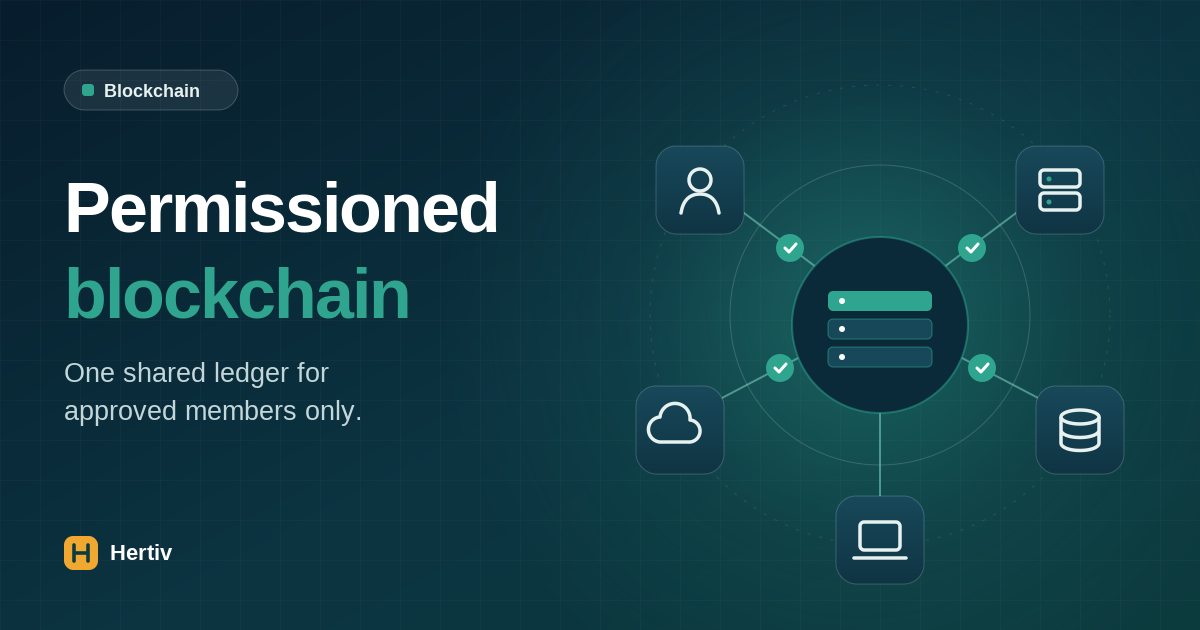
A permissioned blockchain is a shared ledger where only approved organisations can join the network, run nodes and write records. Unlike a public chain, membership is controlled: each participant is identified, given a role, and held to rules the members agree in advance.
Each member runs one or more nodes that hold a copy of the ledger. Transactions are checked against the network rules, then recorded in blocks that every member can verify. Because the members are known, the network can use fast agreement methods instead of the energy-heavy mining used by public chains.
Permissioned chains are used where a small group of organisations needs one shared record: banks settling trades, suppliers tracking goods, or hospitals sharing referral data. The point is not to remove trust, but to make the shared record checkable by everyone who relies on it. You can read the background in what a permissioned blockchain is before planning a build.
When does a permissioned blockchain fit?
A permissioned blockchain fits when several organisations share data but no single one should own the record. If one company controls the database, the others must trust its admin; if each keeps a copy, the copies drift apart. A shared ledger gives every member the same verified record.
| Use case | Why it fits | Watch out for |
|---|---|---|
| Trade finance | Banks and shippers share documents | Legal status of digital records |
| Supply chain tracking | Suppliers add events to one record | Bad data entered at the source |
| Interbank settlement | Banks settle directly, fewer steps | Regulatory reporting duties |
| Health data sharing | Clinics share referrals with consent | Privacy rules and patient consent |
| Land and asset records | Registries and buyers share titles | Paper records that must match |
It fits less well when one organisation owns the data, when only two parties are involved, or when a normal shared database with access control would do the same job for less effort. A ledger adds value only when the members need to verify each other's records without a central owner.
How do you choose the platform?
You choose the platform by matching its features to your members, your data rules and your team's skills. The main options are Hyperledger Fabric, Quorum, Corda and Hyperledger Besu, and each suits a different shape of network.
Fabric suits networks where members need private channels between subsets of participants, such as banks that trade in pairs. Corda suits financial agreements where each deal is visible only to the parties involved. Quorum and Besu suit teams that want Ethereum-style smart contracts with access control added on top.
Ask four questions before choosing: does the platform support the privacy model you need, does it run in your members' environments, can your team write and test its smart contracts, and is it still maintained? A platform with a small community leaves you fixing bugs alone. The cost picture is covered in enterprise blockchain implementation cost.
What are the steps to set up the network?
You set up a permissioned blockchain in seven steps, starting with agreement between members and ending with a tested network that real users can join.
- Agree the members and rules. List who joins, what each member may do, and how decisions are made. Write this down as a governance agreement before any code.
- Define the data model. Decide what a record looks like, which fields are shared and which stay private, and who may read each field.
- Set up identity. Give every organisation and user a certificate from a shared identity service, so each transaction is signed by a known party.
- Build the smart contracts. Write the rules that check each transaction, such as who may transfer an asset and what approvals are needed.
- Deploy the nodes. Each member runs its own nodes, usually in its own cloud account, connected through the network's agreed settings.
- Test with realistic data. Run the full workflow with test records, including failures, retries and a member going offline.
- Go live in stages. Start with one workflow and a small volume, then add members and workflows once the first one runs cleanly.
Keep the first version small. A network that does one workflow well teaches the members how to work together, and later workflows are cheaper to add than the first one.
Example (hypothetical): a trade finance network
Example (hypothetical): four banks and two shipping firms want one shared record for letters of credit. Today each keeps its own copy of every document, and reconciling them takes days.
The group agrees that each bank runs two nodes and each shipper runs one, so the network has 10 nodes. A letter of credit is a record with the buyer, seller, amount and expiry. A payment is released only when the shipper's delivery record and the bank's inspection record both appear on the ledger.
The numbers: the group expects 200 letters of credit a month. Each letter needs about 6 ledger writes, so the network handles 1,200 writes a month, or about 40 a day. At that volume a small node each is enough, and the main cost is the shared testing and the legal agreement, not the hardware.
After three months of testing with old cases, the group goes live with one trade route. Reconciliation time falls from 3 days to same-day, because every member reads the same record instead of comparing copies. The group then adds a second route using the same contracts.
What are the common mistakes?
The most common mistakes are starting with technology before agreement, letting one member run everything, and treating the ledger as a fix for bad data.
- No governance agreement. If members cannot agree who decides when rules change, the network stalls at the first dispute.
- One member hosts all nodes. That member becomes the central owner the ledger was meant to avoid.
- Bad data on the ledger. A blockchain records what it is given; it cannot check whether a shipment really arrived.
- Too many workflows at once. Launching five workflows together means five sets of bugs and five arguments.
- Forgetting upgrades. Smart contracts need a tested upgrade path, or a bug becomes permanent.
How do you run the network after launch?
You run a permissioned blockchain like shared infrastructure: with a rota for upgrades, monitoring that every member can see, and a clear process for adding or removing members.
Each member monitors its own nodes and shares uptime reports with the group. Upgrades to the platform or the smart contracts are tested on a copy of the network first, then rolled out together so no member is left on an old version.
Adding a member means issuing certificates, syncing a node and checking that the new member can read only what it should. Removing one means revoking its certificates and confirming its nodes stop writing. Plan these steps in advance, because the first membership change usually arrives sooner than expected. Compare the two network types in permissioned vs permissionless blockchain if your group is still deciding.
Key takeaways
- A permissioned blockchain is a shared ledger for approved, identified members
- Governance and the data model come before any code
- Choose the platform by privacy model, skills and maintenance, not by fashion
- Start with one workflow, test with realistic data, then expand
- A ledger cannot fix bad data entered at the source
Frequently asked questions
Do members need to run their own nodes?
Yes, in most networks. Each member should run at least one node so it holds its own copy of the ledger and can verify records without asking another member. A member that only reads through someone else's node gains little from the network.
How is a permissioned blockchain different from a shared database?
A shared database has one owner who controls access and can change records. A permissioned ledger gives every member a verified copy, and records are checked against rules the members agreed together. The difference matters when members do not fully trust one central owner.
Which platform should a small network start with?
There is no single right answer. Hyperledger Fabric suits private channels between members, Corda suits financial agreements, and Quorum or Besu suit Ethereum-style contracts. Pick the one your team can run and test, and that is still actively maintained.
How long does a first network take to build?
A small network with one workflow often takes three to six months from agreement to live use, with most of the time spent on the governance agreement, the data model and testing. The ledger code itself is usually the smaller part of the work.
Can a member be removed from the network?
Yes. The network revokes the member's certificates so its nodes can no longer write, and the remaining members confirm the change. Plan the removal steps in the governance agreement, because a disputed removal is much harder to handle later.
Does a permissioned blockchain need cryptocurrency?
No. Permissioned networks do not use a public coin. Members pay their own running costs, and any fees between members are agreed in the governance agreement rather than paid in a token.


