Permissioned vs Permissionless Blockchain: What Differs
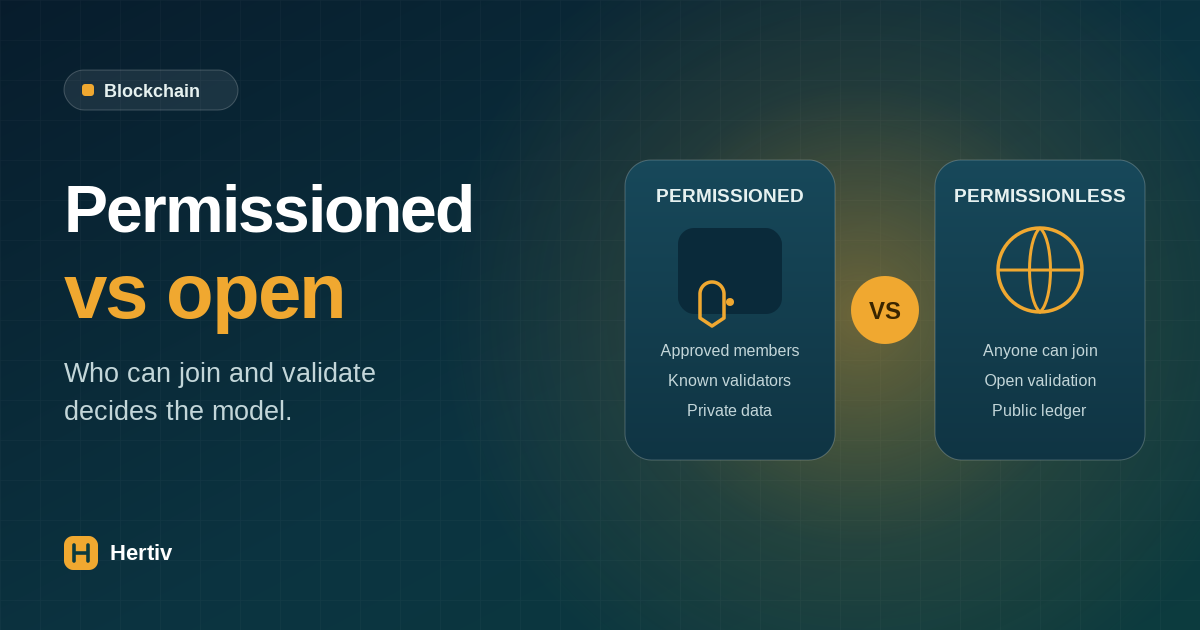
Permissioned blockchains limit who can join and validate; permissionless ones let anyone join. Compare control, speed, trust and cost to pick the right model.
On this page
Short answer
A permissioned blockchain restricts who can read, write and validate transactions to approved participants, while a permissionless blockchain lets anyone join and validate without approval. Permissioned networks suit regulated businesses that need known identities and privacy; permissionless networks suit open systems where no single party should control access. The choice shapes governance, speed and cost.
What is a permissioned blockchain?
A permissioned blockchain is a blockchain where participation is controlled: an authority or a group of members decides who can join the network, who can submit transactions and who can validate them. Every participant has a known identity.
Well-known examples are Hyperledger Fabric, Corda and Quorum. They are used for trade finance, supply chains and interbank settlement, where the parties know each other and the rules are set by agreement. Because validators are known, the network can use faster consensus methods and keep transaction data private between the parties involved.
Permissioned does not mean centralised in the old sense. The ledger is still shared across the members, and no single member can rewrite history alone. But the trust model is different: you trust the members and the governance rules, not open competition between anonymous validators. For the basics of the technology, see what a blockchain is.
What is a permissionless blockchain?
A permissionless blockchain is a blockchain anyone can join, read, submit transactions to and validate, without asking anyone for approval. Participants are identified by keys, not by real-world identity, and the rules are enforced by the protocol.
Bitcoin and Ethereum are the best-known examples. Anyone can run a node, anyone can propose a block under the consensus rules, and anyone can build an application on top. That openness is the point: no single party can block a transaction or change the rules on its own.
The cost of openness is speed and privacy. Open consensus is slower and more expensive than a closed validator set, and transaction data is visible to everyone on the network. That is why permissionless networks suit open money and public applications, and less often suit private business data.
Permissioned vs permissionless: side by side
The two models differ on access, identity, speed, privacy and governance. The table below is the short version; the sections after it explain when each one fits.
| Feature | Permissioned | Permissionless |
|---|---|---|
| Who can join | Approved members only | Anyone |
| Identity | Known, verified participants | Pseudonymous keys |
| Who validates | A chosen set of validators | Anyone under the protocol rules |
| Speed | Faster, fewer validators | Slower, open consensus |
| Privacy | Data can be kept between parties | Transactions are public |
| Governance | Set by member agreement | Set by protocol and community |
| Typical use | Trade, banking, supply chains | Money, public apps, DeFi |
One common confusion is permissioned versus private. A private blockchain is visible to one organisation, while a permissioned one can be shared across many organisations with controlled access. The two ideas overlap but are not the same. Public versus private is about who can see the ledger; permissioned versus permissionless is about who can join and validate.
When should you choose a permissioned blockchain?
You should choose a permissioned blockchain when the participants are known, the data is sensitive, and the rules need to be agreed in advance. That is the normal case for regulated business networks.
Good fits include trade finance between banks, supply chain tracking between known suppliers, and settlement between financial institutions. In each case the parties already have legal agreements, they need to know who they are dealing with, and they need transaction privacy. A permissioned network gives them a shared ledger without giving up control over who joins.
The governance work is real: someone must run onboarding, set the rules for adding members, and decide what happens when a member breaks them. That is a business agreement first and a technical setup second. Get the agreement signed before writing code.
When should you choose a permissionless blockchain?
You should choose a permissionless blockchain when the system must be open to anyone, when no single party should control access, and when the value of the network comes from openness itself.
Good fits include public money, open marketplaces and applications where users should not need permission to join. A permissionless network also fits when the participants do not know or trust each other in advance, and the protocol itself has to provide the trust. Smart contracts on a public chain can enforce rules without a central operator, which is why most DeFi and NFT applications run there. For the contract side, see smart contract development.
The trade-offs are speed, cost and privacy. Transactions are public, fees vary with demand, and throughput is lower than a closed validator set. If your use case needs private data or high throughput, a permissionless chain is usually the wrong fit.
Example (hypothetical): a trade-finance network
Example (hypothetical): four banks want a shared ledger for letters of credit, so each bank can see the status of a shipment without phone calls and paper. The banks know each other, they are regulated, and the documents are confidential.
A permissionless chain would be a poor fit: the documents cannot be public, and the banks need to know exactly who validated each entry. A permissioned network fits: the four banks run validator nodes, the regulator gets a read-only node, and each letter of credit is visible only to the banks involved in it.
The setup takes 12 weeks. Onboarding and the legal agreement take 4 weeks, the network and smart contracts take 6 weeks, and testing with real documents takes 2 weeks. The cost is the engineering time plus the governance work, and the saving comes from fewer manual checks: if each letter of credit saves 6 hours of manual work and the network handles 100 a month, that is 600 hours a month saved.
What are the common mistakes?
The most common mistakes are choosing the model from hype, confusing permissioned with private, and skipping the governance agreement.
- Choosing permissionless for private data. Public transactions cannot be made private later. If the data is sensitive, start permissioned.
- Choosing permissioned for an open market. A closed network kills the network effect an open marketplace needs.
- Confusing permissioned with private. A permissioned network can span many organisations. Decide separately who can see the ledger and who can validate it.
- Skipping governance. Without rules for adding members and handling disputes, the network stalls at the first disagreement.
- Ignoring regulation. Financial and identity rules vary by market, so check the rules that apply before picking a model. The MiCA regulation guide is a useful starting point for Europe.
Key takeaways
- A permissioned blockchain limits who can join and validate to approved members
- A permissionless blockchain lets anyone join, read and validate without approval
- Permissioned fits regulated business networks with known participants and private data
- Permissionless fits open systems where no single party should control access
- Public versus private is about visibility; permissioned versus permissionless is about who can join and validate
Frequently asked questions
What is the difference between permissioned and private blockchains?
A private blockchain is visible to one organisation, while a permissioned blockchain can be shared across many organisations with controlled access. Public versus private is about who can see the ledger; permissioned versus permissionless is about who can join and validate it.
Can a permissioned blockchain become permissionless later?
In theory yes, but in practice it is a rebuild of the trust model, the consensus rules and the governance agreement. The choice is hard to reverse, so decide from the use case before building, not after the network is live.
Are permissioned blockchains less secure?
They are secure in a different way. A permissioned network relies on known validators and governance rules, while a permissionless network relies on open competition and economic incentives. The right question is which trust model fits your participants, not which one is stronger in general.
Which is faster, permissioned or permissionless?
Permissioned networks are usually faster, because a small known set of validators can agree quickly. Permissionless networks are slower because open consensus takes more work. Speed alone is not a reason to choose: privacy and openness matter just as much.
Do permissioned blockchains use smart contracts?
Yes. Permissioned platforms such as Hyperledger Fabric and Corda support smart contracts, often called chaincode or CorDapps, that encode the business rules between members. The contracts run only for the parties involved in a transaction.
Can the public use a permissioned blockchain?
Only if the governance rules allow it. Some permissioned networks give the public read access to part of the ledger, such as shipment status, while keeping write and validation access to approved members. That mix is common in supply chains.


