What Is a Permissioned Blockchain, and How Does It Work?
A permissioned blockchain is a ledger where only approved organisations can read, write or validate. Learn how it differs from public chains and when one fits.
On this page
Short answer
A permissioned blockchain is a distributed ledger where a defined set of approved participants can read data, submit transactions and validate blocks, while everyone else is kept out. It trades the open access of public chains for control over who joins, what they can see and how disputes are settled.
What is a permissioned blockchain?
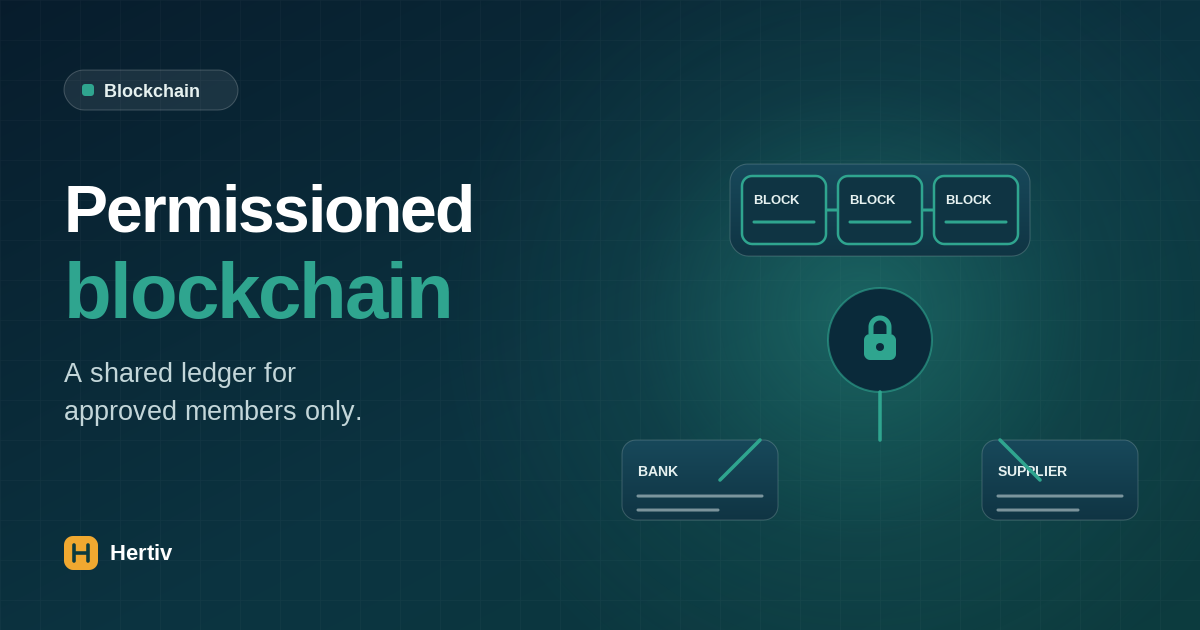
A permissioned blockchain is a shared ledger run by a known group of organisations, where each participant needs approval before it can join the network, read data or validate transactions. Access is controlled by an identity system, so every node and user is known to the network operator.
Unlike a public chain, where anyone can download the software and take part, a permissioned chain has a gate. A bank, a supplier or a regulator can be given exactly the permissions it needs, and no more. The ledger is still shared and tamper-resistant, but it is shared among a closed group.
Think of it as a shared database with strict membership rules and a built-in audit trail. The members agree on the rules in advance, and the ledger records every change so that any member can check what happened and when.
How does a permissioned blockchain differ from a public one?
The main difference is who can take part. Public chains are open to anyone, while permissioned chains limit membership to approved organisations. That single choice changes speed, privacy and governance in ways that matter for business use.
| Feature | Permissioned blockchain | Public blockchain |
|---|---|---|
| Who can join | Approved organisations only | Anyone with the software |
| Who validates | Known, named validators | Anyone who meets the rules |
| Speed | Faster, fewer validators | Slower, many validators |
| Privacy | Data visible only to members | Data visible to everyone |
| Governance | Members vote by agreement | Protocol rules and community |
| Use case | Shared records between firms | Open payments and assets |
Permissioned chains also avoid the energy cost of mining, because a small set of known validators can agree on new blocks without competition. The trade-off is trust: members must trust the group that controls membership, even if they do not trust each other.
How does access control work on a permissioned chain?
Access control on a permissioned chain starts with identity. Each organisation gets a digital certificate that proves who it is, and the certificate decides what it can do: read data, submit transactions, run a validator node, or only view selected records.
Permissions are usually split by role. A regulator might read everything but write nothing. A supplier might submit delivery records but never see another supplier's prices. A bank might validate blocks and settle payments. These rules are written into the network configuration, not left to goodwill.
When a member leaves, its certificate is revoked and its nodes stop being accepted by the network. When a new member joins, the existing members approve it and issue a certificate. This makes onboarding and offboarding a normal administrative task rather than a technical project.
For teams that need to keep data private between members, the same pattern appears in enterprise blockchain projects, where channels or private collections hide data from members who do not need it.
What consensus do permissioned chains use?
Permissioned chains use consensus methods built for known validators, such as Practical Byzantine Fault Tolerance, Raft or proof of authority. These methods agree on new blocks quickly because the validators are identified in advance and there is no need for mining or staking.
A common setup is a voting rule: a block is final once two-thirds of the validators agree on it. With six validators, four must agree. That gives fast finality, often within a second, and there is no risk of the chain splitting into competing versions the way public chains can.
The trade-off is fault tolerance. If more than a third of validators fail or turn dishonest, the network can stall. That is why members choose validators they trust and spread them across organisations and locations, rather than letting one member run them all.
Where do permissioned blockchains fit in practice?
Permissioned chains fit where several organisations must share one record but cannot see each other's private data. The classic cases are trade finance, supply chains, interbank settlement and shared identity checks.
In trade finance, a buyer, a seller, two banks and a shipper can share the status of a shipment and its documents on one ledger, instead of each keeping a separate copy and reconciling by email. In supply chains, a manufacturer and its suppliers can prove the origin of parts without sharing prices. In banking, a group of banks can settle payments between themselves without a central clearing house.
They fit less well where the users are unknown or where the value comes from open access, such as public payments or open marketplaces. If anyone should be able to join, a public chain is the better tool.
Tokenised assets are a growing use case: a group of issuers and custodians can move fund shares or bonds between approved holders on a permissioned ledger, with the legal register staying off-chain. See how tokenization works for the mechanics behind that pattern.
How to run a small permissioned blockchain pilot
A pilot should prove one shared workflow with two or three organisations, not the whole business. Pick a process where reconciliation already wastes time, such as invoice matching or shipment status, and put only that on the ledger.
- Pick the members. Choose two or three organisations that already share data and agree to take part.
- Define the record. Agree on exactly which fields go on the ledger and which stay private.
- Set the permissions. Decide who reads, who writes and who validates, and write it down before any code.
- Choose the platform. Pick a framework that fits your team's skills, such as Hyperledger Fabric or a managed service.
- Run parallel. Keep the old process running alongside the ledger for a month and compare the results.
- Measure the gap. Count the hours saved on reconciliation and the errors caught, then decide whether to expand.
Most pilots fail on governance, not technology. If the members cannot agree on who approves new members or how disputes are settled, the ledger will stall before it ships.
Example (hypothetical): four banks share a settlement ledger
Example (hypothetical): four regional banks settle payments between themselves each day, and each bank keeps its own ledger of what it owes the others. Reconciliation takes two staff members about three hours a day, and disagreements take a day to resolve.
The banks set up a permissioned chain with two validator nodes each, eight nodes in total. A block is final when six of the eight validators agree, so the network keeps working even if two nodes go offline. Each bank can read all settlement records but can only submit its own payments.
After a month running in parallel, the banks compare the ledgers. The shared ledger matches on every payment, and the two staff members spend their time on exceptions instead of routine matching. The arithmetic is simple: 2 staff × 3 hours × 20 days is 120 hours a month, and the pilot cuts that to about 20 hours of exception work.
The banks keep the old process as a backup for three more months, then agree to settle on the ledger alone. The lesson is that the value came from one shared record, not from the chain itself.
What are the common mistakes?
The most common mistakes are treating a permissioned chain as a database, skipping governance and putting too much data on the ledger.
- Using it as a database. If only one organisation writes and reads, a normal database is cheaper and faster.
- No governance agreement. Without written rules for membership, disputes and upgrades, the first disagreement stops the network.
- Too much data on-chain. Large files and personal data belong off-chain, with only hashes and references on the ledger.
- One member runs everything. If a single organisation controls all validators, the ledger adds nothing over its own database.
- Ignoring the legal layer. The ledger record must match contracts and regulations, or it has no standing when a dispute arises.
Regulatory questions matter here too. Rules such as the EU's MiCA framework shape what tokenised assets and stablecoins can do, which is why what MiCA covers is worth reading before a financial pilot.
Key takeaways
- A permissioned blockchain limits membership to approved organisations with known identities
- Fewer validators means faster finality and stronger privacy than public chains
- Permissions split by role control who reads, writes and validates
- They fit shared records between firms, such as trade finance and settlement
- Governance and the legal layer decide success more than the technology does
Frequently asked questions
Is a permissioned blockchain the same as a private blockchain?
They are closely related. A private blockchain is usually run by one organisation, while a permissioned blockchain is run by a group of organisations that each control some nodes. Both restrict access, but permissioned chains share control across members.
Can the public see transactions on a permissioned blockchain?
No. Only approved members can read the ledger, and permissions can hide data from members who do not need it. This is one of the main reasons businesses choose permissioned chains over public ones.
Which platforms are used for permissioned blockchains?
Common choices include Hyperledger Fabric, Hyperledger Besu and Corda, plus managed services from cloud providers. The right choice depends on your team's skills, the privacy model you need and whether you want smart contracts.
Are permissioned blockchains secure?
They are secure against tampering by members, because every change is recorded and signed. The main risk is governance: if one member controls most validators, or if certificates are poorly managed, the security guarantees weaken.
Do permissioned blockchains need cryptocurrency?
No. Most permissioned chains run without a token, because validators are known organisations rather than anonymous miners who need payment. Tokens appear only when the use case needs one, such as settling payments on the ledger.
When should we choose a public chain instead?
Choose a public chain when anyone should be able to join, when the asset must be openly tradable, or when censorship resistance matters more than privacy. For shared records between known firms, a permissioned chain is usually the better fit.


