Enterprise Blockchain Implementation: What It Costs
Enterprise blockchain costs depend on the use case, the network model and how much existing systems must change. This guide breaks down each phase and its costs.
On this page
Short answer
Enterprise blockchain implementation costs vary widely because no two projects share the same use case, network model or integration load. A small pilot on a managed network costs far less than a production system with custom smart contracts, integrations and compliance work, so the honest answer starts with scope, not a single number.
What does enterprise blockchain implementation cost?
Enterprise blockchain implementation is the work of putting a blockchain system into production inside a company: designing the network, building smart contracts, connecting existing systems, and running it under real operating and compliance rules.
Costs vary widely because no two projects share the same use case, network model or integration load. A small pilot on a managed network costs far less than a production system with custom smart contracts, integrations and compliance work, so the honest answer starts with scope, not a single number.
| Cost driver | What pushes it up |
|---|---|
| Use case | Payments and settlement cost more than simple record-keeping |
| Network model | A private network needs more setup than a managed one |
| Smart contracts | Custom logic and audits add weeks of work |
| Integrations | Each legacy system adds design and testing time |
| Compliance | Regulated data adds review, reporting and controls |
| Scale | More users and transactions need more infrastructure |
Most of the money goes to people, not to the chain itself. Design, development, testing and audit usually make up the largest share of the budget, while network fees and hosting are a smaller running cost. Our guide to what enterprise blockchain is explains the models these costs apply to.
The phases of an enterprise blockchain project
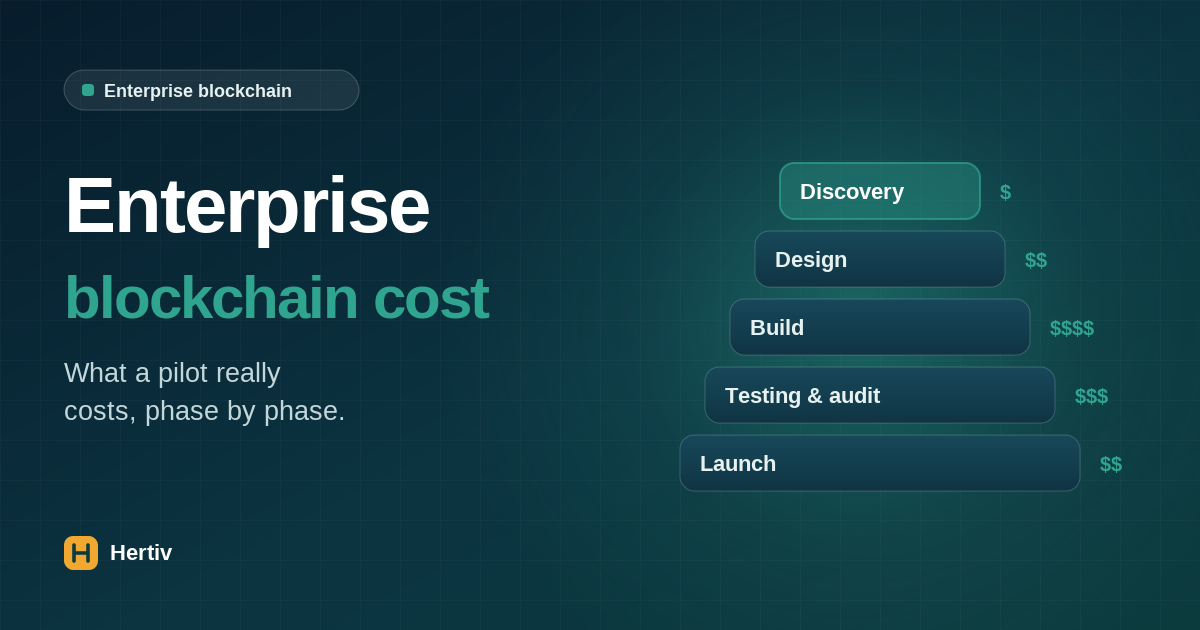
An enterprise blockchain project moves through five phases: discovery, design, build, testing and launch. Each phase has its own cost, and skipping one usually moves the cost to a later, more expensive phase.
| Phase | What happens | Typical share of budget |
|---|---|---|
| Discovery | Use case, users and success measures | Small |
| Design | Network model, data model, contracts | Medium |
| Build | Contracts, apps and integrations | Largest |
| Testing | Security audit, load and user testing | Medium |
| Launch | Go-live, training and support | Small to medium |
Discovery is the cheapest phase and the one most often rushed. A use case that does not need a blockchain is far cheaper to drop at discovery than to rebuild after launch.
Testing deserves its own budget line. A smart contract audit is not optional for a production system: once a contract is live, fixing a flaw can mean redeploying and migrating data, which costs more than the audit did.
What drives the cost up or down?
Three choices drive most of the cost: the network model, the number of integrations, and how much custom contract logic the project needs.
The network model sets the baseline. A managed blockchain service handles node operations for you, while a private network that you run yourself needs infrastructure, monitoring and staff time. A private blockchain gives control, but that control has a running cost.
Integrations are the second driver. Connecting a blockchain to an ERP, a warehouse system or a bank feed means mapping data, handling failures and testing both sides. Each integration adds design and testing time, and the count of systems matters more than the size of any one of them.
Custom contract logic is the third driver. A simple record-keeping contract is quick to write and audit. A contract that moves value, enforces business rules and talks to other contracts takes longer to build and longer to audit, and the audit cost grows with it.
Team, timeline and running costs
A typical enterprise blockchain pilot needs a small team: a blockchain developer, a back-end developer, a designer or front-end developer, and a project lead. Larger projects add a security reviewer, a DevOps engineer and a business analyst.
Timelines run from about eight weeks for a narrow pilot to six months or more for a production system with several integrations. The pilot proves the use case; the production build adds the hardening, audit and operating work that a pilot can skip.
Running costs include node hosting or a managed service fee, monitoring, support and contract maintenance. These are usually a small share of the first-year budget, but they continue every year, so a business case should show them for three years, not one.
If you need outside help, enterprise blockchain companies can supply the team.
An enterprise blockchain service page shows what a delivery partner usually covers. Prices vary, so ask vendors for a scoped quote rather than a day rate.
Example (hypothetical): a supply-chain pilot budget
Example (hypothetical): a distributor plans a pilot that tracks shipments on a permissioned network. The team is three developers working for 12 weeks at 40 hours a week, which is 1,440 hours: 3 developers times 12 weeks times 40 hours equals 1,440 hours.
At a planning rate of $90 per hour, the build work costs $129,600: 1,440 hours times $90 equals $129,600. A managed network and tooling adds $15,000 for the pilot period, and a security review of the contracts adds $10,000.
Those three lines total $154,600. A 10 percent reserve for surprises adds $15,460, which brings the pilot budget to $170,060. The reserve matters because integration work often uncovers data problems that no one planned for.
This is a planning figure, not a quote. Real costs depend on the use case, the team's rates and the systems involved, so treat the arithmetic as a way to test a budget, not as a price list.
How to keep implementation costs under control
Costs stay under control when the scope stays small and the use case stays clear. The most effective control is a pilot that proves one flow end to end before the team builds the rest.
- Start with one flow. Pick the single process that benefits most, and prove it before adding more.
- Use a managed network for the pilot. Let a provider run the nodes while you test the business logic.
- Reuse before you build. Standard token and registry contracts cost less to audit than custom ones.
- Freeze the scope at design. New features during the build push the audit and the launch date back.
- Budget the audit early. Put testing and audit in the first budget, not in the leftover funds.
Permissioned networks suit many enterprise pilots because access is controlled and data stays private. Read what a permissioned blockchain is before choosing the model, since the choice shapes both cost and compliance work.
What are the common mistakes?
The most common mistakes with enterprise blockchain budgets are starting with technology instead of a use case, skipping the audit, and forgetting the running costs.
- No clear use case. If a shared database would do the job, a blockchain adds cost without benefit.
- Skipping the audit. An unaudited contract in production is a risk, not a saving.
- Forgetting running costs. Hosting, monitoring and support continue after launch and belong in the business case.
- Underestimating integrations. Legacy systems hold messy data, and cleaning it takes time.
- Building everything at once. A big-bang launch is harder to test and harder to fix than a staged rollout.
Scope the pilot, price the audit, and plan for three years of running costs. A blockchain project that starts small and proves value earns the budget for the next phase; one that starts big rarely gets a second chance.
Key takeaways
- People, not the chain, are the largest cost in most projects.
- Discovery is cheap; skipping it makes later phases expensive.
- Network model, integrations and custom contracts drive the price.
- Budget the audit and three years of running costs up front.
- Start with one pilot flow before building the full system.
Frequently asked questions
What is enterprise blockchain implementation?
Enterprise blockchain implementation is putting a blockchain system into production inside a company. It covers network design, smart contracts, system integrations, testing and ongoing operation.
How much does an enterprise blockchain project cost?
There is no single figure. A narrow pilot costs far less than a production system with custom contracts and several integrations, so vendors quote from a scoped use case, not a price list.
What is the most expensive part of the project?
People are usually the largest cost: design, development, testing and audit. Network fees and hosting are a smaller share, but they continue every year.
Do I need a private blockchain for enterprise use?
Not always. A managed or permissioned network often fits a pilot, while a private network gives more control at a higher running cost. The use case and compliance needs decide.
How long does implementation take?
A narrow pilot takes about eight weeks, while a production system with several integrations can take six months or more. Audit and hardening add time that a pilot can skip.
Can a pilot prove the business case?
Yes, if it covers one real flow end to end with real users. A pilot that proves time or cost savings earns the budget for the next phase.


