Enterprise Blockchain Companies Worth Shortlisting
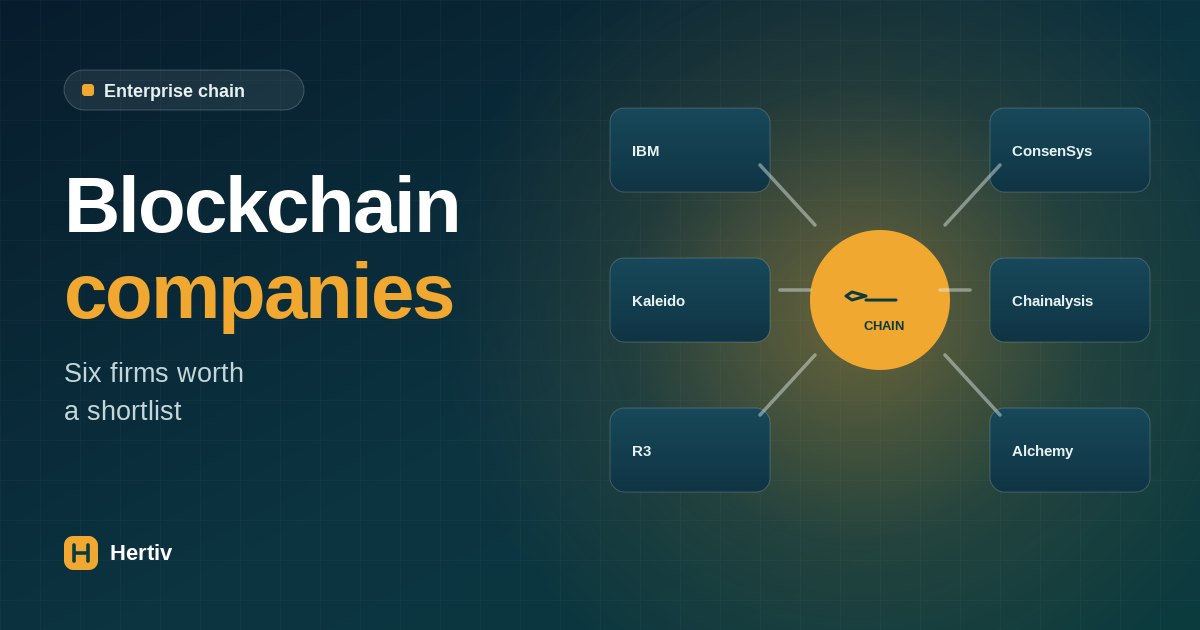
Enterprise blockchain companies from IBM and ConsenSys to R3 and Alchemy help startups build on proven platforms. Compare what each offers before you shortlist.
On this page
Short answer
Enterprise blockchain companies are firms that sell platforms, tools and services for building business blockchain applications, and the ones worth shortlisting for a startup are those with proven networks, clear pricing, and support that a small team can actually use. The right choice depends on whether you need a private ledger, a public chain, or tools to build on one.
Which enterprise blockchain companies should startups shortlist?
Shortlist enterprise blockchain companies by what your product needs: a private ledger for shared records between known parties, a public chain for open assets, or developer tools that hide the chain complexity. Most startups need one of these three, not all of them.
Use this comparison to narrow the list. Pricing is not listed because enterprise deals are usually negotiated; check the vendor site for current plans.
| Company | Best for | Core offering | Chain type |
|---|---|---|---|
| IBM | Regulated, large-scale projects | Blockchain platform and services | Private, Hyperledger-based |
| ConsenSys | Ethereum products and wallets | MetaMask, Infura, Besu | Public Ethereum |
| R3 | Finance and trade networks | Corda platform | Private, permissioned |
| Alchemy | Developer APIs and scaling | Node APIs, smart contract tools | Public chains |
| Kaleido | Fast private chain setup | Managed blockchain platform | Private, multi-protocol |
| Chainalysis | Compliance and investigations | Transaction monitoring | Analytics, chain-agnostic |
Start with the problem, not the vendor. A startup tokenising real estate needs a different partner than one building a wallet, and the company that fits a bank pilot may be too heavy for a five-person team.
IBM
1. IBM: best for large, regulated blockchain projects
IBM offers a blockchain platform built on Hyperledger Fabric, plus consulting teams that design and run enterprise networks. It is the vendor most often chosen when a project involves banks, governments or supply chains that need permissioned access and audit trails.
For a startup, IBM fits best as a partner on a project that already has an enterprise customer attached. Its platform is strong on identity, privacy and integration with existing systems, but the engagement model is built around larger deals, so a small team should check the minimum scope before committing.
- Pros: proven in regulated industries, strong identity and privacy controls, large partner network
- Cons: engagement model suits larger deals, setup can be heavy for a small team
ConsenSys
2. ConsenSys: best for Ethereum products and wallets
ConsenSys builds the tools many Ethereum products rely on: MetaMask for wallets, Infura for node access, and Besu for running an Ethereum-compatible private network. A startup building on Ethereum will meet at least one of these tools sooner or later.
The practical value is that you can start with Infura APIs and MetaMask integration without running your own nodes, then move to dedicated infrastructure as usage grows. ConsenSys also runs a services arm that helps teams design token and wallet products, which suits startups that need product guidance as well as tooling.
- Pros: core Ethereum tooling, easy start with hosted APIs, wallet reach through MetaMask
- Cons: focused on Ethereum, so other chains need separate tooling
R3
3. R3: best for finance and trade networks
R3 builds Corda, a platform designed for financial firms that need to share records without sharing everything. Banks use it for trade finance, settlements and digital asset issuance, where only the parties to a deal should see its details.
For a startup, R3 fits when the product is a network between financial institutions rather than a public consumer app. Corda's privacy model — transactions visible only to the parties involved — matches how banks actually work, and R3's network of bank partners can help a startup reach its first customers.
- Pros: built for finance, strong transaction privacy, established bank network
- Cons: narrow fit outside finance, smaller developer community than public chains
Alchemy
4. Alchemy: best for developer APIs and scaling
Alchemy provides node infrastructure, APIs and developer tools for building on public chains, so a startup does not have to run its own nodes or build indexing from scratch. It covers Ethereum and several other chains, with dashboards for usage, errors and performance.
The value for a small team is speed: connect an app to reliable APIs, get alerts when something breaks, and scale the plan as traffic grows. Alchemy suits startups building wallets, marketplaces or apps that read and write to public chains every day.
- Pros: reliable APIs across chains, good dashboards and alerts, fast to start
- Cons: hosted dependency, costs grow with traffic
Kaleido
5. Kaleido: best for fast private chain setup
Kaleido is a managed blockchain platform that lets a team launch a private network in hours rather than weeks, with a choice of protocols including Hyperledger Fabric, Besu and Corda. It handles node hosting, upgrades and monitoring so a small team does not need blockchain operations staff.
It fits startups that need a private ledger between known parties — for example, a supply chain pilot or a shared record between a company and its suppliers — without building the infrastructure first. The managed model means less control over the underlying nodes, but much faster time to a working pilot.
- Pros: quick setup, multi-protocol choice, no operations team needed
- Cons: less control than self-hosted nodes, enterprise pricing on larger plans
Chainalysis
6. Chainalysis: best for compliance and investigations
Chainalysis sells transaction monitoring and investigation tools that help companies check where crypto funds come from, screen wallets, and meet anti-money-laundering rules. Exchanges, banks and payment firms use it to decide which transactions to allow.
For a startup, Chainalysis fits once the product handles real customer funds and needs to show regulators and partners that it checks transactions. It is not a building platform, so pair it with a chain or wallet provider; its job is to make the product safe to operate, not to build the product itself.
- Pros: trusted by regulators and exchanges, strong screening and investigation tools
- Cons: compliance focus only, pricing aimed at companies with live volume
How to choose an enterprise blockchain company
Choose by matching the vendor to the product, not by brand size. A startup building a consumer wallet needs different help than one running a bank pilot, and the wrong partner costs months.
- Decide private or public first. Shared records between known firms point to a private ledger; open assets point to a public chain.
- List what you need: node hosting, APIs, wallets, compliance, or a full build team.
- Ask for a pilot scope and price in writing, with a clear exit if the pilot fails.
- Check support hours and response times, because a small team cannot wait days for help.
- Ask who owns the data and keys, and how you move away if you switch vendor.
Run the pilot with real users and real data, not a demo. A two-week pilot with one customer teaches more than a month of vendor presentations. For the build itself, enterprise blockchain services can design the network.
Before you scope the work, read what smart contract development involves.
Common mistakes when choosing a blockchain vendor
Most vendor mistakes come from choosing on reputation, skipping the pilot, and ignoring the cost of leaving.
- Picking the biggest name by default. A large vendor can be too heavy for a five-person team.
- Skipping the pilot. A paid pilot with real users is the only reliable test of fit.
- Ignoring exit costs. Ask how data and keys move if you switch, before you sign.
- Confusing a demo with a product. A polished demo does not prove the platform handles your volume.
- Forgetting compliance. If you handle customer funds, budget for screening and monitoring from day one.
Check how the vendor's customers actually use the product. Fortune 500 blockchain use cases show what large companies run in production, which is a useful reality check before you commit to a platform.
Key takeaways
- Match the vendor to the product: private ledgers, public chains and tools solve different problems
- Start with a paid pilot using real users, not a vendor demo
- Check support hours, data ownership and exit costs before signing
- Compliance and monitoring need budgeting from day one if you handle customer funds
- A big-name vendor can be too heavy for a five-person team
Frequently asked questions
Do startups need an enterprise blockchain company at all?
Not always. Many startups build directly on public chains using hosted APIs and open-source tools. An enterprise vendor earns its place when you need a private network, regulated-industry support, or a partner that an enterprise customer already trusts.
What is the difference between a private and a public blockchain?
A private blockchain limits who can read, write and validate, which suits shared records between known companies. A public blockchain lets anyone join, which suits open assets and consumer products. Most enterprise projects use private ledgers; most consumer products use public chains.
How much does an enterprise blockchain platform cost?
Prices vary widely and most enterprise deals are negotiated, so check the vendor site for current plans. Budget for the platform fee, a pilot, integration work and ongoing support. A small pilot with one customer is the cheapest way to learn the real cost.
Can a startup use IBM or R3?
Yes, usually as a partner on a project that already has an enterprise customer. Both firms work with startups through partner programmes and pilots, but their engagement model suits larger deals, so ask for the minimum pilot scope and price before committing.
What should a pilot include?
A pilot should run with real users, real data and a clear success measure, such as settlement time or manual work saved. Agree the scope, price and exit terms in writing first, and decide in advance what result would justify continuing.
Do I need compliance tools from the start?
If your product moves customer funds, yes. Screening wallets and monitoring transactions is usually required by partners and regulators, and adding it later is harder than building it in. If your product only stores shared records, compliance tooling matters less.


