How to Create a Private Blockchain, Step by Step
A private blockchain is a shared ledger run by a known group of organisations. Here is how to design the network, pick a platform and launch it safely.
On this page
Short answer
A private blockchain is a shared ledger run by a known group of organisations, where only approved members can read, write or validate transactions. Unlike a public chain, the members are identified, access is controlled, and the network can be tuned for speed and privacy.
What is a private blockchain?
A private blockchain is a distributed ledger where participation is restricted to approved organisations. Every member is known, the rules for joining are written down, and the ledger is shared only among the members.
The main reason to use one is trust between organisations that do not fully trust each other. A group of banks, suppliers or hospitals can share a record that none of them controls alone, so each party can check the history without asking the others for it.
Private chains differ from public and consortium chains:
| Type | Who can join | Who validates | Speed |
|---|---|---|---|
| Public | Anyone | Anyone | Slower |
| Private | Approved members only | Approved members | Faster |
| Consortium | Approved groups | A chosen group | Faster |
A private chain is not the right tool for every shared record. If one organisation can be trusted to hold the record, a database is simpler and cheaper. The chain earns its place when several organisations need the same record and none of them should control it alone. You can read more about the business case in enterprise blockchain development.
How do you choose the platform and network design?
Choose the platform by the features you need: permissioned membership, private transactions, and smart contracts in a language your team knows. The three well-known options are Hyperledger Fabric, Quorum and Besu.
Hyperledger Fabric fits cases where different members need different views of the data, because it supports private data collections and channels. Quorum and Besu fit teams that want Ethereum-style smart contracts with permissioned access. Pick the one your team can operate, because running the network matters more than the feature list.
Design decisions to make early:
- Members and roles. Which organisations join, and what each one can read and write.
- Consensus. How the nodes agree on the next block, and how many nodes must agree.
- Privacy. Which transactions are visible to all members and which are visible to a few.
- Data on chain. Store hashes and references on the chain, and keep large files off the chain.
Write these decisions down as a network charter before you build. The charter is the agreement the members sign, and it should cover joining, leaving, disputes and upgrades. The blockchain consulting service can help you draft it.
How do you build it, step by step?
Build a private blockchain in steps: set up the network, write the smart contracts, connect the applications, then test and launch. Each step has a clear check before you move on.
Follow these steps:
- Set up the members. Create identities for each organisation and issue certificates, so every node and user is known.
- Start the network. Run the nodes, agree on the genesis block and check that the nodes can reach each other.
- Write the smart contracts. Code the rules for the transactions, such as who can record a shipment or approve a payment.
- Connect the applications. Build the APIs and the user screens that read from and write to the chain.
- Test the network. Run failure tests, such as stopping a node, and check that the network keeps working.
- Launch in phases. Start with one use case and a small group, then add members and transactions.
Keep the smart contracts small and simple. Each contract should do one job well, because a contract that tries to do everything is hard to test and hard to fix. The smart contract development guide covers how to structure them for audit.
Example (hypothetical): a four-node supply chain network
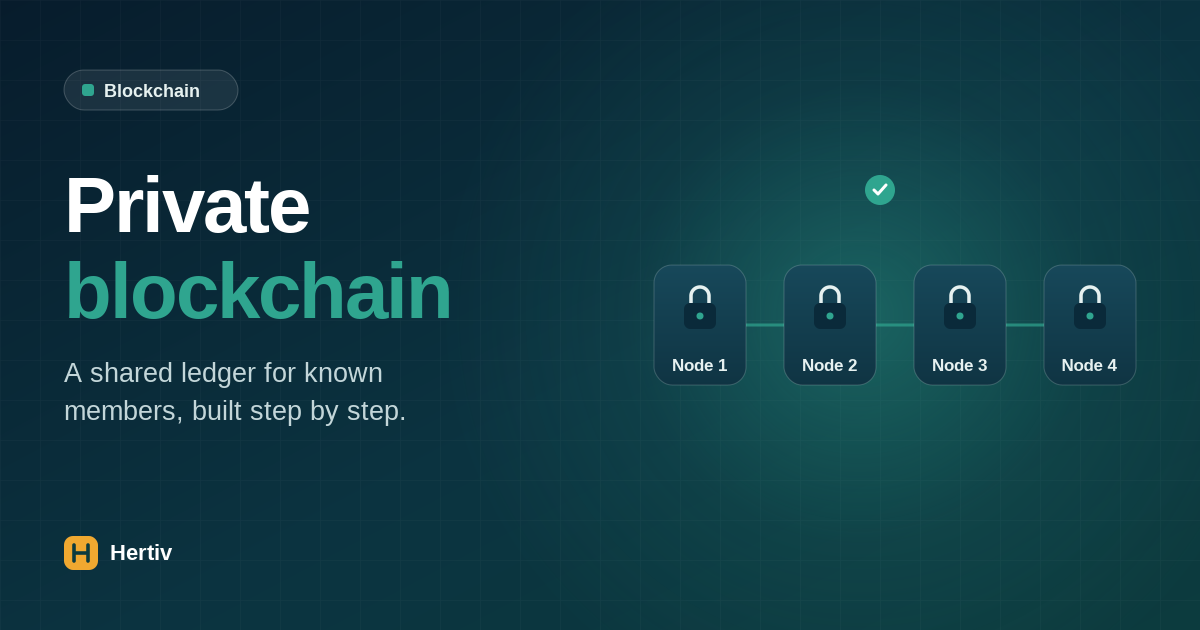
Example (hypothetical): four suppliers share a private blockchain to record shipments, with each supplier running one node and three of the four nodes needed to agree on a block.
The network is set to create a block every two seconds, and each block holds up to 200 transactions. Two hundred transactions divided by two seconds gives 100 transactions per second. Over an hour, that is 100 times 3,600 seconds, which is 360,000 transactions per hour, far above the few thousand shipments the group records each day.
The group decides that a shipment record needs two approvals: one from the sender and one from the receiver. Each approval is a transaction, so a shipment with two approvals uses two transactions. If the group records 500 shipments a day, that is 1,000 transactions a day, which the network handles in a few seconds of block time.
The point of the arithmetic is the method: block time and block size give you the ceiling, and the real load is usually far below it. Size the network for the real load, not for the ceiling, and keep room to add nodes as more suppliers join.
How do you handle identity, access and keys?
Handle identity, access and keys with certificates for every member and a clear process for losing a key. In a private chain, identity is the security boundary, so it deserves as much care as the code.
Each organisation has a certificate authority that issues certificates to its nodes and users. Access rules say which certificates can call which contracts, and those rules are enforced by the network itself, not by the application.
Key rules to set:
- Key storage. Keep private keys in a hardware module or a managed vault, not in a file on a server.
- Rotation. Replace certificates on a schedule, and have a plan for replacing a compromised one quickly.
- Revocation. When a member leaves, revoke its certificates so it cannot write to the chain.
- Recovery. Decide who can approve a key recovery and how it is recorded.
Test the recovery process before launch. A network that cannot recover from a lost key will stop working at the worst moment, so practise the recovery the way you would practise a fire drill. A smart contract audit can check the access rules before you go live.
How do you test and launch it?
Test a private blockchain by running the real transactions on a test network, breaking things on purpose, and checking the audit trail. Launch only when the test network survives the failure tests.
Run three kinds of test. First, functional tests that check each transaction does what the contract says. Second, failure tests that stop a node, cut a connection and restart a node, to check the network recovers. Third, load tests that send more transactions than the real load, to check the network keeps up.
For the launch, start with one use case and a small group of members, and keep the old system running beside the chain for a few weeks. That way, if the chain has a problem, the business keeps running while you fix it. Add members one at a time, and check the audit trail after each addition.
Monitor the network from day one: block time, node health, failed transactions and certificate expiry dates. A dashboard that shows these numbers will catch most problems before the members notice them.
Common mistakes when creating a private blockchain
The most common mistakes are putting too much data on the chain, skipping the network charter, and treating the launch as the end of the work.
Large files do not belong on a chain. Store the file elsewhere and put only its hash on the chain, so the chain stays small and fast while still proving the file has not changed.
Other mistakes to avoid:
- No charter. Without a written agreement on joining, leaving and disputes, the first disagreement stops the network.
- One organisation controls everything. If one member runs all the nodes, the chain adds nothing over a database.
- Smart contracts that are too large. A contract that does everything is hard to test, hard to audit and hard to fix.
- No key recovery plan. A lost key without a recovery process can lock a member out of its own data.
Plan for the network to run for years, not weeks. That means upgrades, new members and certificate renewals are part of the design, not surprises. If you need help with the launch, the blockchain development service covers network setup and operations.
Key takeaways
- A private blockchain fits when several known organisations need one shared record.
- Store hashes on the chain and large files off it, so the chain stays fast.
- Write the network charter before you build, covering joining, leaving and disputes.
- Test failure cases on purpose: stop a node, cut a connection, lose a key.
- Launch with one use case and a small group, keeping the old system running beside it.
Frequently asked questions
What is the difference between a private and a public blockchain?
A private blockchain limits membership to approved organisations, while a public chain lets anyone join. Private chains are faster and give members control over who sees the data, while public chains are open and need no permission to join. The choice depends on whether the members are known and whether the data must stay private.
Which platform should I use for a private blockchain?
Hyperledger Fabric, Quorum and Besu are the well-known options. Fabric fits cases where members need different views of the data, while Quorum and Besu fit teams that want Ethereum-style smart contracts with permissioned access. Pick the platform your team can operate and support for years.
Do I need a token for a private blockchain?
No. Most private blockchains do not need a token, because the members are known and the network does not need to pay strangers to validate blocks. A token only makes sense if you need to charge for access or reward behaviour inside the network, which most private networks do not.
How many nodes does a private blockchain need?
At least three or four, so the network keeps working if one node stops. The exact number depends on how many members you have and how many must agree on a block. Start small with one node per member, and add nodes as more members join.
Can a private blockchain connect to a public chain?
Yes, through a bridge or an anchor that records a hash of the private chain on the public chain. That lets outsiders check that a record existed at a certain time without seeing the data itself. Bridges add risk, so use one only if an outside party needs that proof.
How long does it take to create a private blockchain?
A small network with one use case usually takes two to four months, including the network charter, the smart contracts and the applications. The charter and the member agreements often take longer than the code, so start the legal work at the same time as the technical work.


