How to Build an NFT Marketplace Like LooksRare
LooksRare rewards traders with its LOOKS token and charges a low fee. Here is how its model works and the seven steps to build a marketplace like it.
On this page
Short answer
A marketplace like LooksRare is a community-first NFT marketplace on Ethereum that rewards traders with its LOOKS token and sends all trading fees to LOOKS stakers. To build one, you need a smart contract for listings and settlement, a token rewards system, an indexer for listings, and a frontend with wallet support. The model works when trading volume is high enough to fund the rewards.
What is LooksRare?
LooksRare is a decentralised NFT marketplace on Ethereum that launched in January 2022 as a community-first alternative to OpenSea. Its defining idea is that the people who trade on the marketplace should share in its revenue, rather than the revenue going to a company that runs the platform.
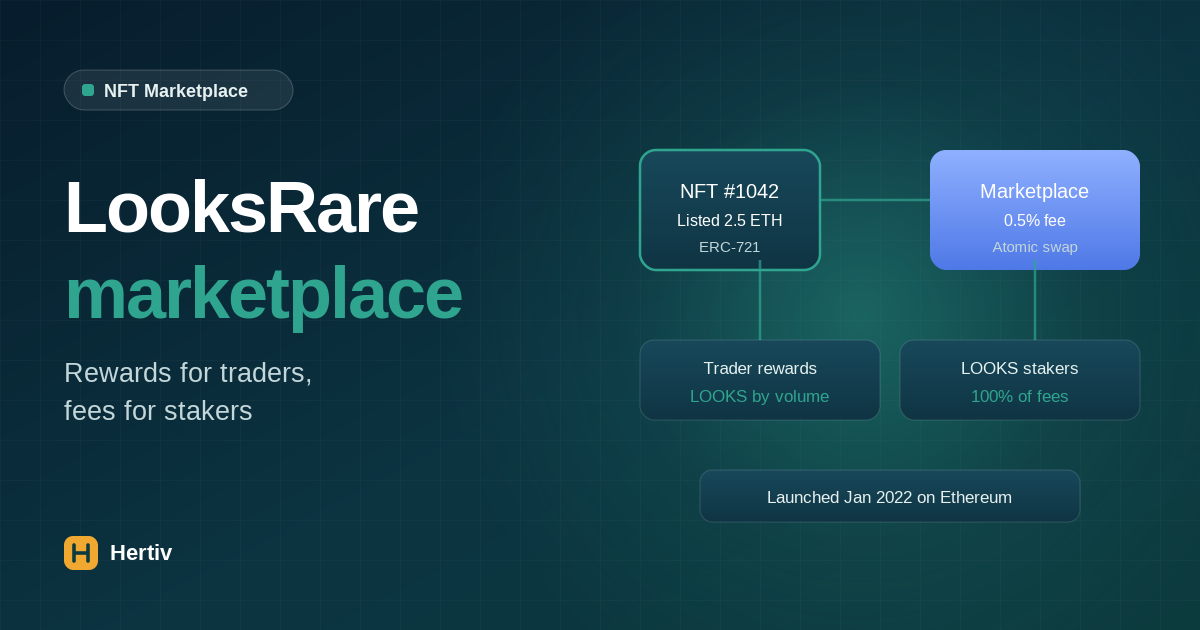
The marketplace runs on its own token, LOOKS, an ERC-20 token with a maximum supply of 1 billion. Traders earn LOOKS as trading rewards, and holders who commit, or stake, their LOOKS receive all of the trading fees the platform collects. LooksRare launched with a 2% fee on sales, then cut it to a fixed 0.5% fee when version 2 launched in April 2023, adding bulk buys and custom recipients.
LooksRare was founded by two pseudonymous founders using the names Zodd and Guts, and it airdropped LOOKS to traders who had used OpenSea before launch. The community-first pitch attracted high volume in its first weeks, though the platform was also criticised for wash trading, where traders bought and sold between their own wallets to earn rewards. For the basics of the token itself, see what is ERC-721 and how NFT standards work.
How does the LOOKS rewards model work?
The LOOKS rewards model works by paying traders for volume and paying stakers from fees, so both sides of the marketplace are rewarded for participating.
| Reward type | Who earns it | How it is paid |
|---|---|---|
| Trading rewards | Buyers and sellers | LOOKS, daily, by volume share |
| Protocol rewards | LOOKS stakers | All trading fees, in WETH or ETH |
| Staking rewards | LOOKS stakers | Extra LOOKS on top of fees |
| Creator royalties | Collection creators | Set per collection at sale |
Trading rewards are calculated daily from a trader's share of the day's volume in eligible collections, and both the buyer and the seller earn them on the same trade, except for private sales. Protocol rewards are the trading fees collected over each 6,500-block period, about a day, which are then distributed to LOOKS stakers over the following period.
The model only works if real trading volume covers the rewards. When traders game the system by trading between their own wallets, the platform pays rewards for volume that brings no real fees, which is why LooksRare limited rewards to eligible collections and excluded private sales. A marketplace that copies this model needs the same anti-gaming rules from day one.
What features does a LooksRare-like marketplace need?
A LooksRare-like marketplace needs the standard marketplace features, plus the token rewards system and the fee distribution that make it different from OpenSea.
| Feature | First version | Later release |
|---|---|---|
| Listings and offers | Fixed price and offers | Auctions, bulk buys |
| Settlement | On-chain escrow, atomic swap | Batch settlement, gas savings |
| Token rewards | Trading rewards by volume | Staking, compounding |
| Fee distribution | Fees to stakers | Creator revenue share |
| Discovery | Search, collections, rankings | Personalised feeds |
| Wallets | Browser wallet connect | Mobile wallets, social login |
| Royalties | Per-collection royalty | Enforced royalties |
| Moderation | Verified collections | Reporting, delisting |
The settlement contract is the core. It must hold the NFT and the payment, swap them in one atomic transaction so neither side can be cheated, and pay the fee and the royalty in the same call. The rewards system sits on top of that: it reads the trade volume from the contract, calculates each trader's share, and distributes the token.
Discovery is the feature teams underestimate. A marketplace with no search, no rankings and no verified collections is hard to use even if the contracts are perfect, and traders will not return to a marketplace where they cannot find what they want.
How to build an NFT marketplace like LooksRare, step by step
You build a marketplace like LooksRare by starting with the settlement contract, then adding the token, the indexer and the frontend in that order, because each layer depends on the one before it.
- Define the fee and rewards model. Fix the trading fee, the share that goes to stakers, the token supply and the emission schedule before writing any code, because these numbers shape the contracts.
- Build the settlement contract. Write the contract that lists NFTs, accepts offers, and swaps the NFT and the payment atomically, paying the fee and the royalty in the same transaction.
- Build the token and rewards contracts. Deploy the reward token, the staking contract, and the distribution contract that calculates trading rewards from volume and pays fees to stakers.
- Build the indexer. Index on-chain events into a database so the frontend can show listings, prices, sales history and rankings without querying the chain for every page.
- Build the frontend. Build browsing, collection pages, listing and offer flows, wallet connection and a rewards dashboard that shows a trader's earned rewards and staking position.
- Audit the contracts. Get an independent audit of the settlement, token and rewards contracts, and fix every finding before launch, because the contracts hold user funds.
- Launch with a small set of collections. Start with verified collections, watch the rewards and fee flow for a few weeks, and expand only when the numbers work without wash trading.
The usual build order in the wider market is covered in how to develop an NFT marketplace, and the LooksRare model adds the token and rewards contracts to that same sequence.
For a comparison with the largest marketplace, see how to build an NFT marketplace like OpenSea.
What does it cost to build?
Building a marketplace like LooksRare costs more than a basic marketplace, because the token and rewards contracts, the staking system and the fee distribution are extra work on top of listings and settlement.
| Build | Indicative cost | What is included |
|---|---|---|
| Basic marketplace | $60,000–$120,000 | Listings, settlement, frontend |
| With token rewards | $120,000–$250,000 | Token, staking, fee distribution |
| Full product | $250,000–$500,000 | Bulk buys, analytics, mobile, audits |
These are indicative ranges, not quotes, and the audit is a large part of the cost. A marketplace that holds user funds needs an audit of every contract that touches money, and the audit alone can cost tens of thousands of dollars. Gas costs for the team are separate: deploying contracts and seeding liquidity on Ethereum costs real ETH, and the team should budget for it.
The running costs are the indexer, the frontend hosting and the support team. The rewards themselves are not a running cost in the usual sense, because they are paid from trading fees, but the team must fund the token emission until volume is high enough to cover it.
Example (hypothetical): fee and rewards on 1,000 ETH of volume
Example (hypothetical): a new marketplace copies the LooksRare model with a 0.5% trading fee and a reward token. In its first month it processes 1,000 ETH of trading volume across its listed collections.
The fees collected are 1,000 x 0.005 = 5 ETH for the month. Under the model, all 5 ETH goes to token stakers, distributed over the following period. If 1,000,000 tokens are staked in total, a holder who staked 10,000 tokens holds 10,000 / 1,000,000 = 1% of the stake, so that holder receives 5 x 0.01 = 0.05 ETH in fees for the month.
On top of that, the marketplace distributes trading rewards. If it emits 100,000 tokens a month as trading rewards and a trader did 2% of the month's volume, that trader receives 100,000 x 0.02 = 2,000 tokens.
The lesson is that the model depends on volume. At 1,000 ETH a month, the fees are 5 ETH, which is a small reward for the whole staking pool. The marketplace needs far more volume before the rewards attract real traders, which is why LooksRare airdropped tokens to existing traders to seed that volume at launch.
What are the common mistakes?
The most common mistakes in a LooksRare-like marketplace are launching the token before the volume, skipping the audit, and designing rewards that wash traders can exploit.
- Token before volume. A reward token with no trading volume behind it pays nothing, and traders leave.
- No audit. Contracts that hold user funds without an independent audit are the most common way marketplaces lose money.
- Rewards without anti-gaming rules. Paying rewards for any trade invites wash trading; limit rewards to eligible collections and exclude private sales.
- Ignoring gas costs. On Ethereum, listing, bidding and claiming rewards all cost gas, and high gas kills small trades.
- No verified collections. Without verification, fake collections and copied art appear within days of launch.
- Copying the fee without the community. The low fee alone does not bring traders; the rewards, the airdrop and the community did the work at launch.
Key takeaways
- LooksRare launched in January 2022 on Ethereum with the LOOKS token and a community-first model
- Trading rewards pay buyers and sellers in LOOKS; all fees go to LOOKS stakers
- Version 2 cut the fee from 2% to 0.5% and added bulk buys
- Build settlement first, then the token, indexer and frontend, and audit before launch
- The model only works with real volume, so seed it with verified collections and anti-gaming rules
Frequently asked questions
What is LooksRare?
LooksRare is a decentralised NFT marketplace on Ethereum that launched in January 2022 as a community-first alternative to OpenSea. It rewards traders with its LOOKS token and sends all trading fees to holders who stake LOOKS, rather than keeping the revenue for a company.
What is the LOOKS token?
LOOKS is the ERC-20 token of the LooksRare marketplace, with a maximum supply of 1 billion. Traders earn it as trading rewards, and holders who stake it receive the platform's trading fees plus extra LOOKS as staking rewards.
How much does LooksRare charge in fees?
LooksRare launched with a 2% fee on sales, then cut it to a fixed 0.5% fee when version 2 launched in April 2023. All of the fees collected go to LOOKS stakers, distributed over the following 6,500-block period.
How do trading rewards work on LooksRare?
Trading rewards are calculated daily from a trader's share of the day's volume in eligible collections, and both the buyer and the seller earn them, except for private sales. The rewards are paid in LOOKS and can be claimed by the trader.
What is wash trading on LooksRare?
Wash trading is when a trader buys and sells NFTs between their own wallets to create fake volume and earn trading rewards. LooksRare was criticised for this in its early months, which is why it limited rewards to eligible collections and excluded private sales.
Is it cheaper to build a marketplace like LooksRare or like OpenSea?
A LooksRare-like marketplace usually costs more, because the token, staking and fee distribution contracts are extra work on top of listings and settlement. A basic marketplace is cheaper to build, but it has no rewards system to attract traders.


