How to Build an NFT Marketplace Like OpenSea
Building an NFT marketplace like OpenSea means listings, wallets, smart contracts and royalties. Here is the full path, from chain choice to a staged launch.
On this page
Short answer
An NFT marketplace like OpenSea is a platform where users list, buy and sell non-fungible tokens, with wallets for payment, smart contracts that move the tokens, and a search and discovery layer on top. Building one means choosing a chain, writing or reusing the trading contracts, and building the storefront around them.
What is an OpenSea-style NFT marketplace?
An NFT marketplace like OpenSea is a platform where users list, buy and sell non-fungible tokens, with wallets for payment, smart contracts that move the tokens, and a search and discovery layer on top. OpenSea launched in 2017 as one of the first general NFT marketplaces, and its model became the template: anyone can list an NFT, anyone can buy it, and the marketplace takes a fee on the sale.
The platform has three layers. The smart contracts hold the trading logic: listings, offers, sales and royalties. The backend indexes blockchain events so the storefront can show listings, prices and ownership without reading the chain on every page load. The frontend is the shop window: search, filters, collection pages and the wallet connection.
Most of the work is in the first two layers. A marketplace that lists tokens it cannot verify, or that settles sales unreliably, loses trust fast. The storefront matters too, but it is the easiest part to rebuild. For how marketplaces are used in practice, see NFT marketplace use cases.
What features does an NFT marketplace need?
An NFT marketplace needs wallet login, listing and buying, search and discovery, offers and auctions, royalties, and an admin layer for moderation and fees.
| Feature | What it does | Build or reuse |
|---|---|---|
| Wallet login | Connects a wallet, proves ownership | Reuse a wallet library |
| Listing and buying | Fixed price and auction sales | Smart contract |
| Search and filters | Find tokens by trait, price, collection | Build on an indexer |
| Offers and bids | Buyers propose prices below listing | Smart contract |
| Royalties | Creator share on resales | Smart contract |
| Collection pages | Floor price, volume, traits | Build on an indexer |
| Moderation | Flag copies and scams | Build admin tools |
| Fee settings | Marketplace fee per sale | Smart contract |
Royalties deserve a note. Creator royalties are enforced by the marketplace, not by the token standard, so a sale on another marketplace may not pay them. If royalties matter to your creators, say so plainly in your terms and design for it.
How does an NFT marketplace work, step by step?
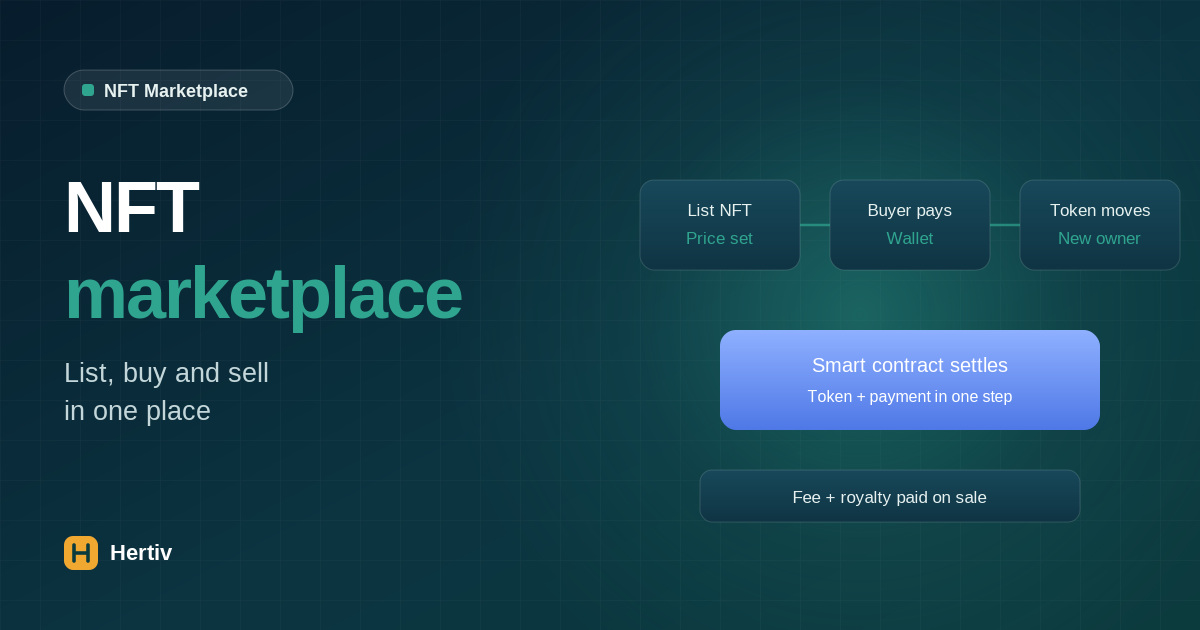
An NFT marketplace works by matching a seller's listing with a buyer's payment through a smart contract, then recording the transfer on the blockchain and updating the storefront from the chain's events.
- Connect a wallet. The seller connects a wallet and signs a message proving they control it. No account or password is needed.
- List the NFT. The seller sets a price or starts an auction, and signs a listing that the marketplace contract can execute.
- Index the listing. The backend reads the listing event from the chain and shows the token in search results and collection pages.
- Buy or bid. A buyer pays in the accepted cryptocurrency, or places an offer below the asking price.
- Settle on-chain. The contract moves the NFT to the buyer, sends payment to the seller, pays the royalty to the creator and takes the marketplace fee, all in one transaction.
- Update the storefront. The backend reads the sale event and updates the listing, the floor price and the collection volume.
The settlement step is where trust is won or lost. A contract that moves the token and the payment in one atomic transaction means neither side can be left with nothing. A design that splits them across two transactions creates a window where one side can fail. For the token standard behind the trade, see what is ERC-721.
Build from scratch or start from existing code?
Building from scratch gives you full control over fees, royalties and the trading logic, but it costs the most and takes the longest. Starting from existing code, such as OpenSea's Seaport protocol or a marketplace template, cuts the contract work but leaves you with someone else's design choices.
Seaport is OpenSea's open-source marketplace protocol, released in 2022. It handles listings, offers, auctions and multi-token trades, and many marketplaces build on it rather than writing their own settlement contract. Using it means your settlement logic is battle-tested, but you still need to build the storefront, the indexer and the moderation tools around it.
A third route is a white-label marketplace product, where a vendor supplies the contracts and the storefront and you brand it. That is the fastest path to launch, but fees and feature changes depend on the vendor.
The choice comes down to how much of the trading logic you need to own: if your marketplace has unusual rules, build; if it follows the standard pattern, reuse. The development side is covered by DEX development, where the same build-or-reuse question applies to trading contracts.
Which chain and token standards should you choose?
You should choose the chain your target users already hold assets on, and support the ERC-721 and ERC-1155 token standards so your marketplace can list the tokens those users already own.
Ethereum is the largest NFT market and the home of ERC-721, the standard for unique tokens, and ERC-1155, which can hold both unique and identical items in one contract. Most general marketplaces start there because the collections and the buyers are already there. The cost is gas: every listing, sale and transfer pays network fees, which can exceed the price of a cheap NFT.
Cheaper chains such as Polygon, Solana and BNB Chain cut those fees sharply, but each has a smaller NFT market and its own token standards and wallet ecosystem. A marketplace can support more than one chain, but each chain adds a full set of contracts, an indexer and wallet support, so start with one chain and add a second only when your users ask for it. For the wallet side, see crypto wallet development.
Example (hypothetical): a marketplace for game items
Example (hypothetical): a game studio builds a marketplace for its players' items, starting on one chain with a fixed-price listing model and a 2.5% marketplace fee. The studio expects 5,000 items listed in the first month and 1,000 sales.
If the average sale price is 0.1 ETH, the month's sales total is 1,000 x 0.1 = 100 ETH. The marketplace fee is 100 x 0.025 = 2.5 ETH. The creator royalty is set at 5%, so the studio receives 100 x 0.05 = 5 ETH in royalties on top of the fee, for a total of 7.5 ETH in the month.
The studio also budgets for gas. If each sale costs the buyer about 0.005 ETH in network fees, the month's 1,000 sales cost buyers 1,000 x 0.005 = 5 ETH in gas, which is more than the marketplace earns.
That is why the studio plans a cheaper chain for its second version: the fee math only works for low-priced items when the chain is cheap. The lesson is to model gas alongside fees before choosing a chain.
What are the common mistakes?
The most common mistakes in NFT marketplaces are launching without moderation, ignoring gas costs, and treating royalties as guaranteed when they depend on the marketplace.
- No moderation. A marketplace without copy and scam checks fills with fake collections within days of launch.
- Ignoring gas. High network fees kill low-priced items, because the fee can exceed the item's price.
- Assuming royalties are enforced. Royalties are a marketplace policy, not a token rule, so sales elsewhere may skip them.
- Weak wallet handling. A wallet flow that fails on mobile or on a popular wallet loses buyers at the first step.
- No indexer. Reading the chain on every page load makes the storefront slow and unreliable under traffic.
- Launching with no listings. A marketplace with no items to buy has no reason for anyone to visit, so seed it with partner collections first.
How to launch an NFT marketplace in stages
You launch an NFT marketplace in stages: contracts and settlement first, then the storefront, then a seeded launch with partner collections, and only then open listings to everyone.
- Choose the chain and standards. Pick the chain your users already use and commit to ERC-721 and ERC-1155 support.
- Build or reuse the contracts. Decide between your own settlement contract, Seaport, or a white-label product, and audit whatever you ship.
- Build the indexer and storefront. Index listings and sales from chain events, and build search, collection pages and wallet login.
- Add moderation tools. Build flagging, delisting and creator verification before the first public listing.
- Seed the launch. Open with partner collections so buyers have something to buy on day one.
- Open listings gradually. Let verified creators list first, watch settlement and gas costs for a month, then open to everyone.
If you need a team to build the contracts and the storefront, smart contract development covers the audit-first approach the settlement layer needs.
Key takeaways
- An OpenSea-style marketplace combines listings, wallets, trading contracts and discovery
- Settlement must move the token and the payment in one atomic transaction
- Start from Seaport or a template unless your trading rules are unusual enough to need custom contracts
- Choose the chain your users already hold assets on, and model gas costs alongside fees
- Launch in stages, with moderation and seeded collections, before opening listings to everyone
Frequently asked questions
How much does it cost to build an NFT marketplace like OpenSea?
The cost depends on the route. A white-label product is the cheapest and fastest path, a build on Seaport or a template costs more, and a fully custom marketplace with its own settlement contracts and audit costs the most. Ask vendors for a fixed scope and an audit line item, because the audit is not optional.
What is Seaport in NFT marketplaces?
Seaport is OpenSea's open-source marketplace protocol, released in 2022. It handles listings, offers, auctions and multi-token trades, and many marketplaces build on it instead of writing their own settlement contract. Using it means the settlement logic is battle-tested, but you still build the storefront and indexer.
Which blockchain is best for an NFT marketplace?
The best chain is the one your target users already hold assets on. Ethereum has the largest NFT market but the highest gas fees, while Polygon, Solana and BNB Chain are cheaper with smaller markets. Start with one chain and add a second only when your users ask for it.
Do NFT marketplaces make money from royalties?
Marketplaces earn a fee on each sale, usually a small percentage of the price. Creator royalties are a separate share that goes to the creator, and they are enforced by the marketplace rather than by the token standard, so a sale on another marketplace may not pay them.
Do I need a smart contract audit for an NFT marketplace?
Yes. The settlement contract moves tokens and payments, so a bug can lose user funds. An audit by an independent firm, plus a bug bounty and a staged launch, is the standard way to reduce that risk before opening to the public.
Can an NFT marketplace support more than one chain?
Yes, but each chain adds a full set of contracts, an indexer and wallet support, so the work grows with every chain. Most marketplaces start on one chain, prove the model, and add a second chain when their users ask for it.


