How to Create an MPC Crypto Wallet App
An MPC wallet app splits the private key into shares held in different places, so no single device can sign alone. Here is how to build one.
On this page
Short answer
An MPC crypto wallet app is a wallet that splits the private key into shares held in different places, so no single device or server can sign a transaction alone. Building one means choosing a threshold scheme, wiring key generation and signing into the app, and handling recovery, audit and compliance before the first user signs.
What is an MPC crypto wallet app?
An MPC crypto wallet app is a wallet that uses multi-party computation to split a private key into shares, so that signing a transaction needs a threshold of shares rather than one whole key. The key never exists in one place, which removes the single point of failure that a normal wallet has.
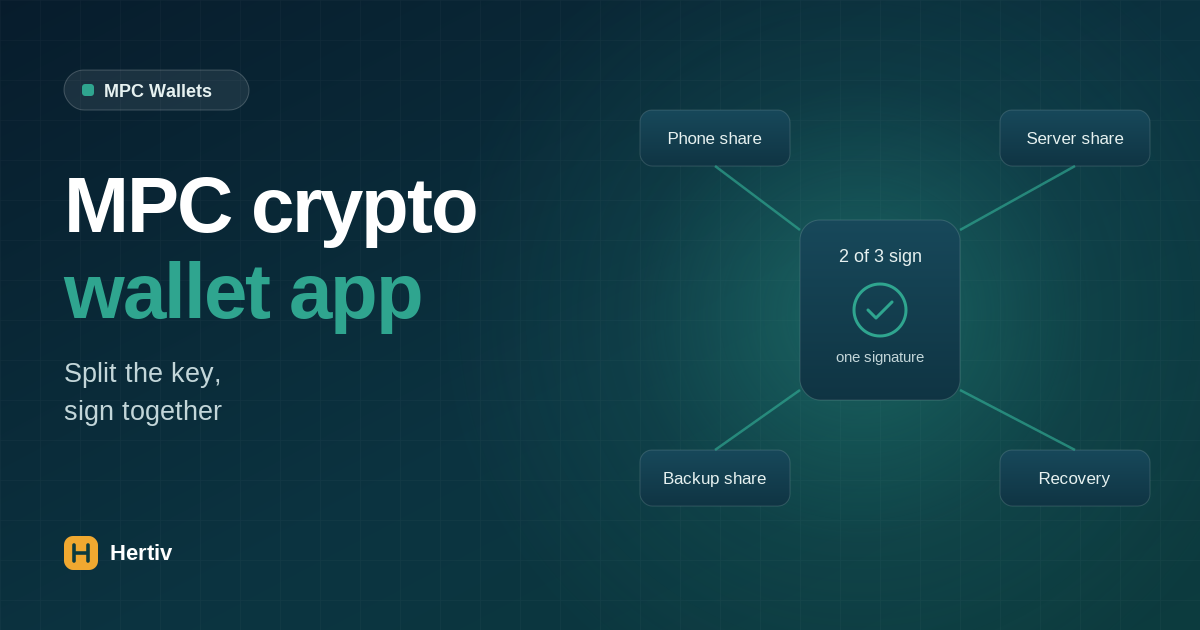
In a typical setup, the shares live in three places: the user's phone, the provider's server and a backup. With a 2-of-3 threshold, any two of those shares can sign, so the user can still transact if one share is lost, and a thief who takes one share gets nothing usable.
The app itself looks like any other wallet: balances, send and receive, transaction history and approvals. The difference is under the surface, in how keys are made, stored and used. For the wallet concept itself, see what an MPC wallet is.
How does MPC key signing work?
MPC signing works by having each share holder compute a partial signature, then combining the partials into a valid signature without ever rebuilding the full key. The maths behind this is called threshold signature schemes, and the common ones are based on ECDSA or EdDSA.
| Approach | How the key is held | What goes wrong |
|---|---|---|
| Single key | One whole key on one device | One theft or loss ends access |
| Multisig | Several keys, several signatures on chain | Costs more and shows the setup on chain |
| MPC 2-of-3 | Three shares, any two can sign | Needs the signing parties to be online |
| MPC 2-of-2 | Two shares, both needed | Losing one share blocks signing |
| Custodial | Provider holds the key | Provider is a single point of trust |
The key point is that the full key is never assembled. Each party holds only its share, and the signing protocol combines partial results into a signature that the blockchain accepts as normal. That is what makes MPC different from simply splitting a key into pieces and storing them.
What does the app need to include?
An MPC wallet app needs the wallet basics plus the MPC machinery: key generation, signing, recovery and audit. Each part has to work before the app is safe to use with real funds.
The core features are:
- Key generation. A distributed ceremony that creates the shares without ever making a full key.
- Signing. A flow where the phone and the server produce partial signatures and combine them.
- Approvals. A clear screen showing the amount, address and fee before the user approves.
- Recovery. A way to rebuild a lost share from the backup, with identity checks.
- Transaction history. A readable record of every signing, for the user and for audit.
- Policy controls. Limits on amounts, addresses and signing frequency, set by the user or the business.
Security is a feature, not a layer added later. The approval screen, the recovery flow and the audit log all need to be designed with the key scheme, because a signing flow that users do not understand will be approved without reading.
How do you build it, step by step?
Building an MPC wallet app takes a team through seven steps, from the key scheme to the audit. The cryptography comes first, because it shapes every screen and flow that follows.
- Pick the threshold scheme. Choose 2-of-3 for consumer wallets or 2-of-2 for a simpler phone-plus-server setup, and pick a tested library for it.
- Design key generation. Plan the ceremony that creates shares, who holds each one, and how a share is replaced.
- Build the signing flow. Wire the phone and server to produce partial signatures and combine them, with a clear approval screen.
- Add recovery. Build the flow for a lost phone or server share, with identity checks that cannot be bypassed by a single party.
- Add policy controls. Build amount limits, allow-listed addresses and signing alerts.
- Audit the code. Get an independent review of the cryptography and the app, and fix what it finds before launch.
- Pilot with small amounts. Launch to a small group with low limits, watch the signing failures, then raise the limits.
Do not write your own threshold cryptography. Use a tested library or service for the signing protocol, and spend your effort on the flows around it: approvals, recovery and audit. For the provider side of the same question, see the top MPC wallet providers.
How do you handle recovery and security?
Recovery is the hardest part of an MPC wallet, because it must work when a user has lost a share while staying closed to an attacker who claims to be that user. The design has to answer both cases before launch.
A workable recovery flow uses the backup share plus an identity check that no single party controls. For example, the backup share plus a code sent to the user's email and a waiting period of a day gives the real user time to object if the request was not theirs. A recovery that is instant and needs no check is an attack route, not a feature.
Security also means watching the signing parties. Log every signing attempt, alert on unusual amounts or addresses, and keep the server share in a hardened environment with no direct internet access. If a share is suspected to be compromised, the app must be able to rotate it without moving the user's funds. For the user side of setup, see how to set up an MPC wallet.
Example (hypothetical): a three-share signing flow
Example (hypothetical): a wallet uses a 2-of-3 scheme, with shares on the user's phone, the provider's server and an encrypted backup. Any two shares can sign, so there are 3 possible pairs: phone plus server, phone plus backup, and server plus backup.
The app has 1,000 users, and about 5% lose or replace a phone each year. That is 1,000 x 5% = 50 recovery cases a year. Each recovery takes about 10 minutes of support time, so the team spends 50 x 10 = 500 minutes, or about 8 hours, a year on recoveries.
Signing itself is fast when both parties are online. If the server is down for 1 hour in a year, users can still sign with the phone plus backup pair, so the 2-of-3 design keeps the wallet working. A 2-of-2 design would have stopped all signing for that hour, which is why the third share matters.
The lesson is that the threshold is a product decision, not just a security one. It decides what happens when a phone is lost, when a server is down, and when a user needs help, so it deserves the same care as the cryptography.
What are the common mistakes?
The most common mistakes teams make building an MPC wallet app are writing their own cryptography, treating recovery as an afterthought, and shipping an approval screen nobody reads.
- Home-grown cryptography. A threshold scheme written in-house is the riskiest part of the build; use a tested library.
- Recovery as an afterthought. Users lose phones, and a wallet with no tested recovery flow strands their funds.
- Unreadable approvals. An approval screen that hides the amount or address will be tapped through blindly.
- No audit. Shipping a wallet without an independent review of the cryptography is a gamble with user funds.
- One share, one point of failure. A 2-of-2 scheme with no backup blocks all signing when one share is lost.
- Skipping policy controls. Without amount limits and alerts, a compromised share can drain the wallet in one signing.
Key takeaways
- MPC splits the key into shares; no single share can sign alone
- 2-of-3 keeps the wallet working when one share is lost
- Use a tested threshold library, never write your own
- Recovery needs an identity check plus a waiting period
- Audit the cryptography and pilot with small amounts first
Frequently asked questions
What is the difference between MPC and multisig?
Multisig uses several whole keys and puts several signatures on the blockchain, which costs more and shows the setup publicly. MPC splits one key into shares and produces a single normal signature, so it looks like an ordinary transaction. MPC also keeps the key from ever existing in one place, while multisig keys each exist whole on their own device.
Is an MPC wallet safer than a normal wallet?
It removes the single point of failure: stealing one share gives an attacker nothing usable, and losing one share does not lock the user out. It is not safer in every way. The signing protocol, the server share and the recovery flow all need to be sound, and a weak recovery flow can undo that benefit.
What happens if I lose my phone with an MPC wallet?
With a 2-of-3 scheme, the server share plus the backup share can still sign, so the wallet keeps working while you set up a new phone. The recovery flow then creates a fresh share for the new phone and retires the lost one. With a 2-of-2 scheme, losing one share blocks signing until the provider helps you recover.
Do I need a blockchain background to build an MPC wallet app?
You need a team that understands key management, threshold signatures and secure app design. The cryptography itself should come from a tested library, but the team still needs to design key generation, signing, recovery and audit correctly. Most teams pair an app team with a cryptography review before launch.
How much does it cost to build an MPC wallet app?
Costs vary with scope, chains, policy controls and audit, so there is no fixed figure. The main cost drivers are the threshold scheme, the recovery design, the audit and the compliance work. Ask vendors for a scoped estimate based on your chains and limits, and budget for the audit separately rather than treating it as optional.
Which chains work with MPC wallets?
Most major chains work with MPC, because the threshold schemes are built for the signature types those chains use, such as ECDSA for Ethereum-compatible chains and EdDSA for Solana. Check that your chosen library supports each chain you plan to ship, and test signing on each one before promising support to users.


