Top MPC Wallet Providers for Crypto Teams Compared
Eight MPC wallet providers that split private keys across parties, compared on custody model, signing and fit. Choose the one that matches your team's risk profile.
On this page
Short answer
The top MPC wallet providers to compare are Fireblocks, Zengo, Web3Auth, Particle Network, Dfns, Safeheron, Lit Protocol and Fordefi. The right choice depends on whether you need institutional custody, a consumer wallet, or an embedded wallet inside your own app.
Which MPC wallet providers should you compare first?
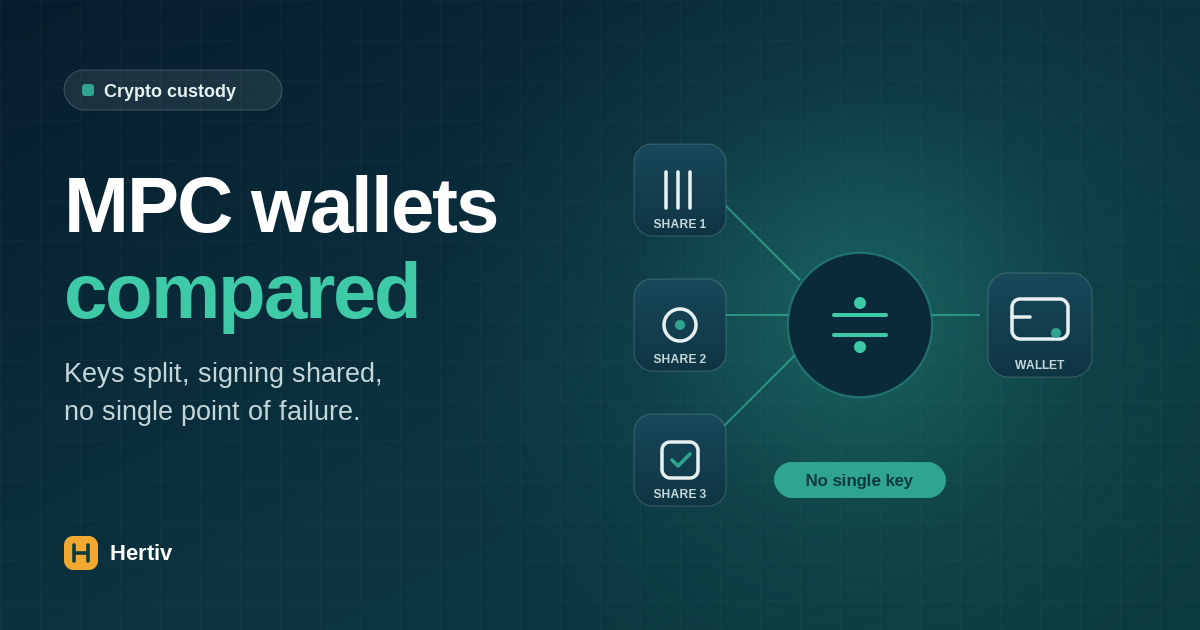
An MPC wallet splits a private key into shares held by different parties, so no single party can sign a transaction alone. Multi-party computation lets the shares sign together without ever rebuilding the full key, which removes the single point of failure of a normal wallet.
| Provider | Custody model | Best for | Main use |
|---|---|---|---|
| Fireblocks | Institutional custody | Funds and exchanges | Large treasuries |
| Zengo | Consumer wallet | Individual users | Everyday holding |
| Web3Auth | Embedded wallet | Apps with login wallets | Onboarding users |
| Particle Network | Embedded wallet | Apps and games | Social login wallets |
| Dfns | API wallet platform | Developers | Wallet infrastructure |
| Safeheron | Institutional custody | Teams and funds | Shared signing |
| Lit Protocol | Decentralised keys | Programmable access | Condition-based signing |
| Fordefi | Institutional custody | DeFi teams | DeFi operations |
All eight use key shares instead of a single key, but they serve different users. Some are custody platforms for institutions, some are consumer wallets, and some are infrastructure for developers. The sections below group them by who they fit. For the basics, see what is an MPC wallet.
Institutional custody: Fireblocks and Safeheron
1. Fireblocks: best for large treasuries
Fireblocks is a custody platform for institutions that move large amounts of crypto. It combines MPC signing with policy controls, so a team can set rules about who can sign, how much, and to which addresses, before any transaction goes through.
Its strength is control at scale: policy rules, audit trails and integrations with exchanges and DeFi protocols in one place. Its weakness is fit. It is built for institutions, so a small team or a consumer app will find it heavier and more expensive than it needs. See vendor site for current pricing.
- Pros: strong policy controls, audit trails, broad protocol support
- Cons: built for institutions, heavier setup than a simple wallet
2. Safeheron: best for shared team signing
Safeheron offers MPC custody for teams and funds, with wallets that several people sign together. It suits teams that need shared control over a treasury, where no one person can move funds alone.
Its strength is team workflows: approval rules, role-based access and signing policies that match how a small fund actually works. Its weakness is reach. It is less widely integrated than the largest custody platforms, so check the chains and protocols you need first.
- Pros: team approval workflows, shared signing, clear policy rules
- Cons: fewer integrations than the largest platforms, check chain support
Consumer wallets: Zengo and Web3Auth
3. Zengo: best for everyday users
Zengo is a consumer crypto wallet built on MPC, with no seed phrase to lose. The key is split between the user's device and Zengo's servers, and signing needs both, so losing a phone does not mean losing the funds.
Its strength is simplicity: users get a wallet without writing down a seed phrase, and recovery works through the app. Its weakness is that it is a consumer product, not infrastructure, so a team building its own app cannot embed Zengo as a wallet.
- Pros: no seed phrase, simple recovery, easy for new users
- Cons: a consumer wallet, not embeddable infrastructure
4. Web3Auth: best for login-based wallets
Web3Auth lets apps create a wallet for a user from a social login or email, with the key split across shares. It suits apps that want users to have a wallet without installing one or writing down a seed phrase.
Its strength is onboarding: a user gets a wallet in the same step as signing in, which removes the biggest drop-off in crypto apps. Its weakness is dependence on the login provider. If the login method changes, recovery needs a plan, so set up backup options from the start.
- Pros: wallet from a social login, fast onboarding, no seed phrase
- Cons: tied to login methods, needs a recovery plan
How MPC compares with the older shared-signature model is covered in MPC vs multisig wallets.
Developer infrastructure: Particle Network and Dfns
5. Particle Network: best for apps and games
Particle Network provides embedded wallets and account tools for apps and games, with MPC key shares behind a social login. It suits products where the wallet should be invisible and the user should not think about keys at all.
Its strength is the full stack: wallet creation, login, and gas and chain handling in one SDK. Its weakness is lock-in. The more of the stack you use, the harder it is to swap one part later, so check the parts you can replace.
- Pros: full wallet stack, social login, built for apps and games
- Cons: stack lock-in, check which parts can be swapped
6. Dfns: best for wallet infrastructure
Dfns is an API-first wallet platform that gives developers MPC wallets, signing policies and key management through code. It suits teams building their own wallet product or custody flow and wanting control over the details.
Its strength is control: policies, signing rules and key shares are all set through the API, so a team can build exactly the flow it needs. Its weakness is effort. An API platform needs more building than a ready wallet, so it fits teams with developers, not teams that want a finished product.
- Pros: API-first, fine-grained policies, full control over the flow
- Cons: more building required, needs a development team
Programmable and DeFi custody: Lit Protocol and Fordefi
7. Lit Protocol: best for condition-based signing
Lit Protocol spreads key shares across a network of nodes and signs only when set conditions are met, such as holding a token or passing a check. It suits products where access or signing should depend on rules written in code.
Its strength is programmability: signing rules can check on-chain or off-chain conditions before a key is used. Its weakness is complexity. Condition-based signing needs careful design, and a wrong condition can lock users out or let the wrong transaction through.
- Pros: signing tied to conditions, decentralised key shares, flexible rules
- Cons: complex to design well, conditions need careful testing
8. Fordefi: best for DeFi operations
Fordefi is an MPC wallet platform built for teams that work across DeFi protocols, with policy controls and a browser extension for signing. It suits trading and treasury teams that sign many DeFi transactions and need rules around them.
Its strength is DeFi fit: it understands smart contract interactions and lets a team approve them with policies instead of blind signing. Its weakness is scope. It is built for DeFi operations, so a team that only holds assets will find simpler options.
- Pros: DeFi-aware signing, policy controls, team workflows
- Cons: built for DeFi teams, more than a holding wallet needs
For the custody side of the decision, see what is crypto custody.
How to choose an MPC wallet provider
Choose by who holds the shares and who can sign, not by the brand name. The custody model decides your risk more than any feature list.
- Decide who must sign. One person, a team, or a policy. The signing rule is the core of the wallet, so fix it before comparing tools.
- Check who holds the key shares. Shares on your own servers, on the provider's, or spread across a network. Each option has a different failure mode.
- List the chains and protocols you need. Confirm each one is supported for signing, not only for viewing balances.
- Test recovery. Lose a device, remove a signer, and change a policy in a test wallet. Recovery that works in a demo can fail in practice.
- Read the policy and audit options. Who can change the rules, and is there a log of every signing decision. If the answer is unclear, keep looking.
Keep the shortlist to two providers and test both with a small amount. A wallet is only as good as its recovery path, so test that first. A custom build is also possible through MPC wallet development when no ready provider fits.
What are the common mistakes?
The most common mistakes are trusting the brand instead of the signing rules, skipping recovery tests, and letting one person hold too much power.
- Not knowing who holds the shares. If one party holds enough shares to sign alone, the wallet is not really shared. Ask where each share lives.
- Skipping recovery tests. Recovery is the moment a wallet is truly tested. Test losing a device and removing a signer before real funds arrive.
- Blind signing in DeFi. Approving a transaction without reading what it does is how funds are lost. Use a provider that shows the action clearly.
- Policies nobody can change. A policy that cannot be updated when the team changes becomes a lock on your own funds.
- One provider for every chain. Support varies by chain, so check each chain you use rather than assuming the provider covers them all.
Key takeaways
- MPC splits a private key into shares so no single party can sign alone
- Fireblocks and Safeheron suit institutions and teams that need shared custody
- Zengo, Web3Auth and Particle Network suit consumer apps and fast onboarding
- Dfns and Lit Protocol suit developers who need API control or condition-based signing
- Test recovery before moving real funds into any MPC wallet
- The signing rule and who holds the shares matter more than the brand
Frequently asked questions
What is an MPC wallet?
An MPC wallet splits a private key into shares held by different parties. The shares sign a transaction together through multi-party computation, without ever rebuilding the full key in one place. No single party can move funds alone.
How is an MPC wallet different from a multisig wallet?
A multisig wallet needs several separate signatures from different keys on the blockchain. An MPC wallet uses one key split into shares, so the signing looks like a normal transaction on-chain. Both spread control, but they do it in different ways.
Can I lose my funds if I lose my phone?
With most MPC wallets, no. The key shares are split, so losing one device does not lose the key. Recovery usually needs the remaining shares or a backup method, which is why testing recovery before funding the wallet matters.
Do MPC wallets work with DeFi?
Yes, several providers in this list are built for DeFi, including Fireblocks and Fordefi. They show the smart contract action before signing and apply policy rules, so a team can approve DeFi transactions without blind signing.
Who holds the key shares in an MPC wallet?
It depends on the provider. Shares can sit on your device, on the provider's servers, or spread across a network of nodes. Ask each provider where the shares live, because that decides who must cooperate to sign.
Are MPC wallets safe for large treasuries?
They are widely used for large treasuries, but safety comes from the setup, not the name. Policy rules, recovery tests, audit logs and clear share custody matter more than the provider's brand. Test the setup with a small amount first.


