What Is an MPC Wallet, and How Does It Work?
An MPC wallet splits a private key into shares held by different parties, so no single share can move funds alone. Here is how the shares work.
On this page
Short answer
An MPC wallet is a crypto wallet that uses multi-party computation to split a private key into several shares, each held by a different party or device. No single share can sign a transaction on its own; a set number of shares must work together to approve it. That removes the single point of failure of a normal wallet, where one stolen key means the funds are gone.
What is an MPC wallet?
An MPC wallet is a crypto wallet that never holds a whole private key in one place. Instead, the key is split into shares, and each share lives with a different party or on a different device. To sign a transaction, a set number of shares must take part, and the full key is never put back together.
MPC stands for multi-party computation, a method that lets several parties compute a result together without any of them seeing the others' inputs. In a wallet, the computation is the signature: each share holder adds its part, and the result is a valid signature that the blockchain accepts.
The point is simple. A normal wallet has one key, and anyone who copies it owns the funds. An MPC wallet has no single key to steal, so an attacker must compromise several shares at once, which is far harder to do.
How does multi-party computation split a key?
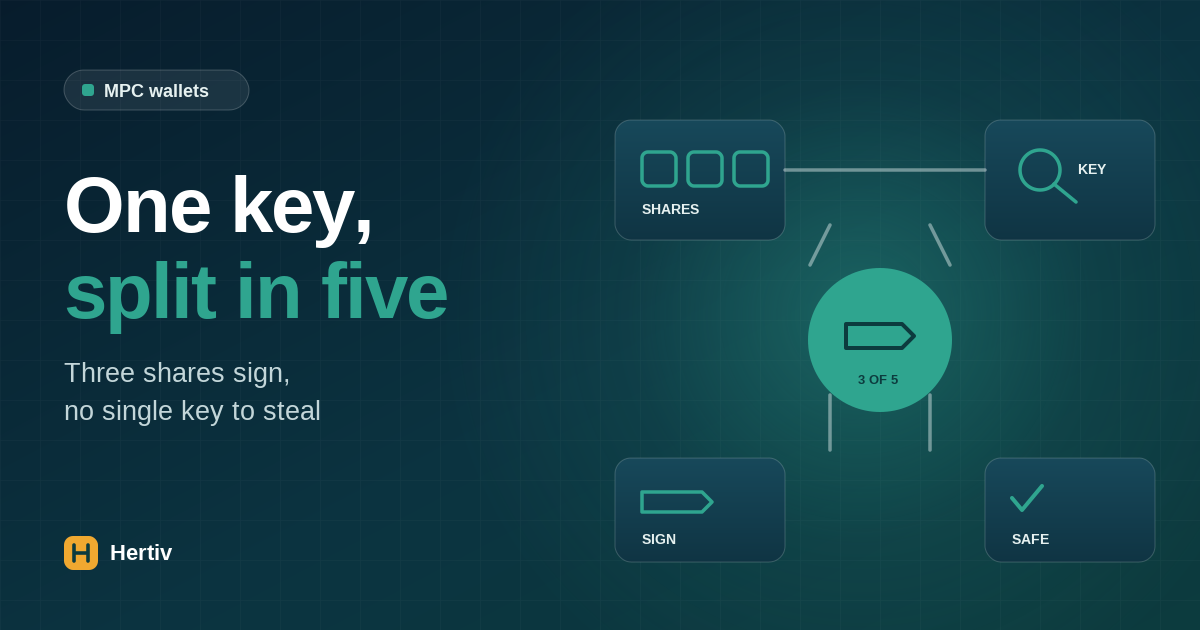
When an MPC wallet is created, the software makes a private key and then splits it into shares using maths that lets the shares sign together without ever rejoining. A common setup is 3-of-5: five shares exist, and any three of them can sign. The other two can be lost or offline, and the wallet still works.
Each share is stored separately, often in different places: one on the user's phone, one on a company server, one with a recovery provider, and so on. The shares are useless on their own, so losing one share does not lose the funds, and stealing one share does not give the attacker anything.
To sign, the parties run a short protocol. Each share holder signs its part, the parts are combined into a single signature, and the transaction is sent to the chain. The full key never exists in memory at any point, which is the whole point of the design.
MPC wallet vs multisig wallet vs single-key wallet
MPC wallets are often confused with multisig wallets, because both need more than one approval. The difference is where the key lives and what the chain sees.
| Wallet type | Where the key lives | What the chain sees | Main weakness |
|---|---|---|---|
| Single-key | One whole key, one place | One signature | One stolen key loses everything |
| Multisig | Several whole keys | Several signatures | On-chain rules are public |
| MPC | Shares, no whole key | One signature | Needs the share holders online |
A multisig wallet keeps several whole keys, and the blockchain itself enforces the rule that a set number must sign. Anyone can read that rule on-chain, which tells an attacker exactly how many keys to target. An MPC wallet looks like an ordinary wallet on-chain, because it produces a single signature, so the threshold is private.
The trade-off is that MPC needs the share holders to take part in the signing protocol, which means they must be reachable. A multisig wallet can sign with keys that have been offline for months. For teams that hold funds together, crypto wallet development trends covers how both approaches are being used today.
Where are MPC wallets used?
MPC wallets are used wherever more than one party must approve a move, or where a single key is too risky to hold. The most common users are teams, exchanges and apps that hold funds for their users.
- Company treasuries. A finance team holds shares across several people, so no single employee can move funds alone, and the wallet still works when one person is away.
- Exchanges and custodians. Customer funds sit in wallets whose shares are spread across servers and sites, so a breach of one server does not expose the keys.
- Consumer apps. A wallet app can hold one share on the phone and one on its server, so the user can recover access with the server's help if the phone is lost.
- Trading desks. Traders get shares that let them sign up to a limit, while larger moves need more shares, which gives the desk a built-in approval rule.
The pattern in all four cases is the same: the key is spread out, the approvals are built into the signing, and the chain sees nothing unusual. That is why MPC has become the default choice for professional crypto custody.
What are the risks and limits of MPC wallets?
MPC wallets remove the single-key risk, but they add risks of their own, and a team should know them before choosing one.
- Share holders must be reachable. If too many share holders are offline, the wallet cannot sign. A 3-of-5 setup can survive two shares being down, but not three.
- The software must be trusted. The splitting and signing maths is complex, and a bug in it can be worse than a stolen key. Use a wallet whose code has been reviewed by independent auditors.
- Recovery needs a plan. If a share is lost, the wallet must be able to make a new one without putting the full key together. Check how the provider handles that before relying on it.
- Regulation varies. Some regions treat shared custody differently from single custody, and the rules change. A wallet that works in one country may need a different setup in another.
None of these risks is a reason to avoid MPC, but each one needs an answer before the wallet holds real funds. The most important check is the recovery plan, because a wallet that cannot recover a lost share is a wallet that can lock the funds away for good.
Example (hypothetical): a small fund sets up a 3-of-5 MPC wallet
Picture a small investment fund with five partners that holds $200,000 in crypto. The partners do not want any one of them to move funds alone, but they also do not want the wallet to freeze when someone is on holiday.
They set up a 3-of-5 MPC wallet: five shares, any three of which can sign. That means up to two shares can be lost or offline and the wallet still works, because three shares remain. At the same time, a single partner cannot move funds, and neither can any pair of them, because two shares are not enough.
One month later, two partners are travelling and one share is stored on a laptop that breaks. That leaves two shares working, which is one short of the three needed, so the wallet cannot sign until one of the travelling partners returns. The fund learns the lesson and adds a sixth share held by a recovery provider, making the setup 3-of-6, so that three shares can be down and the wallet still signs.
The example shows the trade-off in plain numbers: a higher threshold is safer against theft, but a lower threshold is safer against lockout. A 3-of-5 setup balances the two, and the fund's fix shows why the threshold and the number of shares should be chosen together.
What are the common mistakes?
The most common mistakes with MPC wallets are choosing the wrong threshold, trusting unreviewed software, and having no recovery plan.
- Threshold too high. A 4-of-5 setup is safer against theft, but one lost share and one holiday can lock the wallet. Pick a threshold that survives normal absence.
- Threshold too low. A 2-of-5 setup is easy to use, but only two shares need to be stolen. The threshold should need more than one person to agree.
- Unreviewed software. MPC maths is easy to get wrong and hard to check by eye. Use a wallet that has been audited, and ask to see the audit.
- No recovery plan. Shares get lost: phones break, people leave, servers fail. The wallet must be able to replace a share without ever joining the full key.
- All shares in one place. Shares stored on the same laptop or the same cloud account defeat the whole design. Spread them across people, devices and sites.
The simplest test is to ask what happens if one share is lost and one holder is away. If the answer is not clear, the setup is not finished. For the wider picture of wallet security, what is smart contract development explains how the contracts that hold funds are built and checked.
How to choose an MPC wallet
Choosing an MPC wallet is mostly about the threshold, the recovery plan and the audit record. The steps below run in order.
- Decide who holds shares. List the people and systems that should be able to approve a move, and how many must agree.
- Pick the threshold. It must be high enough that no one person can move funds, and low enough that normal absence does not lock the wallet.
- Check the audit. Ask for an independent audit of the signing software, and read what it found, not just that it exists.
- Test the recovery. Lose a share on purpose in a test wallet, and check that a new share can be made without joining the key.
- Check the rules where you operate. Custody rules differ by country, and the wallet setup may need to change to fit them.
Start with a test wallet holding a small amount, run it for a month, and practise losing a share before the wallet holds anything important. For the rules that apply to crypto custody in Europe, what is MiCA regulation explains the framework that governs it.
Key takeaways
- An MPC wallet splits a private key into shares, so no single share can move funds
- A 3-of-5 setup needs any three shares to sign, and survives two shares being lost
- On-chain, an MPC wallet looks like an ordinary wallet with one signature
- The threshold must balance theft protection against lockout
- Test the recovery plan on a small wallet before trusting it with real funds
Frequently asked questions
What does MPC stand for in crypto?
MPC stands for multi-party computation, a method that lets several parties compute a result together without any of them seeing the others' inputs. In a wallet, the computation is the signature, so the key is never put back together in one place.
Is an MPC wallet safer than a hardware wallet?
They solve different problems. A hardware wallet keeps one key safe on one device, while an MPC wallet spreads the key across several shares. For a team or a business, MPC is safer, because no single person or device can move the funds.
What happens if I lose one share of an MPC wallet?
Nothing, as long as enough shares remain to meet the threshold. In a 3-of-5 setup, two shares can be lost and the wallet still signs. The lost share should be replaced, so the wallet keeps its full safety margin.
Are MPC wallets the same as multisig wallets?
No. A multisig wallet keeps several whole keys, and the chain enforces the rule that a set number must sign. An MPC wallet splits one key into shares, and the chain sees a single ordinary signature, so the threshold stays private.
Can an MPC wallet be hacked?
An attacker must compromise enough shares at once to meet the threshold, which is far harder than stealing one key. The main risks are unreviewed software and a bad recovery plan, which is why audits and recovery tests matter.
Do MPC wallets cost more than normal wallets?
The wallet software itself is often free or low cost, and the cost comes from the setup: more people, more devices and more process. For a team holding shared funds, that cost is small next to the risk of a single stolen key.


