Blockchain in Banking: How Banks Use It Today
Banks use blockchain for payments, trade finance, shared KYC checks and tokenized assets. Here is where it helps, where it does not, and how to run a first pilot.
On this page
Short answer
Blockchain in banking is the use of shared, tamper-resistant ledgers to record and settle financial activity between banks, customers and other parties. Banks use it for cross-border payments, trade finance, shared identity checks and tokenized assets, because a single ledger can replace reconciliations between separate systems. It fits best where several parties must agree on the same record, and fits poorly where one bank controls the whole process.
What is blockchain in banking?
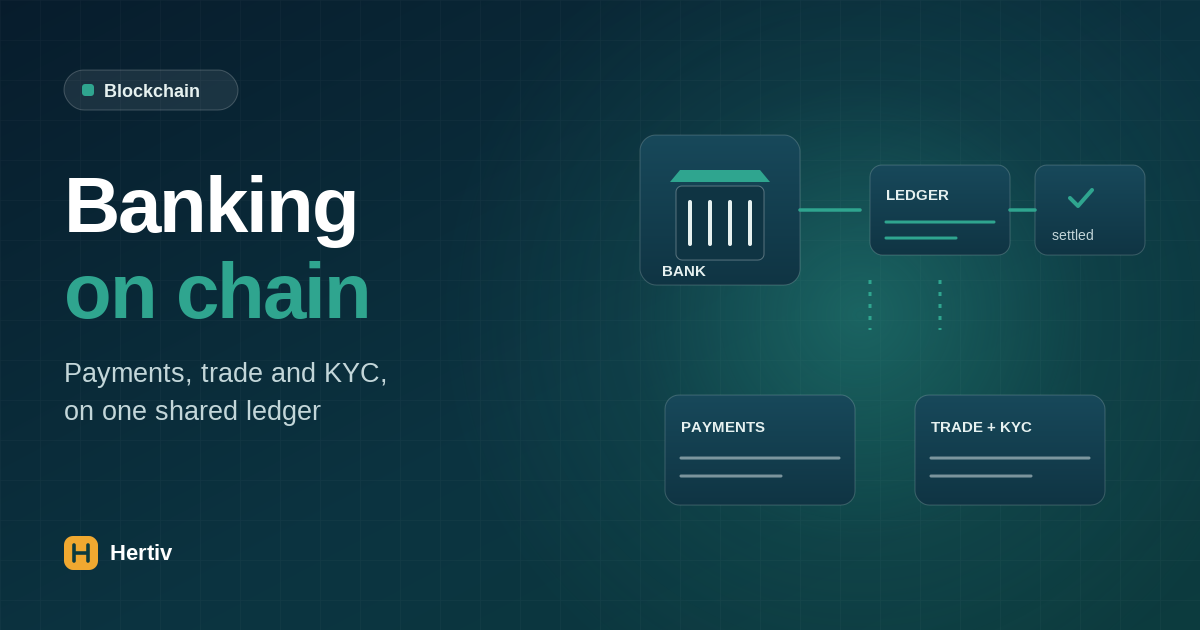
Blockchain in banking is the use of shared, tamper-resistant ledgers to record and settle financial activity between banks, customers and other parties. Instead of each bank keeping its own copy of a transaction and reconciling later, all parties read and write to one ledger they all trust.
The ledger is shared, so a payment, a loan or a trade is recorded once and seen by everyone with permission to see it. That single record is what makes settlement faster and disputes easier to settle, because there is no argument about which copy is right.
| Use case | What changes | Who is involved |
|---|---|---|
| Cross-border payments | Settlement in hours, not days | Sending bank, receiving bank, customer |
| Trade finance | Documents and payments move together | Importer, exporter, both banks |
| Shared KYC checks | One verified identity, reused | Banks, regulators, customer |
| Tokenized assets | Bonds and funds trade as tokens | Issuer, investors, custodian |
| Interbank settlement | Banks settle with each other directly | Central bank, commercial banks |
Not every banking job needs a blockchain. Where one bank controls the whole process, a normal database is simpler and faster. Blockchain earns its place where several parties must agree on the same record and none of them wants to trust the other parties copies.
How do banks use blockchain for payments?
Cross-border payments are the oldest banking use case for blockchain. A payment today often passes through several correspondent banks, each taking a fee and a day, and the sender cannot see where the money is.
On a shared ledger, the sending bank records the payment once, and the receiving bank sees it at once. Fewer middlemen means fewer fees and fewer places where a payment can get stuck. Stablecoins and central bank digital currencies are the usual settlement assets on these networks, and the rules that govern them are set out in regulations such as the MiCA regulation in Europe.
The gain is largest for small, frequent payments, where correspondent fees eat a big share of the amount. For large payments inside one country, existing real-time systems are usually faster and cheaper.
Where does blockchain help in trade finance?
Trade finance runs on paper: invoices, bills of lading, letters of credit and inspection certificates pass between buyer, seller and two banks. Each party checks the documents by hand, and a mismatch can hold up a shipment for days.
On a blockchain, the documents and the payment terms sit on the same ledger. When the agreed conditions are met, the payment releases automatically, and every party sees the same state. That cuts the back-and-forth that causes most delays.
The hard part is not the technology. It is getting exporters, importers, banks and shippers to agree on one set of document standards. Pilots that skip that agreement usually stall, however good the ledger is.
Trade finance also shows why shared ledgers need shared standards. A bill of lading means the same thing in every port only if every party reads it the same way, and the ledger cannot fix a document that two banks describe differently.
What about identity and KYC?
Every bank runs its own know-your-customer checks, so a customer who opens accounts at three banks is verified three times, with three sets of documents. That repeats cost and annoys customers.
A shared KYC ledger lets one bank verify a customer and record the result, so other banks can reuse it with the customer permission. The customer controls who sees the record, and the banks save the cost of repeating the same checks.
Regulators still need to be satisfied, and rules differ by country, so shared KYC works best inside one market first. A bank that wants to learn more about the asset side can read how tokenization works before planning a pilot.
How does a bank run a first pilot?
A first pilot should be small, boring and easy to measure. Pick one workflow, one counterparty and one clear success metric, then run it beside the existing process rather than replacing it.
- Pick the workflow. Cross-border payments between two branches or two partner banks is a common first choice.
- Choose one counterparty. A pilot with one partner is easier to govern than a network of ten.
- Set one metric. Settlement time, cost per payment or error rate all work; pick one and measure it before and after.
- Run it in parallel. Keep the old process running so a pilot failure does not stop real payments.
- Review and decide. After three months, compare the numbers and decide whether to expand, change or stop.
A pilot that cannot show a number is a demo, not a test. Agree the metric before the first transaction, and write down what result would justify a bigger rollout. A bank that already runs workloads in the cloud can pair the pilot with cloud computing in banking work already under way.
Example: a regional bank settles cross-border payments
Example (hypothetical): a regional bank sends 200 cross-border payments a month for small business customers. Each payment costs $25 in correspondent fees and takes two days to arrive.
On a shared ledger pilot with one partner bank, the fee falls to $6 per payment and the money arrives the same day. That is 200 x $25 = $5,000 a month before the pilot, and 200 x $6 = $1,200 after it, a saving of $3,800 a month, or $45,600 over a year.
The bank keeps the old route running for large payments and moves only small ones to the ledger. The saving is real, but it only covers the payments on that one corridor; expanding to more partners needs new agreements, not just new software.
What are the common mistakes?
The most common mistakes are treating blockchain as a goal, skipping the legal work, and expecting one ledger to fix a broken process.
- Starting with the technology. A pilot that begins with a ledger and looks for a problem usually finds none worth solving.
- Ignoring regulation. Payment, identity and token rules differ by country, and a pilot that breaks them stops fast.
- Expecting every party to join at once. Networks grow one partner at a time; a pilot with no second party proves nothing.
- Replacing a process that already works. If one bank controls the whole workflow, a database is simpler.
- No success metric. Without a number agreed in advance, every pilot looks like a success.
Key takeaways
- Blockchain in banking means a shared ledger that several parties read and write, instead of each keeping its own copy
- Cross-border payments, trade finance, shared KYC and tokenized assets are the main use cases
- The gain is largest where several parties must agree on one record
- A first pilot should be small, run in parallel, and measured on one metric
- Regulation and partner agreements decide success more often than the technology
Frequently asked questions
Do banks use public blockchains or private ones?
Most banking pilots use permissioned ledgers, where only approved banks and partners can read and write. Public chains are used for some tokenized assets and stablecoins, but banks usually need control over who joins and who sees the data.
Is blockchain in banking the same as cryptocurrency?
No. Cryptocurrency is one use of blockchain, and most banking work does not involve it. Banks use the ledger idea for payments, documents and identity, and they usually settle in normal money or in regulated stablecoins.
How long does a banking blockchain pilot take?
A small pilot with one partner usually takes three to six months from agreement to first live transaction. The technology is rarely the slow part; legal review, compliance checks and partner agreements take most of the time.
Does blockchain replace correspondent banks?
Not yet, and not everywhere. It can cut the number of middlemen on one corridor, but most banks still need correspondent relationships for markets where no shared ledger exists. The change is gradual, corridor by corridor.
What is the biggest risk for a bank starting with blockchain?
The biggest risk is building for a network that never forms. A ledger with one bank on it adds cost without benefit. The second risk is regulation: payment, identity and token rules differ by country and change often.
Can small banks use blockchain, or only large ones?
Small banks can join networks built by others instead of building their own. Joining a payment or trade network as a member is cheaper than running a ledger, and it is how most small banks get started.


