Best ZK Rollups for Startups: 6 Worth Comparing
Compare six ZK rollups for startups: zkSync Era, Starknet, Polygon zkEVM, Scroll, Linea and Taiko. See fees, EVM fit, tooling and how to choose.
On this page
Short answer
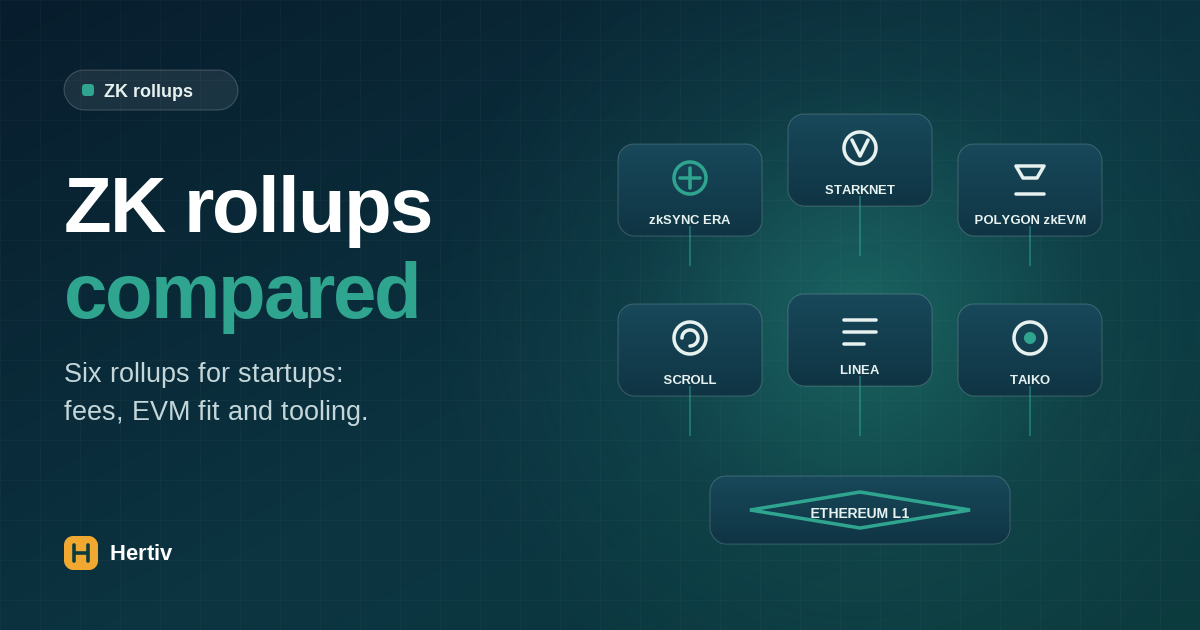
The best ZK rollups for startups are zkSync Era, Starknet, Polygon zkEVM, Scroll, Linea and Taiko. All six settle on Ethereum, but they differ in EVM fit, tooling and wallet support, so the right choice depends on your contracts and your users.
Which ZK rollups should startups compare?
Startups building on Ethereum should compare zkSync Era, Starknet, Polygon zkEVM, Scroll, Linea and Taiko before choosing a rollup. All six use zero-knowledge proofs to settle transactions on Ethereum, but they differ in tooling, fees and how close they stay to Ethereum's own rules.
A ZK rollup moves most work off the main chain and posts a proof back to Ethereum, so users get lower fees and faster confirmation while keeping Ethereum's security. For a startup, the choice is less about the proof system and more about the developer tools, the wallets your users already have, and how easy it is to deploy the contracts you already wrote.
This list focuses on general-purpose rollups that run smart contracts, not app-specific chains. A guide to what a ZK rollup is explains the underlying idea before you compare the options.
| Rollup | Proof system | EVM fit | Mainnet status |
|---|---|---|---|
| zkSync Era | ZK-SNARK | Near-EVM | Live |
| Starknet | STARK | Cairo, not EVM | Live |
| Polygon zkEVM | ZK-SNARK | Full EVM | Live |
| Scroll | ZK-SNARK | Full EVM | Live |
| Linea | ZK-SNARK | Full EVM | Live |
| Taiko | ZK-SNARK | Full EVM | Live |
1. zkSync Era
1. zkSync Era: best for teams that want low fees and account abstraction
zkSync Era is a ZK rollup built by Matter Labs that supports native account abstraction, so wallets can pay fees in tokens other than ETH and use social recovery. It runs most Ethereum contracts with small changes, and its tooling is close to the standard Ethereum stack.
Startups choose zkSync Era when they want a large user base and built-in wallet features without building them from scratch. The trade-off is that some contracts need small changes, so a team with complex Solidity code should test the deploy early.
Pros
- Native account abstraction built in
- Large ecosystem of wallets and apps
- Low fees for users
Cons
- Some contracts need small changes to deploy
- Proof system is custom, not standard EVM
2. Starknet
2. Starknet: best for teams building new kinds of apps
Starknet is a ZK rollup that uses the Cairo language instead of Solidity, which lets developers write programs that would be hard to express in standard Ethereum contracts. It is a good fit for games, on-chain order books and other apps that need heavy computation.
The cost of that power is a new language and a smaller tool set. A team that already has Solidity contracts will need to rewrite them, and hiring Cairo developers is harder than hiring Solidity developers.
Pros
- Cairo allows complex on-chain logic
- Strong performance for heavy computation
- Active developer community
Cons
- Contracts must be rewritten in Cairo
- Smaller hiring pool than Solidity
3. Polygon zkEVM
3. Polygon zkEVM: best for teams that want a straight Ethereum deploy
Polygon zkEVM is a ZK rollup that aims to run Ethereum contracts without changes. A team can take a contract that works on Ethereum, deploy it on Polygon zkEVM, and expect the same behaviour, which keeps the migration short.
Polygon zkEVM is a good fit for startups that already have a working Ethereum app and want lower fees without a rewrite. Its ecosystem is smaller than zkSync Era, so a team that needs many integrations should check that its tools are available first.
Pros
- Full EVM fit, no contract changes
- Backed by the Polygon ecosystem
- Simple migration from Ethereum
Cons
- Smaller ecosystem than zkSync Era
- Fewer native wallet features
4. Scroll
4. Scroll: best for teams that value Ethereum alignment
Scroll is a ZK rollup built to match Ethereum as closely as possible, from the bytecode up. It is a good fit for teams that want their contracts to behave exactly as they do on Ethereum, with no surprises from a custom virtual machine.
Scroll is newer than zkSync Era and Polygon zkEVM, so its ecosystem is still growing. A startup that needs many third-party tools should check availability before committing.
Pros
- Very close to Ethereum's own rules
- Clean migration for existing contracts
- Open-source development
Cons
- Smaller ecosystem than older rollups
- Fewer apps live today
5. Linea
5. Linea: best for teams already using Consensys tools
Linea is a ZK rollup from Consensys that runs Ethereum contracts without changes and connects well with MetaMask and other Consensys tools. Teams that already use MetaMask for testing and deployment will find the workflow familiar.
Linea is a good fit for startups that want a simple deploy path and a wallet their users already know. Its fee structure and throughput are in line with other ZK rollups, so the choice comes down to tooling rather than cost.
Pros
- Full EVM fit
- Works well with MetaMask
- Simple deploy path
Cons
- Smaller ecosystem than zkSync Era
- Less account abstraction than zkSync Era
6. Taiko
6. Taiko: best for teams that want a fully open design
Taiko is a ZK rollup that aims to be a type-1 rollup, meaning it matches Ethereum exactly and uses no custom rules. It is fully open source, and its design lets anyone run a prover, which fits teams that care about decentralisation.
Taiko is a good fit for startups that value openness and exact Ethereum behaviour over a large existing ecosystem. A team that needs many live integrations today may find the ecosystem thinner than older rollups.
Pros
- Exact Ethereum match by design
- Fully open source
- Anyone can run a prover
Cons
- Smaller live ecosystem
- Newer, so fewer case studies
How to choose a ZK rollup for your startup
Choose a ZK rollup by testing your own contracts on it, not by reading a feature list. Deploy the contract, run the user flow with a real wallet, and measure the fee and the confirmation time. That test tells you more than any comparison table.
A ZK rollup comparison should also cover the proof system, since it affects how the rollup proves its work to Ethereum. A guide to ZK rollups versus optimistic rollups explains the difference.
A list of top ZK rollup projects shows which teams are building on each rollup, so you can see where the ecosystem is active before you commit.
- List your contracts. Note which ones are standard Solidity and which use custom features.
- Deploy on two rollups. Pick the two closest fits and deploy the same contracts on both.
- Test with a real wallet. Run the full user flow and record fees and confirmation times.
- Check your tools. Confirm that your indexers, oracles and wallets work on the rollup.
- Pick the one that ships fastest. Choose the rollup where your app works today, not the one with the best roadmap.
What are the common mistakes?
The most common mistakes when choosing a ZK rollup are picking on fees alone, ignoring the tooling gap, and deploying without testing the user flow. Fees matter, but a rollup that breaks your contracts or your wallet flow costs far more than a slightly higher fee.
Another common error is assuming every ZK rollup runs Ethereum contracts the same way. Starknet uses Cairo, so Solidity contracts must be rewritten. zkSync Era runs most contracts but not all. Polygon zkEVM, Scroll, Linea and Taiko aim for a closer match, but even there, edge cases exist.
- Choosing on fees alone. A rollup that breaks your contracts costs more than a higher fee.
- Ignoring the wallet. If your users' wallets do not work on the rollup, they will not use the app.
- Skipping the test deploy. Deploy your real contracts before you commit to a rollup.
- Forgetting the prover. Some rollups depend on a small set of provers; check how open the design is.
Key takeaways
- ZK rollups cut fees by proving batches of transactions back to Ethereum
- zkSync Era leads on account abstraction; Starknet leads on custom computation
- Polygon zkEVM, Scroll, Linea and Taiko aim for a close Ethereum match
- Test your real contracts on two rollups before choosing one
- Wallet support and tooling matter more than a small fee difference
Frequently asked questions
What is a ZK rollup?
A ZK rollup is a layer-2 chain that runs transactions off the Ethereum main chain and posts a zero-knowledge proof back to Ethereum. The proof shows the transactions are valid without replaying each one, so users get lower fees and faster confirmation while keeping Ethereum security.
Which ZK rollup is cheapest for startups?
Fees change with network demand, so no rollup is always cheapest. Deploy your contracts on two rollups, run a typical user flow, and compare the real fee your users would pay. A rollup with slightly higher fees but working tooling is usually the better choice.
Can I deploy the same Solidity contract on any ZK rollup?
Mostly, but not always. Polygon zkEVM, Scroll, Linea and Taiko aim to run Ethereum contracts without changes. zkSync Era runs most contracts with small changes. Starknet uses Cairo, so Solidity contracts must be rewritten for it.
What is the difference between zkSync Era and Starknet?
zkSync Era runs Solidity-style contracts and adds native account abstraction, while Starknet uses the Cairo language and allows more complex on-chain programs. Choose zkSync Era for a standard app and Starknet when you need computation that Solidity cannot express well.
Do ZK rollups need a bridge?
Yes. Users move assets from Ethereum to a rollup through a bridge, and back the same way. Most rollups have an official bridge, and third-party bridges exist too. Check the bridge fees and the withdrawal time before you launch.
Are ZK rollups safe for a startup to build on?
ZK rollups settle on Ethereum, so they inherit its security for the final state. The main risks are the maturity of each rollup's code and the centralisation of its sequencer or prover. Check the audit history and the roadmap before you commit.


