AutoGen vs LangChain: Which Agent Framework Fits?
AutoGen and LangChain both build AI agents, but they take different paths. Compare how they work and which one fits your team.
On this page
Short answer
AutoGen is Microsoft's framework for building applications where several AI agents work together, while LangChain is a framework for building applications that chain language model calls, tools and memory into workflows. AutoGen suits multi-agent teamwork, LangChain suits step-by-step workflows, and the right choice depends on whether your job needs agents that talk to each other or a pipeline that runs in order.
What is the difference between AutoGen and LangChain?
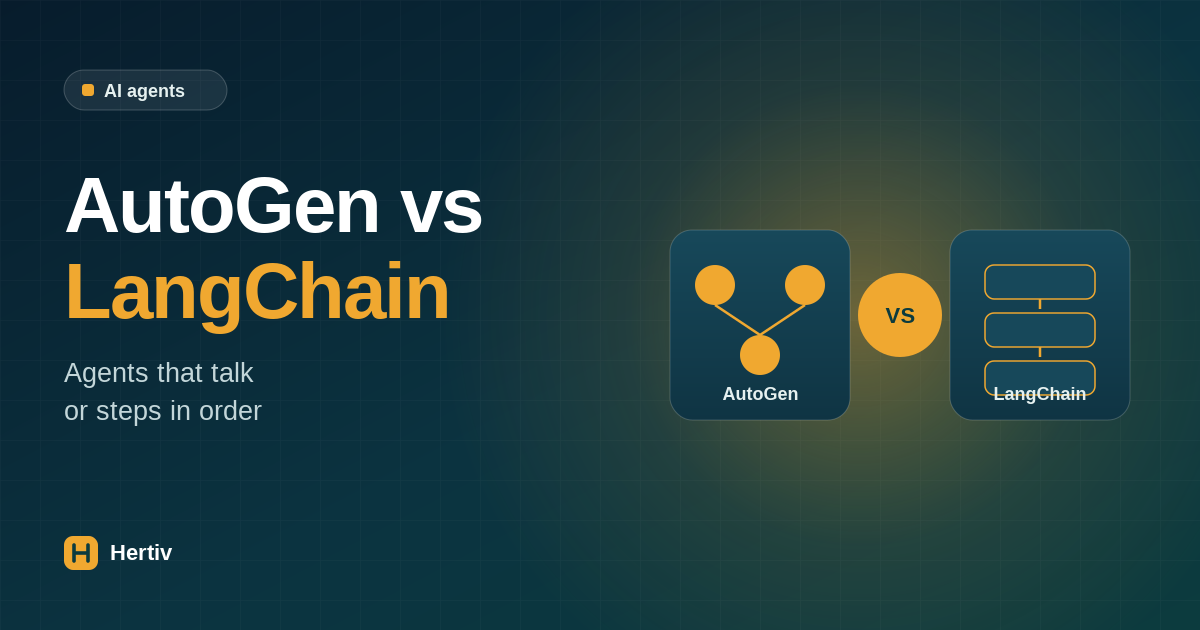
AutoGen is a framework for multi-agent applications: you create several agents, give each one a role, and let them talk to each other to finish a job. One agent might plan, another might write code, and a third might check the result. LangChain is a framework for chaining steps: you describe a workflow as a sequence, for example retrieve documents, draft an answer, then check the draft, and LangChain runs the steps in order.
The difference is who decides the next step. In AutoGen, the agents decide among themselves, so the path through the job can change as they work. In LangChain, the developer decides the path in advance, so the workflow is the same every time. That makes AutoGen flexible and harder to predict, and LangChain predictable and easier to test. The table below compares the two at a glance.
| Point | AutoGen | LangChain |
|---|---|---|
| Main idea | Agents that talk to each other | Steps chained in order |
| Best for | Multi-agent teamwork | Retrieval and step-by-step work |
| Main language | Python, .NET | Python, TypeScript |
| Control | Agents choose the next step | Developer sets the steps |
| Testing | Harder, paths vary | Easier, paths are fixed |
Both frameworks are open source and both work with most language models, so the choice is about the shape of your job, not about which model you use.
A team that needs a support bot to answer from documents will usually pick LangChain, while a team that needs several agents to research, draft and check a report will usually look at AutoGen first. The LangChain vs CrewAI vs AutoGen comparison covers a third option for the same decision.
How does AutoGen work?
AutoGen works by giving each agent a role and a way to talk to the others. A typical setup has a planner agent that breaks the job into parts, worker agents that do each part, and a checker agent that reviews the result. The agents pass messages back and forth until the job is done or until a limit is reached, such as a maximum number of turns.
The strength of this design is that the agents can adapt. If the checker finds a mistake, it can send the work back with a note, and the worker can fix it without the developer writing a new rule for every case.
The weakness is the same flexibility: a run can take a different path each time, which makes testing and cost harder to control. Teams manage this by setting turn limits, by logging every message, and by adding a human check before any action that matters.
AutoGen also ships with tools for running agents in a team, for keeping track of the conversation, and for connecting agents to code and web tools. A team that already builds on Microsoft tools will find the .NET support useful, while Python teams use the Python package. For a simpler agent setup, the open source LangChain alternatives guide lists frameworks that need less multi-agent machinery.
How does LangChain work?
LangChain works by chaining steps into a workflow the developer defines. A common chain retrieves documents from a vector store, passes the relevant ones to the model with the question, and then checks the draft against the sources. The developer can add memory, so the chain remembers earlier turns, and tools, so it can call an API, search the web or run code.
The strength of this design is control. Because the steps are fixed, the team can test each step on its own, measure how often it fails, and fix it without touching the rest of the chain. The weakness is rigidity: a job that needs the model to change its plan mid-way is harder to express as a fixed chain, and the team ends up writing extra logic around the framework.
LangChain also has an agent mode, where the model picks tools in a loop, so the line between the two frameworks is not absolute. The difference is emphasis: LangChain starts from chains and adds agents, while AutoGen starts from agents and adds structure. The AI proof of concept guide shows how teams test either approach in four weeks.
Which one should you choose?
Choose AutoGen when the job needs several agents with different roles, when the plan should change as the work progresses, and when a human can review the result before it goes out. Choose LangChain when the job is a fixed pipeline, when answers must come from your own documents, and when the team needs to test each step on its own.
A practical test is to describe the job in one sentence. If the sentence says "do these steps in order", LangChain is the natural fit. If the sentence says "a team of agents should figure this out together", AutoGen is the natural fit. Jobs that sit in between, such as a support agent that searches documents and then drafts a reply, can be built with either, and the team's language and experience should decide.
Cost also matters. Multi-agent runs use more model calls, because each agent reads the conversation so far, so an AutoGen run usually costs more per job than a LangChain chain that does the same work in fewer steps. Teams that run thousands of jobs a day often start with LangChain for that reason, and use AutoGen where the extra reasoning earns its keep.
Example (hypothetical): the same 20-task job on both frameworks
Example (hypothetical): a support team gives both frameworks the same job, answering 20 customer questions from a help centre, and measures setup time and run time.
On LangChain, setup takes 4 hours: the team writes a retrieval chain, connects the help centre and adds a check step. Running the 20 questions takes 20 times 3 minutes, which is 60 minutes, so the total is 5 hours.
On AutoGen, setup takes 6 hours: the team creates a planner, a researcher and a checker agent and writes the handover rules. Running the 20 questions takes 20 times 2 minutes, which is 40 minutes, so the total is 6 hours and 40 minutes.
The numbers show the trade-off. LangChain is faster to set up for a fixed pipeline, while AutoGen takes longer to build but answers each question slightly faster once the agents are running. For 20 questions the difference is small; for 2,000 questions the run-time gap would matter more than the setup gap, so the team should repeat the test at real volume before choosing.
How do you test the two frameworks in 5 steps?
Test both frameworks on the same job, with the same questions and the same model, so the comparison is fair.
- Pick one real job. Choose a job the team actually does, such as answering support questions from help centre pages.
- Write 20 test questions. Use real customer words, including vague and misspelt questions, and write the correct answer for each one.
- Build the same job twice. One developer builds it in LangChain, another in AutoGen, with the same model and the same documents.
- Score the answers. Count how many answers are correct, how many need a fix, and how long each run takes.
- Check the cost. Add up the model calls for each run, then decide which trade-off the team prefers.
The test takes a few days and answers the question better than any feature list. A framework that wins on your questions, with your documents and your team, is the right one. The how to test AI models guide covers how to write the test set so the scores mean something.
What are the common mistakes?
The most common mistakes are picking a framework before defining the job, letting agents act without a human check, and skipping the cost test.
- Picking before defining the job. A team that chooses AutoGen for a fixed pipeline, or LangChain for open-ended teamwork, fights the framework from day one.
- No human check. Agents that send messages, update records or spend money without review will eventually make a mistake that matters.
- No turn limits. Multi-agent runs without a turn limit can loop for a long time and run up a large model bill.
- Skipping the cost test. A design that works for 20 questions can be too expensive for 2,000, so cost must be measured at real volume.
- Ignoring the upgrade path. Both frameworks change often, so the team should pin versions and test upgrades before shipping them.
Both frameworks are good tools for different jobs. The team that defines the job first, tests both on real questions and keeps a human in the loop gets a working agent; the team that picks by reputation gets a demo. The what is GPT guide explains the models both frameworks call.
Key takeaways
- AutoGen is built for agents that talk to each other; LangChain is built for steps in order
- Pick by the shape of the job, not by which framework is more popular
- Multi-agent runs cost more per job, so test at real volume before choosing
- Test both on the same 20 real questions with the same model
- Keep a human check before any action that matters, and set turn limits
Frequently asked questions
Can I use AutoGen and LangChain together?
Yes. Some teams use LangChain chains inside AutoGen agents, for example an agent that runs a retrieval chain to answer from documents. The combination works when each framework does the part it is best at, but it adds complexity, so most teams start with one.
Is AutoGen only for Python developers?
No. AutoGen supports Python and .NET, so a team building on Microsoft tools can use the .NET version. LangChain supports Python and TypeScript. The team's main language is a fair reason to prefer one over the other.
Which framework is easier to learn?
LangChain is usually easier to start with, because a chain is a list of steps a developer can read from top to bottom. AutoGen needs more thinking about how agents talk to each other, so it takes longer to learn but handles teamwork better.
Do both frameworks work with any language model?
Yes. Both work with most hosted and self-hosted models through a model client. The choice of model is separate from the choice of framework, so you can switch models later without rebuilding the whole application.
Which one is better for a support chatbot?
LangChain is usually the better fit, because a support chatbot is a fixed pipeline: find the right help page, draft an answer and check it. AutoGen earns its place when several agents must research, draft and check together.
Are these frameworks free to use?
Yes. Both are open source, so there is no licence fee. You still pay for the language model calls, for hosting, and for the developer time to build and maintain the application. See vendor site for model pricing.


