LangChain vs CrewAI vs AutoGen: Which Framework Fits Your Project?
LangChain, CrewAI and AutoGen all build multi-agent systems, but from different ideas. This guide compares them so you can pick the one that fits your project.
On this page
Short answer
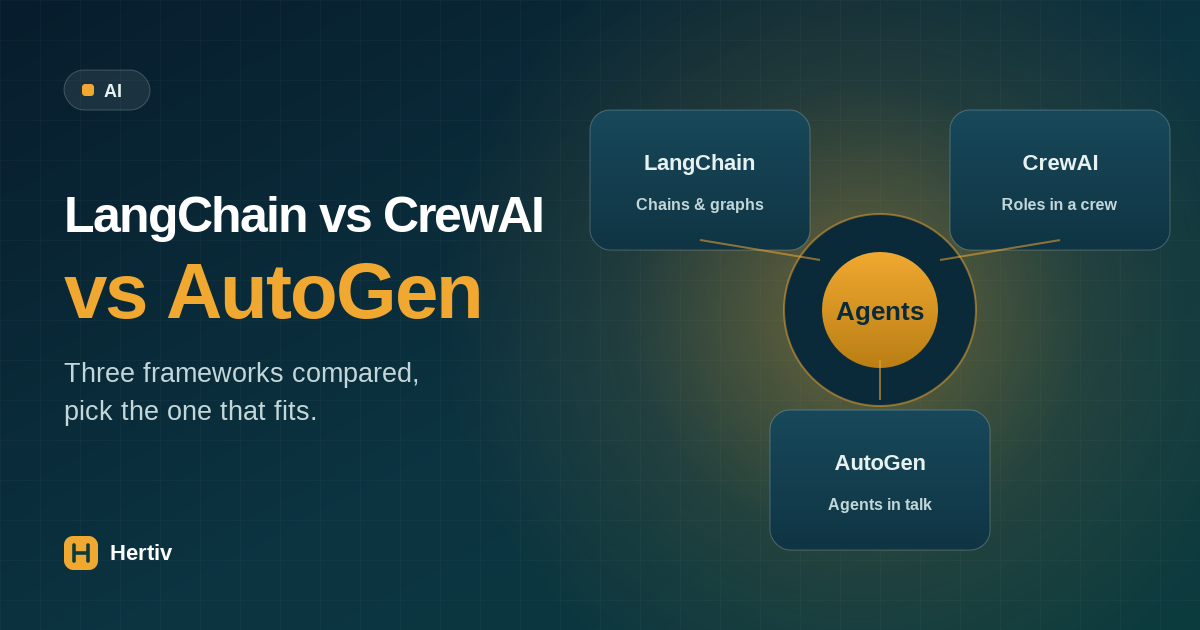
LangChain, CrewAI and AutoGen are three frameworks for building applications where several AI agents work together. LangChain is a broad toolkit for chaining models, tools and memory. CrewAI organises agents into roles that work as a crew. AutoGen focuses on agents that talk to each other to solve a task. The right choice depends on how much control you need and how your agents should cooperate.
What are LangChain, CrewAI and AutoGen?
LangChain, CrewAI and AutoGen are frameworks for building applications in which several AI agents work together on a task. A framework in this sense is a set of building blocks: ways to call a model, give it tools, keep memory between steps, and pass work from one agent to another.
They exist because building multi-agent systems from scratch is slow and error-prone. Each framework makes different choices about how agents are organised, which is why they feel different to use even though they solve similar problems. Picking one is mostly about picking an organising idea that matches your project.
All three are open source and actively developed, and all three can call the same models. The differences are in structure, not in which models they support. LlamaIndex vs LangChain covers a related choice between a data-focused framework and a general one.
What is LangChain good for?
LangChain is the broadest of the three. It started as a toolkit for chaining language model calls together, and it now covers retrieval, tools, memory, evaluation and deployment. If your project is a single agent with tools and a knowledge base, LangChain usually has a building block for it.
Its strength is range: there are integrations for many models, vector stores, tools and services, and a large community writing examples. Its weakness is the same range. A new team can spend a long time choosing between several ways to do the same thing, and the framework has changed quickly, so examples from a year ago may not match the current version.
LangChain also has LangGraph, a way to build agents as graphs of steps with explicit state. Teams that need careful control over the flow of a multi-agent system often end up using LangGraph rather than the simpler chaining parts of LangChain.
What is CrewAI good for?
CrewAI organises agents the way a team is organised: each agent has a role, a goal and a set of tools, and a crew works through a sequence of tasks. A support crew might have a triage agent, a research agent and a reply agent, each with its own instructions.
Its strength is clarity. The role-based structure is easy to explain to non-developers, and it fits projects where the work naturally splits into roles. The configuration is mostly declarative, so a small team can get a working crew quickly without writing much plumbing.
Its weakness is that the structure is also a limit. If your agents need to negotiate, vote or change the plan mid-task, the role-and-task model can feel rigid. CrewAI fits best when the workflow is known in advance and the roles are stable.
What is AutoGen good for?
AutoGen, from Microsoft, organises agents around conversation. Agents take turns speaking, propose solutions, critique each other and keep going until the task is done or a limit is reached. The conversation itself is the workflow.
Its strength is flexibility for open-ended problems. A coding task, for example, can pass between a coder agent, a reviewer agent and a tester agent until the tests pass, with the number of rounds decided by the results rather than a fixed plan. That makes AutoGen a good fit for research-style tasks where the path is not known in advance.
Its weakness is control. Conversations can loop, wander or run long, so a production system needs limits on rounds, costs and time, plus a way to stop gracefully. AutoGen suits teams that are comfortable adding those guardrails themselves. What is a multi-agent system explains the ideas behind all three frameworks.
LangChain vs CrewAI vs AutoGen: side by side
Use this table to compare the three frameworks at a glance. The differences are about structure and control, not about which models they can use.
| Framework | Organising idea | Best for | Watch out for |
|---|---|---|---|
| LangChain | Chains and graphs of steps | Broad projects, retrieval, tools | Many ways to do one thing |
| CrewAI | Roles in a crew | Clear role-based workflows | Rigid when plans must change |
| AutoGen | Agents in conversation | Open-ended, research-style tasks | Needs limits on rounds and cost |
A useful rule of thumb: if you can draw the workflow as a fixed sequence of roles, CrewAI is the fastest path. If the path depends on what the agents discover, AutoGen fits better. If the project is mostly one agent with tools and retrieval, LangChain is the safe default. How to build an AI proof of concept shows how to test any of the three on a small problem first.
Example (hypothetical): picking a framework for a support team
Example (hypothetical): a support team gets 100 tickets a day and wants agents to triage, research and draft replies. The team tests all three frameworks on the same 100 tickets. With LangChain, they build a single agent with a knowledge-base tool and a triage step, and it handles 82 of the 100 tickets without help.
With CrewAI, they split the work into a triage agent, a research agent and a reply agent. The crew handles 85 of the 100 tickets, and the team finds the role structure easy to explain to the support manager. With AutoGen, the agents discuss the hard tickets and handle 84, but the team notices that each ticket costs more, because the agents exchange several messages before answering.
The team picks CrewAI, not because it scored highest, but because the workflow is fixed and the roles are clear. The lesson is that the best framework is the one whose structure matches the work, not the one with the highest score on a small test.
Common mistakes
The most common mistake is choosing a framework before defining the workflow. Teams pick the framework they have heard of, then force their problem into its shape. Write down the steps, the roles and the decisions first, then choose the framework that fits that shape.
Another mistake is ignoring cost. Multi-agent systems call the model many times per task, and a conversation-based design can call it ten times where a chain calls it twice. Measure the cost per task during the pilot, not after launch.
Teams also forget evaluation. A framework does not tell you whether the agents are doing good work. Keep a set of test tasks with expected answers, run it after every change, and do not ship a framework switch that makes the score worse.
Key takeaways
- LangChain is the broadest toolkit; CrewAI organises agents into roles; AutoGen uses conversation.
- Fixed role-based workflows suit CrewAI; open-ended tasks suit AutoGen.
- Measure cost per task during the pilot, not after launch.
- Keep a set of test tasks and run it after every change.
- Pick the framework that fits the workflow, not the one you have heard of.
Frequently asked questions
Which is best, LangChain, CrewAI or AutoGen?
There is no single best choice. LangChain fits broad projects with retrieval and tools, CrewAI fits fixed role-based workflows, and AutoGen fits open-ended tasks where agents must adapt. Pick the one whose structure matches your workflow.
Can I use more than one framework?
Yes, some teams do, but it adds complexity. It is usually better to pick one framework for the pilot and only add a second if a specific part of the system genuinely needs a different structure.
Do these frameworks work with any model?
All three can call the models most teams use, including hosted models and self-hosted ones. The choice of model matters more for cost and quality than the choice of framework does.
Is CrewAI only for multi-agent systems?
CrewAI is built around crews of agents, so it is designed for multi-agent work. A single-agent task is simpler to build with a general toolkit, though a one-agent crew also works.
How much does a multi-agent system cost to run?
Cost depends on how many model calls each task needs and which model is used. Conversation-based designs usually cost more per task than fixed chains, so measure the cost per task during a pilot before committing.
Should I build a proof of concept first?
Yes. A small proof of concept on real tasks shows whether the framework fits and what each task costs. It also gives you a test set you can reuse to check later changes.


