LlamaIndex vs LangChain: Which Framework Fits Your Project?
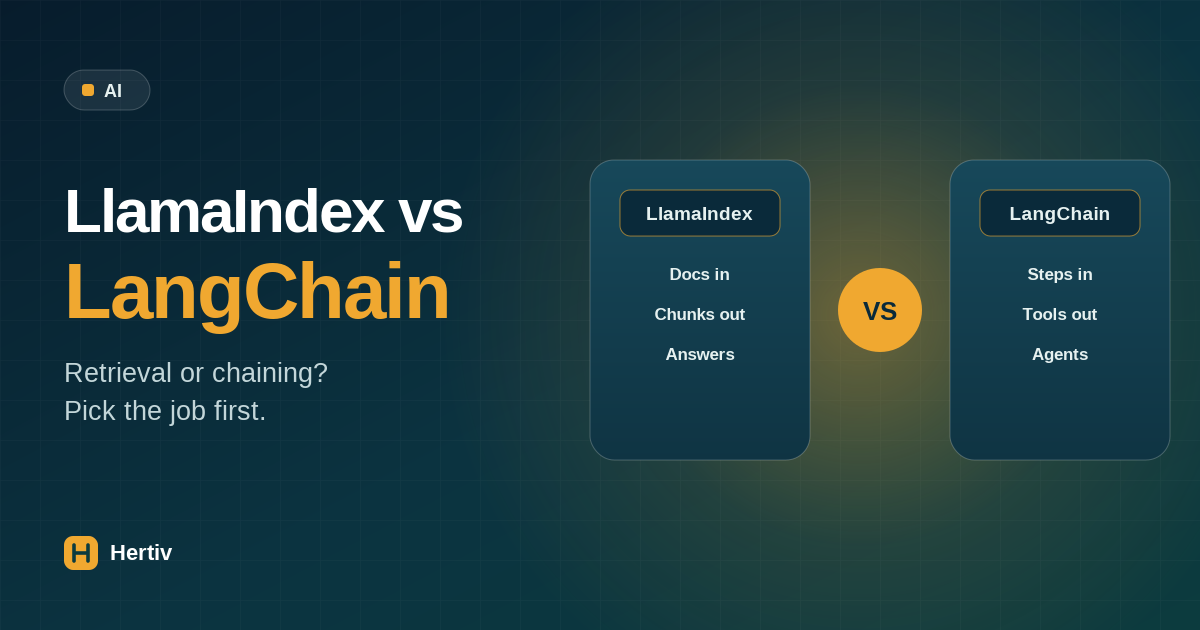
LlamaIndex is built for retrieval over your own documents, while LangChain is built for chaining LLM calls into apps. Pick the one that matches your main job.
On this page
Short answer
LlamaIndex is a framework built for connecting an LLM to your own documents, so it can answer from them. LangChain is a framework built for chaining LLM calls, tools and memory into a working application. The two overlap, but each one is designed for a different main job, and that job should decide which one a team picks.
What is the difference between LlamaIndex and LangChain?
The difference between LlamaIndex and LangChain is focus. LlamaIndex focuses on retrieval: taking your documents, splitting them into chunks, storing them, and finding the right chunks to answer a question. LangChain focuses on orchestration: linking prompts, models, tools and memory into steps that run in order, so an app can do more than answer one question.
A team that mainly needs answers from its own documents will spend most of its time on the retrieval side, which is where LlamaIndex shines. A team that mainly needs an app that plans, calls tools and keeps state across steps will spend most of its time on orchestration, which is where LangChain shines.
| Point | LlamaIndex | LangChain |
|---|---|---|
| Main job | Retrieval over your documents | Chaining LLM calls into apps |
| Document loading | Many loaders and connectors | Loaders exist, less central |
| Indexing | Core strength, many index types | Basic, via vector stores |
| Agents and tools | Supported, not the focus | Core strength |
| Memory | Basic chat history | Several memory types |
| Best first use | Answer from your docs | Multi-step app or agent |
Many teams use both: LlamaIndex for the retrieval layer and LangChain for the app around it. That combination is common, and it works because each framework does the part it was built for.
What is LlamaIndex?
LlamaIndex is a framework for building retrieval into an LLM app. It loads documents from files, wikis, databases and APIs, splits them into chunks, turns the chunks into vectors, and stores them in an index. When a user asks a question, LlamaIndex finds the chunks that match and hands them to the model, so the answer comes from the team's own documents instead of the model's training data.
Its strength is the range of retrieval options. A team can use a simple vector index, a keyword index, a tree index that summarises documents at several levels, or a mix of these. That range matters when the documents are long or structured, because a single retrieval method often misses the right passage.
LlamaIndex also offers query engines that decide how to search: retrieve one chunk, retrieve several and combine them, or walk a tree of summaries. For a team whose main problem is that the model cannot see its documents, LlamaIndex gives the most direct path to a working answer.
What is LangChain?
LangChain is a framework for building apps that chain LLM calls together. A chain is a sequence of steps: take the user's input, look something up, call the model, take the output, call a tool, and call the model again. LangChain provides the pieces for each step: prompt templates, model wrappers, memory, tool calling and agents that decide which tool to use next.
Its strength is orchestration. A team can build an agent that reads a ticket, searches the docs, drafts a reply and files it, with each step visible and testable. LangChain also has a large library of integrations, so connecting to a database, an API or a vector store is usually a few lines of code.
The trade-off is that LangChain's retrieval side is thinner. It can load documents and search a vector store, but it does not offer the range of index types that LlamaIndex does. For how to test either framework on real examples, see how to build an AI proof of concept.
When should you use LlamaIndex, and when LangChain?
Use LlamaIndex when the main job is answering questions from your own documents. That covers support assistants that read manuals, internal search over policies, and research tools that cite sources. If the team spends its time tuning how documents are split and retrieved, LlamaIndex is the right home for that work.
Use LangChain when the main job is a multi-step app. That covers agents that call tools, workflows that branch on the model's output, and apps that keep memory across a conversation. If the team spends its time wiring steps together and handling tool results, LangChain is the right home for that work.
Use both when the app needs both. A common pattern is LlamaIndex for retrieval and LangChain for the app around it: LlamaIndex finds the documents, LangChain decides what to do with them. The two frameworks work together through standard interfaces, so the team does not have to pick one and give up the other. For the retrieval side in detail, see what retrieval augmented generation is.
How do the two handle data and cost?
Both frameworks send data to a model, so both raise the same questions about cost and privacy. Each question to the model costs tokens, and each document chunk stored as a vector costs storage and indexing time. A team that indexes a large document set should measure the cost of the first index and the cost of keeping it fresh as documents change.
On privacy, the key choice is where the model runs and where the vectors live. Both frameworks work with hosted models and with models a team runs itself, and both work with hosted and self-run vector stores. The framework does not decide this; the team's deployment choice does. What the framework decides is how easy it is to swap one model or store for another when the choice changes.
On maintenance, LlamaIndex code tends to be smaller when the job is retrieval only, because there is less orchestration to write. LangChain code tends to be smaller when the job is a multi-step app, because the chain and agent pieces are already there. The team should pick the framework that leaves the least code to write for its own job.
Example (hypothetical): a support team picks a framework
Example (hypothetical): a shop has 200 support articles and gets 500 tickets a day. The team wants an assistant that drafts replies from the articles. The question is whether to build it with LlamaIndex or with LangChain.
The team first tests retrieval. It loads the 200 articles into LlamaIndex, splits them into 1,500 chunks, and asks 100 past questions. LlamaIndex finds a useful chunk for 92 of the 100, which is 92 percent. The same test with a basic vector search in LangChain finds a useful chunk for 84 of the 100, which is 84 percent. The gap is 8 questions in 100.
The team also tests the app side. With LangChain, wiring the draft, the human review step and the filing step takes one chain with three steps. With LlamaIndex alone, the team has to write the review and filing steps by hand. The team decides to use LlamaIndex for retrieval and LangChain for the chain around it, and the combined test keeps the 92 percent retrieval rate while adding the review step.
The lesson is that the retrieval test decided the retrieval layer, and the app test decided the app layer. Picking one framework for both jobs would have meant accepting a weaker result on one side.
What are the common mistakes?
The most common mistake is picking a framework before naming the job. A team that starts with LangChain for a pure document-question app writes orchestration code it does not need, and a team that starts with LlamaIndex for a multi-step agent writes app code the framework was not built for. Name the main job first, then pick the framework that does that job best.
Another mistake is indexing everything. A team that loads every document it owns into an index gets slow retrieval and noisy answers, because the model sees irrelevant chunks. Index the documents the app actually answers from, and keep the rest out until a user asks for it.
Teams also forget to test retrieval on their own questions. A demo on public documents says little about how the framework handles the team's own manuals and tickets. Test with 50 to 100 real questions from the team's own users before choosing. For how to measure a model, see how to test AI models.
Key takeaways
- LlamaIndex is built for retrieval over your own documents; LangChain is built for chaining LLM calls.
- Pick LlamaIndex when the main job is answering from documents.
- Pick LangChain when the main job is a multi-step app or agent.
- Many teams use both: LlamaIndex for retrieval, LangChain for the app around it.
- Test retrieval on 50 to 100 real questions before choosing.
Frequently asked questions
Can LlamaIndex and LangChain be used together?
Yes. A common pattern is LlamaIndex for the retrieval layer and LangChain for the app around it. LlamaIndex finds the relevant document chunks, and LangChain runs the steps that use them, such as drafting, checking and filing.
Is LlamaIndex only for retrieval?
Mostly yes. LlamaIndex focuses on loading, indexing and searching documents, and it offers agents and query engines on top of that. It can run a simple app, but a multi-step agent is usually easier in LangChain.
Is LangChain only for agents?
No. LangChain can also load documents and search a vector store, so it can answer questions from documents. Its retrieval options are thinner than LlamaIndex, so teams with hard retrieval needs often pair the two.
Which one is easier for a first project?
LlamaIndex is usually easier for a first document-question project, because the path from documents to answers is short. LangChain is usually easier for a first multi-step app, because the chain and agent pieces are ready to use.
Do both frameworks work with any LLM?
Yes. Both work with hosted models and with models a team runs itself, through standard interfaces. The choice of model is separate from the choice of framework, so a team can swap models without rewriting the app.
What does it cost to run either framework?
The frameworks themselves are open source. The cost comes from the model calls, the vector storage and the hosting. Each question costs tokens, and each document set costs indexing time, so the team should measure both on its own data.


