What Is GPT, and How Does It Work?
GPT is a type of AI model that writes text by predicting the next word, one word at a time. It powers chatbots, drafting tools and coding assistants.
On this page
Short answer
GPT stands for Generative Pre-trained Transformer, a type of AI model that produces text by predicting the next word based on the words before it. It is trained on large amounts of text, then tuned to follow instructions, answer questions and complete tasks such as drafting, summarising and writing code.
What is GPT?
GPT is a type of AI model that generates text by predicting what comes next, one piece at a time. Given a prompt such as "Write a short email to a customer about a late delivery", it produces the most likely continuation based on patterns it learned during training.
The name breaks down into three parts. "Generative" means it creates new text rather than picking from a fixed list. "Pre-trained" means it learned language patterns from a huge amount of text before it is tuned for a specific job. "Transformer" is the model design that lets it weigh which earlier words matter most for the next word.
GPT is not a single product. It is a family of models from OpenAI, and different versions differ in size, speed and cost. Many products use GPT through an API, which means the model runs on the provider's servers and the product sends it text and receives text back.
How does GPT produce text?
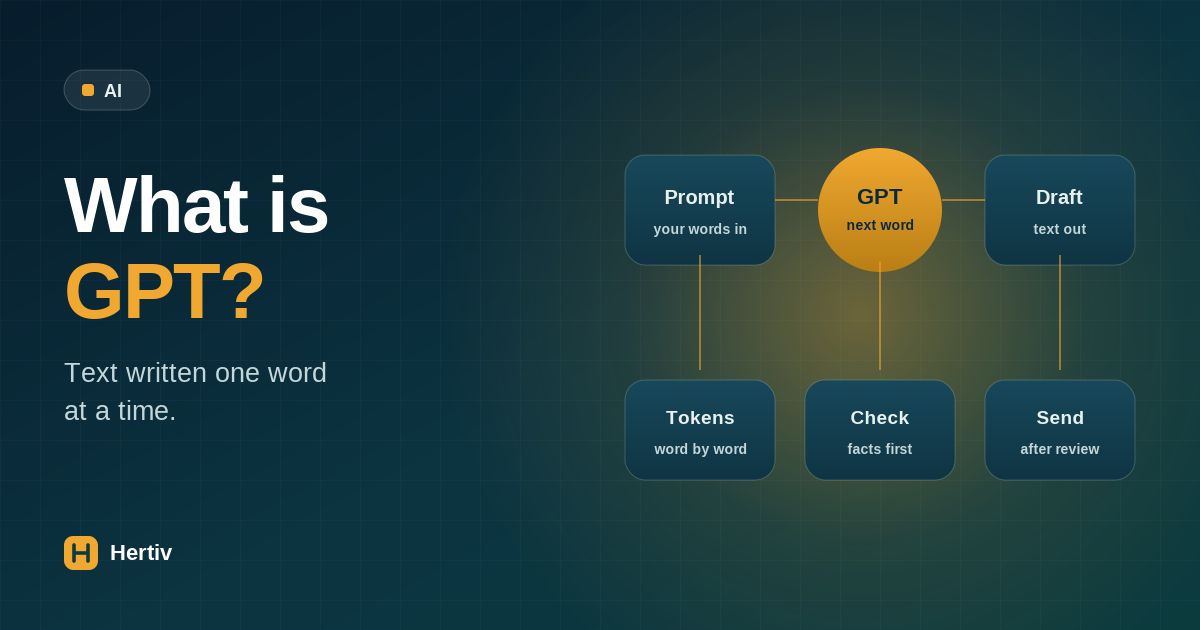
GPT produces text in small steps. It reads the prompt, converts it into tokens, which are short chunks of words or parts of words, and then predicts the next token. It adds that token to the text, predicts the next one, and repeats until the answer is complete or it reaches a length limit.
The model does not look up answers in a database. It stores patterns in its trained weights: which words tend to follow which, how sentences are structured, and how different topics are usually discussed. That is why it can write fluently about many subjects and also why it can state something false with confidence when the patterns point that way.
Teams that test AI models before release check this behaviour directly, because fluency is not the same as accuracy. A model can write a smooth, confident paragraph that is wrong in every detail, so products that need facts must check the output against a trusted source.
What can GPT do, and what can it not do?
GPT is strong at drafting, summarising, rewriting, translating, explaining and producing code from a description. It is useful anywhere the job is to turn one piece of text into another, such as turning notes into an email, a long document into a short summary, or a description into a first draft.
| Task | GPT is usually good at it | Needs a human check |
|---|---|---|
| Drafting | First drafts of emails and documents | Facts, names, dates and numbers |
| Summarising | Short versions of long text | Whether anything important was dropped |
| Explaining | Plain-language explanations | Technical accuracy in specialist topics |
| Writing code | Common patterns and boilerplate | Security, edge cases and tests |
| Answering questions | General knowledge questions | Anything that needs current or private data |
GPT cannot reliably do arithmetic, browse for live facts, or know about events after its training data ends, unless the product connects it to tools that do those things. It also has no memory of a user between sessions unless the product stores conversation history itself. These limits matter when a team plans a product around the model.
How do teams use GPT in products?
Teams use GPT in products in three main ways: as a drafting helper, as a question-answering layer over their own content, and as a classifier that sorts or tags text. Each use needs a different amount of checking before the output reaches a user.
Drafting helpers are the simplest. A user writes a rough note, GPT turns it into a polished draft, and the user edits before sending. The user is the check, so the risk is low. Support teams use this pattern for reply drafts, and marketing teams use it for first versions of copy.
Question-answering products pair GPT with a company's own documents, a pattern often called retrieval-augmented generation. The product finds the relevant documents first, then asks GPT to answer using only those documents. This keeps answers closer to the company's own facts, though a human should still review answers that affect money or safety.
Classification uses GPT to sort text, such as tagging support tickets by topic or flagging urgent messages. Here the output is a label, not a paragraph, so teams can measure accuracy with a test set and set a pass mark before launch.
How to choose a GPT model for your product
You choose a GPT model by matching the job to the model's size, speed and cost, then testing it on your own examples. The largest model is not always the best choice, because a smaller model may be fast and cheap enough for simple tasks.
- List the jobs. Write down what the model must do: draft, summarise, classify, answer questions, or write code.
- Build a test set. Collect 50 to 100 real examples of each job, with the answer you expect.
- Try the smaller model first. Run the test set through it and check how many answers are good enough.
- Move up only if needed. If the smaller model fails on hard cases, try the larger one on the same test set.
- Check the cost. Multiply the price per token by your expected volume, and confirm the total fits the budget.
Most teams also set a review rule: which outputs go straight to the user, which need a human check, and which are blocked. A model that is good enough for drafts may not be good enough to send messages to customers without review, and the review rule should be written down before launch.
Example (hypothetical): a support team drafts replies with GPT
Example (hypothetical): a support team handles 400 customer questions a day, and each reply takes about 6 minutes to write by hand. That is 2,400 minutes a day, or 40 hours, since 400 times 6 equals 2,400 minutes and 2,400 divided by 60 equals 40.
With GPT drafting replies, the team accepts 320 drafts as they are and reviews the other 80. Each review takes about 3 minutes, so the team spends 240 minutes a day on reviews, or 4 hours, since 80 times 3 equals 240 minutes and 240 divided by 60 equals 4.
The team therefore saves about 36 hours a day, since 40 hours minus 4 hours equals 36 hours. The saving is real only if the 320 accepted drafts are actually good, which is why the team checks a sample of accepted drafts every week and sends the weak ones back for review.
Common mistakes
The most common mistake is treating GPT output as fact. The model writes what sounds likely, not what is true, so any number, date, name or claim in its output needs a check against a trusted source before it reaches a customer.
- No test set. Launching without examples of what a good answer looks like, so nobody can tell when quality drops.
- One model for every job. Using the most expensive model for simple classification, or the cheapest for hard reasoning.
- No review rule. Letting the model message customers directly with no human check on risky cases.
- Sending private data unchecked. Pasting customer data into a prompt without knowing where it is stored.
- Ignoring cost. A long prompt on every request can cost far more than the team expected.
The teams that get value from GPT treat it as a fast drafter with a human editor, not as an expert. They measure its accuracy on their own examples, review the risky outputs, and keep the simple jobs on the cheaper model.
Key takeaways
- GPT generates text by predicting the next word, one piece at a time
- It is strong at drafting and summarising, weak at live facts and arithmetic
- Pair it with your own documents when answers must be accurate
- Test models on your own examples before choosing one
- Set a review rule for which outputs reach users unchecked
Frequently asked questions
Is GPT the same as ChatGPT?
No. GPT is the model family, while ChatGPT is a chatbot product built on GPT models. Other products can use the same models through an API, and ChatGPT itself has switched between different GPT versions over time. The distinction matters when a team buys or builds, because the model and the product have different costs and limits.
Does GPT know the latest news?
Not on its own. A GPT model only knows what was in its training data, which ends at a fixed date. Products that need current information connect the model to search results, live data or the company's own documents, so the model can use fresh facts instead of guessing.
Can GPT write code I can ship?
It can write useful first drafts and common patterns, but the code still needs tests, a security review and a human who understands the system. GPT does not run the code or know your codebase, so it can produce code that looks right and fails in ways that only show up later.
How much does using GPT cost?
Providers charge by the token, which is a short chunk of text, and the price differs by model. A short draft costs a fraction of a cent, while a long document processed many times a day adds up. Check the vendor site for current pricing, and estimate cost from your expected volume before launch.
Can I fine-tune GPT for my business?
Yes, providers offer fine-tuning, which trains a model further on your own examples so it follows your style and rules more closely. Fine-tuning helps when prompting alone does not fix repeated mistakes, but it needs a clean set of examples and it does not add facts the model never saw.
What happens to the text I send to GPT?
That depends on the provider and the plan. Some plans use API data to improve models, while others promise not to train on it. Teams handling customer data should read the provider's data terms and, where needed, choose a plan with a data-processing agreement before sending anything sensitive.


