AI-Powered Smart Collars: How They Track Pets
An AI-powered smart collar combines GPS and motion sensors with a model that tracks location and activity. Here is what it can and cannot do, and how to choose one.
On this page
Short answer
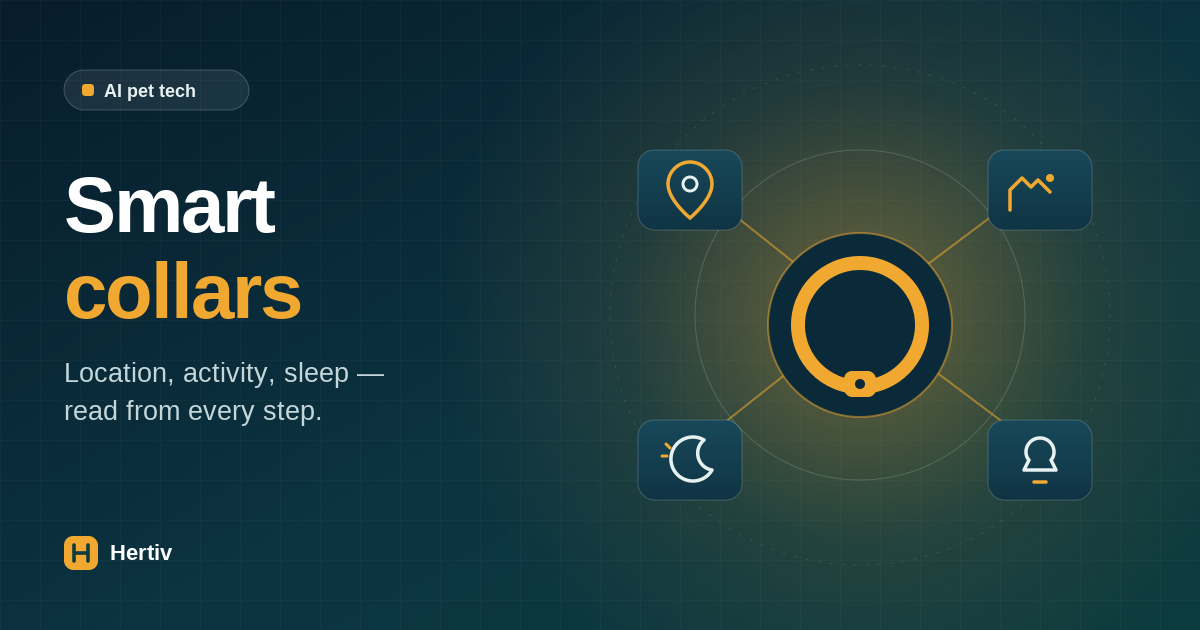
An AI-powered smart collar is a collar fitted with GPS, an accelerometer and other sensors, plus software that turns the raw readings into useful information about an animal: where it is, how much it moves, how it sleeps, and whether its behaviour has changed in a way that might mean illness or stress. The hardware collects the data; the AI reads the patterns.
What is an AI-powered smart collar?
An AI-powered smart collar is a collar that carries GPS, motion and sometimes temperature sensors, and sends the readings to a model that classifies what the animal is doing. The model learns the difference between walking, running, resting, scratching and barking from the motion pattern, then reports the day as activity, rest and alerts instead of raw numbers.
The collar itself is only half the product. The other half is the app, which shows a map, a daily activity score, sleep hours and any change from the animal's normal pattern. Most collars sync over Bluetooth when the animal is near the owner's phone and over a mobile network when it is further away, so the map keeps updating on walks and in the garden.
What the sensors measure:
| Sensor | What it measures | What the AI infers |
|---|---|---|
| GPS | Location over time | Escape, roaming and safe zones |
| Accelerometer | Movement and posture | Walking, running, resting, scratching |
| Temperature | Body and air temperature | Overheating risk on hot days |
| Microphone | Sound near the collar | Barking frequency and duration |
Farm collars use the same idea for cattle and sheep, tracking grazing, rumination and heat cycles so a farmer can spot a sick animal a day earlier. The pet and farm versions share the sensors; the models differ because the behaviour they read is different.
How does the AI turn movement into meaning?
The AI turns movement into meaning by comparing each minute of motion data against patterns it learned from thousands of labelled examples. A steady, rhythmic pattern with a forward gait is walking; short, fast bursts are running; long still periods with a low head position are resting. The model scores each window of data and labels it, then adds the labels up into a daily picture.
The key step is the baseline. A border collie and a bulldog move differently, and the same dog moves differently at two years old and at ten. Good collars spend the first week or two learning the individual animal's normal day, then flag changes from that baseline instead of comparing the animal to an average dog.
Some of this runs on the collar and some runs in the cloud. Simple classification can run on the device, which saves battery and keeps working without a signal. Heavier work, such as comparing a week of data against the baseline or spotting a slow drift in sleep, runs on the server where the full history lives.
Battery life is the practical limit. GPS fixes and mobile sync drain power, so collars trade update frequency against days between charges. A collar that reports location every minute will not last a month; one that checks in every few minutes and only goes live when the animal leaves a safe zone can last weeks. For the hardware side, building IoT wearables covers the same battery and connectivity trade-offs.
What can a smart collar actually detect?
A smart collar can reliably detect location, activity levels, sleep duration and clear changes in routine, such as a dog that suddenly rests far more than usual. These are the things motion and GPS data show directly, and they are where the alerts are most useful.
It can also flag early signs that something is changing. A dog that scratches far more than its baseline may have a skin problem; a cow that stops ruminating may be ill; a dog that barks at night when it never did may be anxious or in pain. The collar does not diagnose; it notices the change early enough for an owner or vet to look.
What it cannot do is replace a vet. A collar cannot measure blood values, see a wound under fur, or tell the difference between a sore leg and a tired day from motion alone. An alert is a prompt to check, not a diagnosis, and any collar that claims to diagnose disease from movement data is overstating what the sensors can show.
Accuracy also varies by animal and fit. A loose collar slides and confuses the motion pattern, a very small dog produces weaker signals, and thick fur can muffle a microphone. The best results come from a collar fitted properly and worn every day, so the baseline stays current.
Smart collars for pets vs livestock
Smart collars for pets focus on location, activity and health alerts for one animal the owner knows well. The buyer is a pet owner who wants to find a lost dog, check the dog got enough exercise, and be told early if its routine changes. The app is built for a single animal or a small household, and the price is a device plus a monthly plan; see vendor site for current pricing.
Livestock collars focus on a herd. A farmer with hundreds of cattle cannot watch each animal, so the collar flags the few that need attention: one that has stopped grazing, one in heat, one that has not moved. The value is labour saved and illness caught early, and the system is sold as a farm platform with dashboards and alerts rather than a single device.
The sensors are similar but the models differ. A pet model is trained on dogs and cats of many breeds; a cattle model is trained on grazing, rumination and heat behaviour. A pet collar used on a cow would misread almost everything, and the reverse is also true. Buy the collar built for the animal you actually have.
Connectivity differs too. Pet collars rely on mobile networks and Bluetooth near the owner, which works in towns and suburbs. Farm collars often use long-range radio, because a field may have no mobile signal, and the base station covers the farm. Check coverage for your area before buying either kind.
How do you choose a smart collar?
You choose a smart collar by matching the sensors and the subscription to the animal and the problem you actually want to solve, not by the longest feature list. A tracker for a dog that escapes needs live GPS; a health monitor for an older dog needs good activity baselines.
- Define the job. Finding a lost pet, tracking exercise, or catching health changes early are different jobs that need different sensors.
- Check the fit and weight. The collar must suit the animal's size and neck, stay in place, and be light enough to wear all day.
- Check battery and charging. Ask how many days it lasts with live tracking on, and how long a charge takes.
- Check coverage. Confirm the mobile or radio network works where the animal actually roams, not just where you live.
- Read the subscription terms. Most collars need a monthly plan for GPS and cloud features; see vendor site for current pricing before you commit.
- Test the alerts. Wear it for two weeks, check whether the activity readings match what you see, and see how many false alerts you get.
Two weeks of real use tells you more than any product page. If the alerts are noisy or the battery dies in three days, the collar will end up in a drawer no matter how good the brochure sounded.
Example (hypothetical): a vet checks a dog's week
Example (hypothetical): a vet is seeing a seven-year-old labrador whose owner says the dog seems slower. The collar data shows the dog's baseline is 12,000 steps a day and 14 hours of rest. This week the dog averaged 7,000 steps, a drop of 5,000 steps, and rest rose to 17 hours, three hours more than usual.
The vet also sees the change started gradually over ten days rather than overnight, and the dog's sleep is broken into more, shorter stretches. That pattern points to discomfort rather than a single injury, so the vet examines the joints first and finds early arthritis in one hip. The collar did not diagnose the arthritis; it gave the vet a dated, measured change to work from.
Without the collar, the owner would have reported only a feeling that the dog was slower. With it, the vet had numbers: 5,000 fewer steps a day and three extra hours of rest, starting ten days ago. The treatment plan is the same either way, but the decision to come in happened earlier.
What are the common mistakes?
The most common mistakes with smart collars are treating an alert as a diagnosis, buying the wrong collar for the animal, and ignoring the subscription cost and battery life.
- Treating alerts as diagnoses. A change in activity is a prompt to check with a vet, not a diagnosis from the collar.
- Wrong fit. A loose collar slides and confuses the motion data, so the activity readings and alerts become unreliable.
- Ignoring the subscription. Most collars need a monthly plan for GPS and cloud features; the device price is only part of the cost.
- Expecting medical accuracy. Motion and temperature cannot show blood values or internal problems, so the collar will miss things a vet would catch.
- Skipping the baseline week. Alerts are only useful once the collar has learned the individual animal's normal day.
- Buying on features alone. A collar with every sensor but three-day battery life is less useful than a simpler one that lasts three weeks.
Smart collars sit where AI meets the Internet of Things: sensors on the animal, models in the cloud, and an owner who gets a useful alert instead of a raw data feed. For the wider picture, AI and IoT in business explains how the same pattern works across other connected devices.
Key takeaways
- A smart collar combines GPS and motion sensors with a model that reads behaviour patterns
- The AI compares each day against the animal's own baseline, not an average animal
- It can flag location, activity and routine changes early, but it cannot diagnose
- Pet and livestock collars share sensors but use different models and connectivity
- Fit, battery life, coverage and the subscription matter as much as the features
- Wear it for two weeks before judging the alerts, so the baseline is real
Frequently asked questions
Can a smart collar find a lost dog?
Yes, if it has GPS and mobile coverage where the dog is. Most collars show live location in the app and can send an alert when the dog leaves a safe zone you set. Coverage depends on the network, so check it for your area.
How accurate is the activity tracking?
It is good for trends such as steps, rest hours and changes from the animal's normal day, once the collar has learned the baseline. It is less reliable for exact counts, and a loose collar or a very small animal can confuse the motion readings.
Can a smart collar tell if my dog is ill?
It cannot diagnose illness, but it can flag a change worth checking, such as far less movement, broken sleep or much more scratching than usual. That early flag is the main health value; the vet still makes the diagnosis.
Do smart collars need a subscription?
Most do, because GPS tracking, cloud storage and the AI features run on the vendor's servers. The device price is only part of the cost, so check the monthly plan on the vendor site before buying.
How long does the battery last?
It depends on how often GPS and the mobile connection are active. Collars that check in every few minutes and go live only outside a safe zone can last weeks; ones reporting live location every minute last far less.
Are smart collars used for farm animals too?
Yes. Cattle and sheep collars track grazing, rumination and heat cycles so a farmer can spot a sick animal or one in heat early. The sensors are similar to pet collars, but the models are trained on livestock behaviour.