AI and IoT in Business: How They Work Together
AI and IoT work best together: sensors collect data from the real world, and AI turns it into decisions. This guide explains how businesses use the combination.
On this page
Short answer
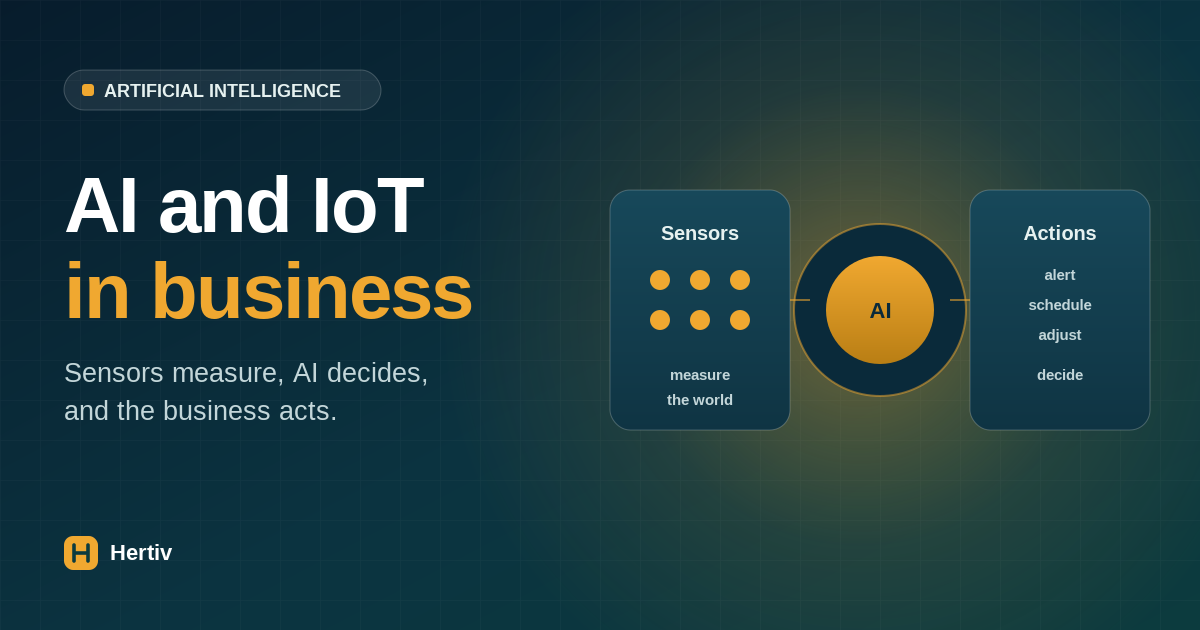
AI and IoT work together when sensors collect data from machines, buildings or products, and AI turns that data into decisions. IoT is the network of connected devices that measure the real world, and AI is the software that finds patterns in what those devices report. Together they let a business see problems early, automate routine decisions and use resources more carefully.
What do AI and IoT mean together?
AI and IoT together mean connected devices that measure the world, plus software that learns from those measurements. IoT devices are sensors and machines connected to a network: a temperature sensor in a warehouse, a vibration sensor on a motor, or a tracker on a delivery van. AI is the software that reads the data those devices produce and finds patterns a person would miss.
On their own, IoT devices produce data and AI models produce answers, but neither is very useful alone. A sensor that reports a temperature every minute is just a stream of numbers until software decides what the numbers mean. A sensor on its own only reports; the software decides what the report means. And an AI model that predicts breakdowns is useless without sensor data to feed it.
The combination is what makes the idea work in business. The devices provide the eyes and ears, and the AI provides the judgement. A warehouse that knows a motor is running hot can fix it before it fails, and a shop that knows foot traffic by the hour can staff accordingly. What is machine learning explains the kind of AI most often used with sensor data.
How AI and IoT work together
The combination follows four stages, from the device to the decision. Each stage has its own job, and a weak stage limits the whole system.
| Stage | What happens | Example |
|---|---|---|
| Sense | Devices measure the real world | Temperature, vibration, location |
| Connect | Data moves to where it is processed | Wi-Fi, mobile, factory network |
| Analyse | AI finds patterns and predicts | Breakdown risk, demand forecast |
| Act | A decision is made or automated | Alert, schedule, adjust settings |
The act stage is where the value appears. A system that only reports is a dashboard; a system that acts, by scheduling maintenance or adjusting a setting, is a tool. The best projects start with one clear action, such as sending an alert when a machine is likely to fail, and add more actions once that one works.
Where do businesses use AI and IoT?
Manufacturing was the first big user, because machines already had sensors and the cost of a breakdown was easy to measure. A factory that predicts which motor will fail next can schedule the repair during a planned stop instead of losing a shift to an unexpected breakdown.
Logistics uses the combination to track vehicles, goods and conditions. A refrigerated truck that reports its temperature can warn the driver before the cargo is spoiled, and a fleet that reports fuel use can show which routes and drivers waste the most. Retail uses it to track foot traffic, manage stock and keep shelves full, while offices use it to manage heating, lighting and space.
Energy and buildings are a growing area. Sensors report how a building is used, and AI adjusts heating and cooling to match, which saves energy without making the building uncomfortable. Healthcare uses the combination too: wearable devices report a patient's heart rate and activity, and software flags readings that need a clinician's attention.
Flagging readings early helps care teams act sooner. The pattern is the same everywhere: measure, learn, act, and check whether the action helped. Blockchain and IoT use cases shows a different way to use the same sensor data.
Example (hypothetical): a warehouse that predicts breakdowns
Example (hypothetical): a warehouse runs 40 conveyor motors, and each unplanned breakdown stops a line for about 2 hours. Before AI and IoT, the warehouse had about 4 breakdowns a month, which is 8 hours of lost time a month.
The team fits vibration and temperature sensors to the motors and trains a model on the sensor data. The model flags motors that are likely to fail within a week, and the team repairs them during planned stops. Breakdowns fall to about 1 a month, which is 2 hours of lost time, saving 6 hours a month.
At 150 pounds an hour for the lost line, the saving is 900 pounds a month, or 10,800 pounds a year. The sensors and software cost less than that in the first year, and the saving repeats every year after. The arithmetic is simple; the hard part is collecting enough good sensor data to train the model.
How to start with AI and IoT in 5 steps
Starting well matters more than starting big. Follow these five steps before buying sensors or software.
- Pick one problem with a cost. Choose a problem you can measure, such as breakdowns, energy use or spoiled goods. If you cannot put a number on the problem, you cannot prove the project worked.
- Check the data you already have. Many businesses already collect sensor data that nobody reads. Look at what exists before buying new devices.
- Start with one machine or one room. A pilot on a small scale shows whether the data is good enough and whether the model can predict anything useful.
- Define the action first. Decide what should happen when the model flags a problem: who gets the alert, what they do, and how fast. A model with no action is a dashboard.
- Measure and expand. Compare the pilot against the old way of working, and only expand to more machines once the saving is clear.
A pilot that saves measurable time or money is the only proof that matters. IoT app development cost covers what a first version of the software costs to build.
Common mistakes
The most common mistake is buying sensors before defining the problem. A warehouse full of sensors that nobody acts on is a cost, not a system. Start with the decision you want to improve, then work backwards to the data you need.
Another mistake is underestimating data quality. Sensors fail, report wrong values and go offline, and a model trained on bad data will make bad predictions. Plan time to clean and check the data, and to handle the gaps when a sensor stops reporting.
Teams also forget security. Connected devices are entry points into a network, so each device needs updates, strong credentials and a way to be removed when it is no longer used. And never automate an action that can cause harm without a human check: an alert is safe, but shutting down a machine should need a person to confirm.
Key takeaways
- IoT devices measure the world; AI finds the patterns and predicts what happens next.
- The value comes from the action: an alert, a scheduled repair or an adjusted setting.
- Manufacturing, logistics, retail and buildings are the most common users.
- Start with one measurable problem and one machine, then expand on evidence.
- Bad sensor data makes bad predictions, so plan time to clean and check it.
Frequently asked questions
What is AI and IoT in business?
AI and IoT in business means connected sensors that measure machines, buildings or products, plus AI software that finds patterns in that data and turns it into decisions, such as predicting a breakdown or adjusting energy use.
How do AI and IoT work together?
Sensors collect data from the real world, the data moves to a system that can process it, AI finds patterns and makes predictions, and then a decision is made or automated, such as sending an alert or scheduling maintenance.
What are examples of AI and IoT in business?
Common examples include predicting machine breakdowns in factories, tracking refrigerated trucks, managing stock in retail, and adjusting heating and cooling in offices based on how the building is used every day.
Is AI and IoT expensive to start?
It depends on the scale, but a small pilot on one machine or one room is a sensible start. Use the worked example in this guide as a template and price the sensors and software with your own team.
What data do AI and IoT systems need?
They need sensor data from the real world, such as temperature, vibration, location or energy use, collected over enough time to show patterns. Bad or missing sensor data is the most common reason a pilot fails.
Are IoT devices secure?
Connected devices can be entry points into a network, so each one needs updates, strong credentials and a way to be removed when it is no longer used. Security should be planned from the start, not added after the devices are installed.


