What Does an IoT App Cost to Build?
An IoT app costs what its scope costs: devices, connectivity, data handling and security set the price. Here are the drivers and how teams budget a first version.
On this page
Short answer
An IoT app is software that connects to physical devices, collects their data and turns it into actions a user can see and control. Its cost depends on how many devices it supports, how they connect, how much data they send and how the app is secured. A small app for one device type costs far less than a platform that manages thousands of devices across sites.
What is an IoT app?
An IoT app is software that talks to connected devices: sensors, machines, vehicles or wearables that send data over a network. The app shows that data to users, lets them control the devices, and can trigger actions automatically, such as switching a machine off when a sensor reports a fault.
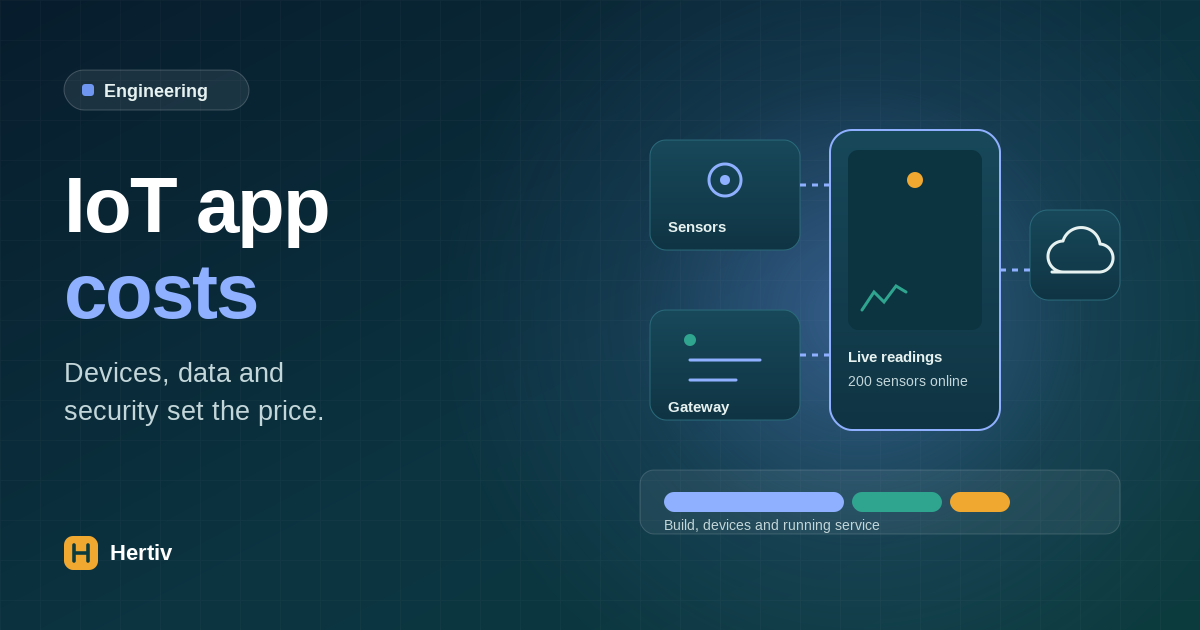
The app is only one part of the system. Behind it sit the devices themselves, the network that carries their messages, a service that stores and processes the data, and the security that keeps the whole chain safe. A cost estimate that covers only the phone or web app misses most of the work.
IoT apps appear in factories, farms, hospitals, shops and homes. A factory app may watch machine health, a farm app may track soil moisture, and a hospital app may follow equipment across wards. The pattern is the same, but the cost changes with the number of devices and the rules they must follow.
What drives the cost of an IoT app?
The number and type of devices drive the cost first. Ten identical sensors are simple to support; a mix of sensors, gateways and machines from different makers needs more integration work, because each one speaks a slightly different protocol and reports data in its own format.
Connectivity is the second driver. Wi-Fi is cheap where it exists, but remote sites need cellular or low-power networks, which add hardware, data plans and testing. The app must also cope with devices that go offline and send their data late, which adds logic the team has to build and test.
Data volume and security come next. An app that stores every reading from thousands of devices needs storage, processing and a way to find old data fast. Security adds work at every step: devices must prove who they are, messages must be protected, and updates must reach devices in the field without breaking them.
How do IoT app costs break down?
IoT app costs usually break down into devices, connectivity, the app itself, the back-end service and security. The table below shows what each part covers and what makes it more or less expensive, so a team can see where the money goes before it commits.
| Part | What it covers | Cost driver |
|---|---|---|
| Devices | Sensors, gateways, firmware | Number and variety of devices |
| Connectivity | Networks, data plans, gateways | Remote sites and offline handling |
| App | Mobile or web interface, alerts | Number of screens and user roles |
| Back end | Data storage, processing, rules | Data volume and retention |
| Security | Identity, encryption, updates | Device count and compliance rules |
Testing deserves a real share of the budget. An IoT system fails in ways a normal app does not: a sensor dies, a network drops, a device sends bad data. Testing each of those cases takes time, and skipping it means the failures reach users instead.
Should you build or buy the platform?
A team can build its own IoT platform or rent one. Building gives full control over how devices connect and how data is stored, but it means the team owns every part: device onboarding, message handling, storage, security and updates.
Renting a platform is faster to start. The provider handles device connections, storage and scaling, and the team builds only the app and the business rules on top. The trade-off is a monthly fee that grows with devices and data, and less control over how the platform changes.
Most first versions rent the platform and build the app. That keeps the team focused on what users see and lets it switch later if the volume or the rules demand it. A team that builds its own platform from day one usually has a reason, such as strict data rules or unusual devices. The IoT use cases across industries show which patterns are common before a team commits to one.
Example (hypothetical): costing a first IoT app
Example (hypothetical): a team plans an app for a warehouse with 200 temperature sensors. They estimate the work at 2,400 hours: three developers working 20 weeks at 40 hours a week, which is 3 times 20 times 40, or 2,400 hours.
At a hypothetical rate of $85 per hour, the build is 2,400 times 85, which is $204,000. The sensors cost 200 times $60, which is $12,000, and the cloud service costs $500 a month, which is $6,000 for the first year.
The total for the first year is $204,000 plus $12,000 plus $6,000, which is $222,000. The numbers are invented to show the arithmetic, not a real quote. The point is that the app itself is only part of the cost, and the devices and the running service are real budget lines too. For real rates, see vendor site or ask a development team for a scoped estimate.
What are the common mistakes?
The common mistakes with IoT app costs start with counting only the app. Teams budget for screens and forget the devices, the connectivity and the back-end service, then run out of money before the system works end to end.
- Underestimating device variety. Supporting one sensor is easy; supporting five kinds from three makers is a different job.
- Ignoring offline behaviour. Devices lose their connection, and an app that cannot handle late or missing data will show wrong information.
- Skipping security. Devices without identity checks can be faked, and an update without signing can be replaced by an attacker's version.
- No plan for updates. Firmware in the field needs a safe way to update, including a way back when an update fails.
Each of these mistakes is cheaper to fix in design than after launch. A device that cannot be updated safely is a liability for its whole life, not just for the first release.
How do you keep IoT app costs under control?
Keep IoT app costs under control by starting with one device type and one site. A small pilot proves the whole chain, from sensor to screen, before the team buys hundreds of devices or builds every feature.
Rent the platform for the first version, and keep the device count small until the data proves its value. Add device types one at a time, and measure what each one costs to run, including its data plan and its support load.
Finally, write the security and update plan before the first device ships. Identity checks, encrypted messages and signed updates are part of the build, not extras to add later, and building them late costs more than building them first. For the app itself, mobile app development teams usually start from the screens users touch every day.
Key takeaways
- An IoT app is only one part of the system: devices, connectivity, back end and security all cost money
- Device count and variety are the biggest cost drivers, followed by connectivity and data volume
- Renting a platform is faster for a first version; building your own only pays off with a clear reason
- Testing offline behaviour, bad data and failed updates deserves a real budget share
- Start with one device type and one site, and write the security and update plan first
Frequently asked questions
How much does a simple IoT app cost?
A simple app for one device type with a rented platform costs far less than a platform for thousands of mixed devices, because the integration, data and security work stays small. The honest answer is always a range tied to device count, connectivity and data volume, so get a scoped estimate for your devices.
Do IoT devices need their own app?
Not always. A dashboard or a web page can be enough when the users sit at desks, but a mobile app fits field staff who need alerts and controls on the move. The choice follows where the users work, not the technology.
What is the most expensive part of an IoT app?
Usually the back-end service and the device integration, not the screens. Connecting many device types, storing their data and keeping them secure takes more work than the interface users see.
Can one app support devices from different makers?
Yes, but each maker speaks its own protocol and reports data in its own format, so the app needs a translation layer for each one. Supporting five kinds of sensor costs more than supporting one kind, even when the screens look the same.
How do IoT apps handle devices that go offline?
The app stores messages on the device or gateway and sends them when the connection returns, and it marks late data as late so users do not act on stale readings. Offline handling is part of the design, not an error case.
Is an IoT app secure by default?
No. Devices must prove who they are, messages must be protected, and updates must be signed, or an attacker can fake a device or replace its firmware. Security has to be designed in from the start, because adding it later costs more.


