AI-Powered RFx: How AI Writes and Scores Bids
AI-powered RFx drafts the request, reads supplier replies and ranks them against your criteria, so weeks of reading become hours of checking.
On this page
Short answer
AI-powered RFx is software that helps a buying team run a request for information, proposal or quotation: it drafts the request from past documents, reads every supplier reply, checks each answer against the criteria and ranks the bids. A person still writes the final criteria, checks the scores and makes the award decision; the AI removes the reading and copying, not the judgement.
What is AI-powered RFx?
AI-powered RFx is software that helps a buying team run a request for information, a request for proposal or a request for quotation, using AI to draft the request, read supplier replies and rank the bids. The letters stand for the three kinds of request, and the AI does the reading and sorting that used to take a team weeks.
It differs from a plain e-sourcing tool. A plain tool sends the request and stores the replies. An AI-powered one reads the replies, pulls out the price, the delivery time and the promises, and shows how each supplier scored against the criteria you set.
The three kinds of request, and what each is for:
| Request | What you ask for | When to use it |
|---|---|---|
| RFI | Information about a supplier | Learning who can do the job |
| RFP | A full proposal and approach | Buying a service or a project |
| RFQ | A price for a defined item | Buying goods with a fixed spec |
| Combined RFx | Information, proposal and price | A large purchase in one round |
The AI is only as good as the criteria you give it. A vague request produces vague bids, and a ranking nobody checks is not a saving, it is a risk. For the wider buying picture, see top AI agents for procurement.
How does AI draft an RFx?
AI drafts an RFx by reading your past requests, contracts and specs, then writing a first draft that follows your usual structure: background, scope, requirements, scoring criteria and the timeline.
The draft starts from your own documents, not from a blank page. The AI pulls the scope from the last similar purchase, reuses the terms that worked, and flags where the old document is out of date, such as a delivery address or a volume that has changed.
A person still edits the draft before it goes out. The criteria, the weights and the deadlines are buying decisions, and the AI cannot know which of them matters most this time. The draft saves the writing time; the review is where the judgement sits.
Good drafts also come with a checklist: every requirement is written so a supplier can answer it in one place, and every answer maps to a score. That structure is what makes the later scoring work.
How does AI read and score supplier replies?
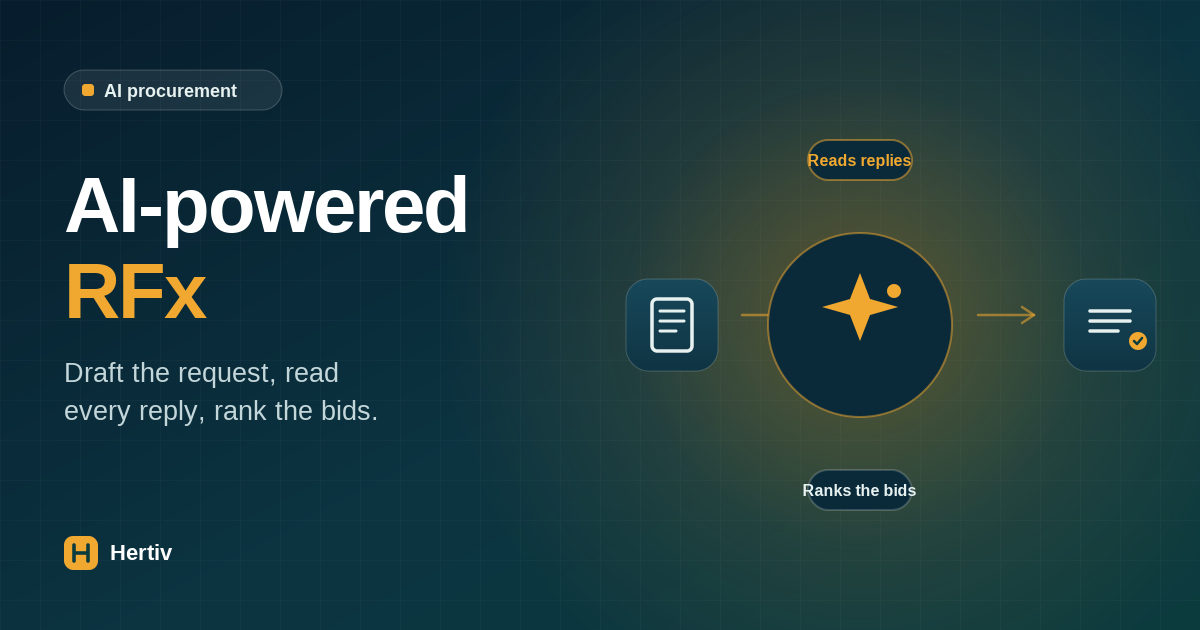
AI reads and scores supplier replies by pulling the answers out of each document, matching them to your criteria, and ranking the bids side by side, so the team compares the same facts instead of hunting through PDFs.
- Collect the replies. The tool gathers every supplier document, whatever the format, and logs which supplier sent what and when.
- Pull out the facts. It extracts the price, the delivery time, the warranty, the team and the promises from each reply.
- Match to criteria. It maps each fact to the criterion it answers, and flags answers that are missing or vague.
- Score and rank. It scores each bid against the weights you set and shows the ranking with the reason for each score.
- Flag the gaps. It lists the questions to send back, such as a missing certificate or an unclear delivery date.
The score is a starting point, not a verdict. A bid that scores well on paper can still hide a risk, such as a supplier with no track record at your volume, and only a person reading the detail will spot it.
Where does AI-powered RFx help most?
AI-powered RFx helps most where the reply count is high and the reading is repetitive: IT services, facilities, logistics and any purchase that draws ten or more bids in different formats.
High-volume rounds are where the saving shows. When eight suppliers each send a forty-page proposal, a buyer cannot read every page with care in a reasonable time, so good bids are skimmed and weak ones slip through. The AI reads all eight and the buyer reads the comparison.
It also helps where the criteria are the same each time. If your team buys the same service every year, the AI can reuse the structure and the scoring, and the team only updates what changed. That consistency also makes audits easier, because every bid was scored the same way.
It helps least where the judgement is the job: a first-of-its-kind purchase, a supplier relationship that matters more than the price, or a deal where the spec is still being written. There the reading is the work, and handing it to an AI saves little. AI agents for procurement covers how these tools fit into the wider buying stack.
How to start with AI-powered RFx
Start with one purchase and one clear set of criteria, not with the whole buying plan. The steps below keep the first run small enough to check.
- Pick one purchase with a clear spec and at least five expected bids.
- Write the criteria and the weights in plain words, and say what a good answer looks like.
- Run the AI on a past round first and compare its ranking with the award you actually made.
- Set the review step: a buyer reads the top bids and the flagged gaps before anyone is shortlisted.
- Go live on the one purchase, track the time saved and the questions raised, and fix the criteria before you expand.
The past-round test in step three is the most useful part. If the AI would have ranked a bad supplier first, the criteria are wrong, and it is cheaper to learn that on old bids than on live ones.
Example (hypothetical): six quotes for warehouse equipment
Example (hypothetical): a company runs six requests for quotation a year for warehouse equipment, and each one draws eight supplier replies. Reading each reply carefully takes about 2 hours, so one round takes 8 replies times 2 hours, which is 16 hours, and six rounds take 96 hours a year.
The company adds AI-powered RFx. The AI reads all eight replies, pulls out the price and delivery time, and ranks them. The buyer then reviews the top three bids at about 30 minutes each, so one round takes about 1.5 hours of review, and six rounds take 9 hours a year.
Reading time falls from 96 hours to about 9 hours, saving roughly 87 hours a year. The saving only holds because the buyer still reads the top bids: an unreviewed ranking is a guess with neat formatting.
What are the limits and risks?
AI-powered RFx stops at judgement: it can rank bids against written criteria, but it cannot tell whether a supplier will deliver on time, cope with your volume, or work well with your team.
Missed detail is the first risk. A supplier can answer a question in a way that scores well while hiding a gap, such as a delivery time that depends on a part they do not stock. A buyer reading the top bids is the check against that.
Biased criteria are the second risk. If the weights favour one kind of supplier, the AI will apply that favour to every bid, at speed. Check the ranking for patterns, and check who the AI puts last as well as who it puts first.
Supplier gaming is the third risk. Suppliers learn what the AI looks for, so replies start to match the words rather than the work. A buyer reading the shortlist is the check against that, and the criteria need updating as suppliers adapt.
Data rules are the fourth risk. Supplier replies hold commercial data, so the tool must store it where your data rules allow and keep it only as long as needed. For the buying side of that, see best cloud procurement software.
What are the common mistakes?
The most common AI-powered RFx mistakes are skipping the review step, writing vague criteria, and letting the ranking decide the award without a person reading the top bids.
- Auto-awarding from the ranking. A bid the AI ranks first is not a decision; a buyer should read the top bids before anyone is awarded.
- Vague criteria. Criteria such as "good service" cannot be scored, so the AI guesses. Write criteria a person could apply.
- Skipping the past-round test. Running the AI on an old round shows whether the criteria work before live money is at stake.
- Ignoring the bottom of the ranking. Check the lowest-ranked bids for patterns; bias shows up there first.
- Buying for every purchase at once. Start with one purchase and prove the criteria before you expand.
- Keeping supplier data too long. Set a retention rule and stick to it, or the tool becomes a data problem.
Key takeaways
- AI drafts the request, reads the replies and ranks the bids against your criteria
- It removes the reading and copying, not the buying judgement
- It helps most on high-volume rounds with many bids in different formats
- Test the criteria on a past round before you run a live one
- A buyer must read the top bids before anyone is shortlisted or awarded
Frequently asked questions
What does RFx mean?
RFx is the umbrella term for the three kinds of buying request: RFI, a request for information; RFP, a request for proposal; and RFQ, a request for quotation. An RFI asks who can do the job, an RFP asks for a full proposal, and an RFQ asks for a price on a defined item.
How does AI help with RFx?
AI drafts the request from your past documents, reads every supplier reply, pulls out the price, delivery time and promises, and ranks the bids against the criteria you set. That turns weeks of reading into a comparison table the buyer can check in hours.
Can AI choose the winning supplier?
No. AI can rank bids against written criteria, but it cannot judge whether a supplier will deliver on time or work well with your team. The award decision stays with people, who read the top bids and check the scores before anyone is chosen.
What data does AI-powered RFx need?
It needs your past requests, contracts and specs to draft from, plus the criteria and weights for scoring. It also needs the supplier replies themselves, in whatever format they arrive. Keep supplier data only as long as your data rules allow.
How long does it take to start using AI-powered RFx?
A first run on one purchase can be set up in a few weeks when the spec and criteria are clear. Most of the time goes into writing the criteria and testing the AI on a past round, not into the software itself.
Is AI-powered RFx only for large companies?
No. Any team that runs repeated rounds with several bids can use it, including small firms buying IT services or equipment. Start with one purchase, prove the criteria on a past round, and expand only when the ranking matches your own judgement.