AI-Powered Financial CRM: What It Does for Advisors
An AI-powered financial CRM helps advisors prepare, draft follow-ups and spot clients who need attention. Here is what it does and the rules it must follow.
On this page
Short answer
An AI-powered financial CRM is a client system built for wealth and advice firms that uses AI to prepare meeting briefs, draft client messages, flag accounts that need attention and keep a record of every recommendation. It works from the firm's own client data and stays inside the record-keeping and suitability rules that advisers must follow.
What is an AI-powered financial CRM?
An AI-powered financial CRM is a client system built for wealth and advice firms that uses AI to prepare for meetings, draft client messages, flag accounts that need attention and keep a record of every recommendation. It holds the same client data as a normal CRM — holdings, goals, conversations — and adds a layer that reads that data and suggests the next step.
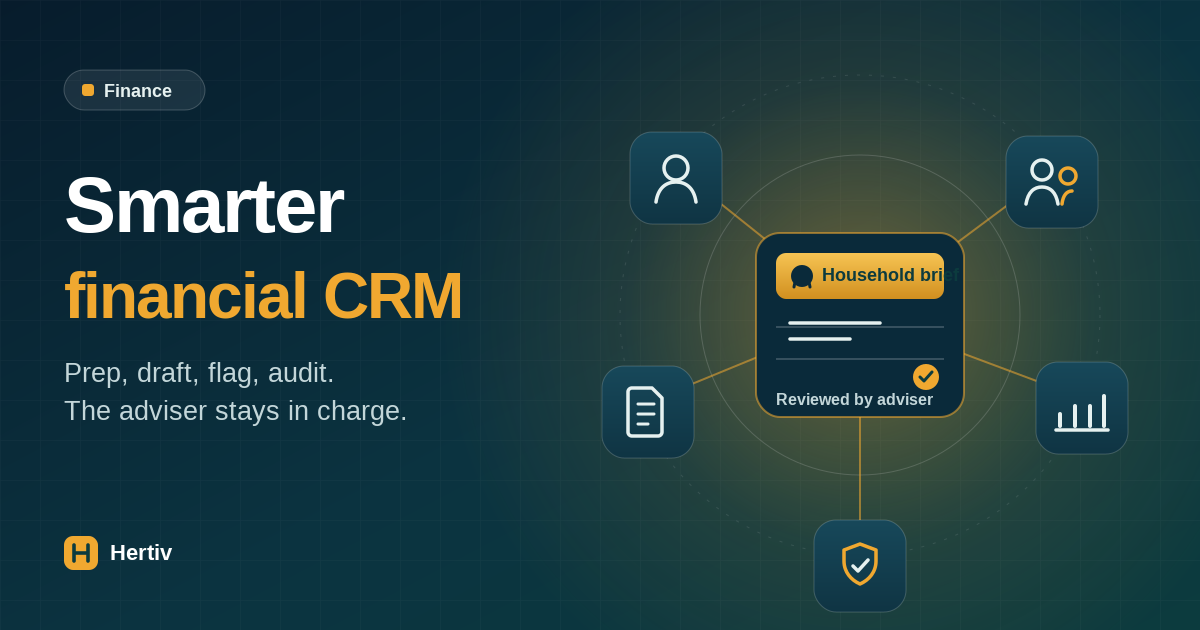
The AI does not replace the adviser. It drafts, summarises and flags, and the adviser checks, edits and sends. That split matters because advice carries a duty of care: the firm must be able to explain why a recommendation was made, and a draft the adviser never read cannot be explained.
The “financial” part is what makes it different from a generic CRM. The system understands households instead of single contacts, tracks suitability and risk profile, and stores every client communication in a form the compliance team can audit later.
How is a financial CRM different from a generic CRM?
A generic CRM tracks contacts and deals. A financial CRM tracks households, suitability and advice, and every difference below comes from that shift.
| Area | Generic CRM | Financial CRM |
|---|---|---|
| Client record | Single contact | Household with linked members |
| Suitability | Not tracked | Risk profile and goals on file |
| Documents | Attachments | Signed reviews and advice records |
| Communication | Emails and calls logged | Every message kept for audit |
| Reporting | Pipeline and sales | Holdings, performance and reviews due |
| Compliance | Basic permissions | Workflow checks before advice is sent |
The practical result is that a financial CRM costs more to set up and needs cleaner data. A firm that buys one for its AI features and skips the data clean-up ends up with confident drafts built on wrong numbers — which is worse than no drafts at all. Banks face the same data problem; see CRM in banking.
Where does the AI actually help?
The AI helps most in four jobs: meeting preparation, drafting, spotting accounts that need attention, and finding the right document. Meeting prep pulls holdings, recent transactions and open actions into a one-page brief. Drafting turns that brief into a follow-up email the adviser edits before sending.
Spotting accounts is the quietest job and often the most useful. The system flags clients whose portfolios drifted from their target, whose documents expired, or who have not heard from the firm in months. Each flag comes with the reason it fired, so the adviser can judge whether it matters.
Document search is the fourth job. Instead of digging through folders, the adviser asks for the last suitability review or the signed risk profile and gets the file with its date and author. The AI retrieves; it does not rewrite the document, which keeps the record intact. Adding these features to an existing system follows the same pattern as integrating AI into your CRM.
What data and compliance rules apply?
A financial CRM holds sensitive data: identity documents, holdings, income, goals and every conversation. That data needs access controls so advisers see only their own clients, encryption in transit and at rest, and a clear record of who viewed or changed each field.
The compliance rules come from the firm's regulator and from its own policies. Suitability must be recorded before a recommendation, communications must be kept for the required period, and marketing messages need consent. The CRM should enforce these as steps in the workflow, not as a document advisers read once a year. Insurers work under similar record-keeping rules; CRM for insurance shows the pattern.
AI adds two more rules. First, anything the AI drafts must be reviewed by a person before it reaches a client. Second, the firm must be able to show what the AI used to produce a draft, so a complaint can be answered from the record rather than from memory.
How do you roll it out in five steps?
Rolling out a financial CRM works best as a small pilot with one team, then a wider launch once the data and the review steps hold up. The five steps below are the order that causes the fewest surprises.
- Pick one team and one client set, such as the advisers who handle the most reviews. A small pilot shows real problems while they are still cheap to fix.
- Clean the data first: merge duplicate households, fill in missing risk profiles and check that holdings match the custodian records.
- Turn on one AI job only, usually meeting preparation. One job is easy to review and easy to switch off if the drafts are wrong.
- Set the review rule in writing: no AI draft reaches a client until the adviser has read it and ticked it off.
- Measure time saved and errors caught for one quarter, then expand to the next team with the same rules.
Example (hypothetical): a 12-advisor firm cuts prep time
Example (hypothetical): a firm with 12 advisers serves 480 households, 40 per adviser. Each adviser reviews every household once a quarter, and preparing for a review takes 30 minutes by hand — reading notes, checking holdings and writing the brief.
With the AI drafting the brief, preparation takes 10 minutes of checking and editing. That saves 20 minutes per household, so across 480 households the firm saves 9,600 minutes, or 160 hours, per quarter. The advisers spend that time on calls with the households the system flagged, rather than on reading files.
The gain is real only if the review step holds. The firm keeps a simple rule: no brief goes to a client until the adviser has read it and ticked it off. In the first quarter, advisers corrected about one brief in ten, mostly where the data was out of date — which is also how the firm found its data gaps.
What are the common mistakes?
Most failed rollouts share one cause: the firm bought the software before it fixed the data and the review habits. The mistakes below are the ones that cost the most. Each one is fixable, and each one is cheaper to fix before launch than after the first client complaint. Start with the data and the review rule, and the rest of the rollout gets easier.
- Buying for AI features before cleaning client data
- Letting AI drafts reach clients without a human review
- Tracking households as single contacts and losing the family view
- Keeping no audit trail for what the AI drafted and what changed
- Rolling out to every adviser at once instead of one pilot team
- Measuring logins instead of time saved and errors caught
Key takeaways
- The AI drafts, summarises and flags; the adviser checks, edits and sends.
- A financial CRM tracks households, suitability and advice, not just contacts and deals.
- Meeting prep, drafting, account flags and document search are where the AI helps most.
- Every AI draft must be reviewed by a person and traceable to a source document.
- Clean the data and pilot with one team before rolling out to everyone.
Frequently asked questions
What makes a CRM a financial CRM?
A financial CRM is built around households, suitability and advice records rather than contacts and deals. It tracks risk profiles, holds signed reviews, keeps every client message for audit and checks suitability before a recommendation goes out.
Does the AI give financial advice?
No. The AI prepares briefs, drafts messages and flags accounts that need attention, but the adviser decides what to recommend and remains responsible for it. Any draft the adviser has not read should never reach a client.
What data does an AI-powered financial CRM need?
It needs clean household records, current holdings, risk profiles, past conversations and signed documents. Without those, the AI drafts from gaps and errors. Data clean-up is the first step of any rollout, before any AI feature is switched on.
How do compliance teams check AI drafts?
The CRM keeps a record of each draft, what the AI used to produce it, what the adviser changed and when it was sent. That trail lets the firm answer a complaint from the record rather than from memory, which is the point of keeping it.
How long does a rollout take?
A pilot with one team usually runs for one quarter: data clean-up, one AI job switched on, and a review rule in writing. Wider rollout follows only if the pilot saves time and the review step holds. Rushing the launch is the most common mistake.
Can a generic CRM do the same job?
A generic CRM can hold client names and emails, but it does not track households, suitability or advice records, and it has no workflow checks before a recommendation is sent. Firms that try it usually end up rebuilding those checks in spreadsheets, which defeats the purpose.